AI and Digital Twins Race to Capture Vanishing Plant Expertise
Key Highlights
- The energy and chemicals sectors are experiencing a wave of retirements, risking the loss of critical operational knowledge.
- Digital tools like AI, digital twins, and 3D models are being used to capture and transfer plant-specific expertise efficiently.
- Training is shifting from procedure memorization to developing skills in abnormal situation management, troubleshooting, and digital tool utilization.
- AI and immersive technologies support scenario-based learning, refreshers, and capturing tacit knowledge from experienced operators.
- Human-autonomy teaming emphasizes AI handling repetitive analysis while operators validate and make final decisions, enhancing safety and performance.
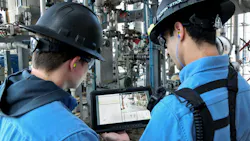
It’s no secret that the energy and chemicals sectors are losing plant-floor experience as large numbers of seasoned operators and engineers reach retirement age. The big question: Will they take their operational knowledge with them when they leave, or can organizations transfer that knowledge to the remaining workforce?
Complicating the gray tsunami, today’s younger workers are changing companies more frequently than previous generations, so knowledge transfer is happening at a swifter pace, according to Jon Epstein, COO at digital-twin software company Myrex.
At the same time, operations are becoming more complex as plants become more automated and digital, added Rahul Negi, director, Autonomous and AI, Honeywell Technologies Process Automation. Control room operators are also being given responsibility for performance criteria, such as throughput and yield.
“As a result, training can no longer focus solely on procedures,” explained Negi. “Operators need stronger skills in abnormal situation management, troubleshooting, process understanding and digital tool utilization. The industry also needs to accelerate the path from novice to expert operator.”
At the LyondellBasell Center for Petrochemical, Energy, & Technology, a training center at San Jacinto College in the Houston area, educators see an increased demand for training in process automation, digital instrumentation, analyzers, advanced control systems and field-based troubleshooting, according to James Ragaisis, Dean of Business and Technology at San Jacinto College. “Employees need a strong understanding of the underlying processes and equipment to recognize abnormal conditions, identify potential issues, and troubleshoot safely and effectively,” he added.
Both process knowledge and digital fluency are crucial.
By 2033, nearly 1.2 million workers — approximately 60% of US employees in the energy and chemical sectors — will need to be “upskilled” in digital technologies, process operations, analytics and other areas, according to a 2025 report by the Deloitte Research Center for Energy & Industrials. Another 200,000 new entrants will need training, and more than 500,000 workers, including those replacing retirees, will need to be reskilled, the report said.
Making Information Accessible
On many manufacturing floors, there is an unmet need for an accessible and organized information system to transfer institutional knowledge for training in the operation and maintenance of equipment, suggested Epstein. The company’s recently launched Myrex IRIS platform aims to meet that need using a realistic, 3D spatial model of an individual industrial asset as the user interface. Training and maintenance content and workflows are then linked to the relevant points on the machine model, providing visual context. The content can be in the form of traditional standard operating procedures, manuals or — in what Epstein said is more helpful for younger workers — videos with step-by-step guides. He said that studies show video content is retained 20% more, and tasks guided by video show 30% fewer errors than tasks guided by text.
High-resolution models are displayed on a handheld device, so that an operator can simultaneously view the digital model and operate the real-world equipment. Cybersecurity is built into the system, and manufacturers can choose to do their own asset scanning and content uploads. Although generative AI could be used to search through content, Epstein said the system does not use AI to solve problems. The focus is rather on training and providing a natural, intuitive visual interface for accessing content.
Digital Tools for Workforce Training
BASF is using AI and enhanced reality as support tools in workforce training, to help trainers efficiently develop training materials, support scenario-based learning and provide refreshers before performing infrequent or high-risk tasks, said Sarah Haneline, workforce development and talent strategy manager at BASF. The tools make information easier to access, and employees can learn at their own pace.
BASF is working to capture the knowledge of experienced operators in digital-simulation training modules that use enhanced reality. “Experienced operators participate in walk-throughs and share tacit knowledge that may not be documented in formal procedures, helping ensure practical, hands-on expertise is captured and passed on to new employees,” said Haneline.
The company is also using an AI-powered co-pilot, trained on BASF data, to enhance new operator training with a chatbot. However, clear boundaries are needed in training to avoid dependence on AI-generated answers, Haneline added. Operators still need to build process understanding to troubleshoot abnormal situations or recognize when something does not look right. “In operations, the ability to question information, understand cause and effect and rely on field experience remains essential,” she said.
Preserving Organizational Knowledge
AI can help employers preserve the operational knowledge of experienced employees and use it to train new employees.
“In chemical plants, some of the most valuable expertise involves understanding how specific units behave under changing feedstocks, seasonal conditions, equipment degradation, startups, shutdowns and upset scenarios,” said Negi. “Much of this knowledge exists in the heads of experienced operators and is rarely documented completely.”
Negi explained that companies increasingly need to preserve this individual expertise and translate it into organizational knowledge that makes an experienced operator's expertise more broadly available. AI tools can do this.
Industrial AI platforms use site-specific information, including operating procedures, engineering documents and alarm-response guidance as a basis for language-model applications. Chemical manufacturers are finding value in using these applications to aid operator effectiveness and knowledge retention, said Negi.
“We're seeing strong adoption in alarm guidance, abnormal situation management, predictive alerts, electronic work instructions and AI-powered knowledge capture. These capabilities help operators quickly understand what's happening, why it's happening and what actions have historically delivered the best outcomes,” he said. “We're also seeing value in predicting process issues before they become alarms or production events. This gives operators additional time to respond, helping improve uptime, reduce variability and avoid abnormal situations.”
Negi insisted that AI should support operator decision-making, not replace it.
“The most effective model is what we call human-autonomy teaming,” he explained. “AI handles repetitive analysis, monitors large volumes of information and identifies emerging risks. Operators remain responsible for validation, oversight, exception handling and final decision-making.”
Honeywell’s AI-assisted Experion Operations Assistant was tested in a pilot deployment at TotalEnergies’ Port Arthur Refinery in Texas. The AI assistant provided predictive alerts and alarm decision support to aid but not replace operator expertise. In the initial pilot, the AI assistant forecasted five potential events. This gave operators insight into emerging issues — on average, 12 minutes before an alarm incident — so that they could make proactive, informed decisions to minimize downtime and reduce flaring emissions.
Chevron worked with Honeywell on AI-assisted alarm guidance. The system used historical operations data to identify alarm patterns and proven response strategies. The tool captured institutional knowledge and helped operators respond more quickly and consistently to critical process events.
Negi expects AI tools to strengthen operator competency and expertise, not reduce it. He said an AI tool can explain the context behind its recommendations and reinforce learning during day-to-day operations.
Training for Operational Excellence
Reinforcing learning is important for sustaining knowledge and gaining long-term competency. If you don’t put training into practice quickly, you’ll lose that knowledge, added David Drerup, CEO of consultancy and software company Operational Sustainability and founding partner at the non-profit Operational Excellence Consortium, which was launched in 2024 as a collaboration between industry and academia. The consortium aims to influence academic programs to produce industry -ready talent, as well as to provide upskilling and training for existing employees and coaching for operations leadership.
Drerup agreed that digital and AI-enabled tools, such as digital twins and 3D simulations, can be valuable for training and gaining competency. Digital procedures provide easy access to procedures when and where operators need them, rather than relying on memory, which can lead to errors.
“AI can weave micro-learnings into an operator’s workday,” said Drerup. Frequent, short video training sessions are more effective than a full-day training session, he said. Today’s generation prefers smaller amounts of information at a time.
While large-language models (LLMs) and generative AI can help operators tap into data sources, there is a danger of overreliance on AI that can gradually erode critical thinking, Drerup cautioned. Training, simulation and walking through procedures are important for building competency so that operators are ready in an emergency. “If you lose power and internet connectivity goes down, what do you do?” he questioned.
Another challenge is that LLMs can “hallucinate” and need to be fact-checked. AI can generate recommendations, but humans should be taking the actions, said Drerup. At this point in the evolution of AI technology, it is key to keep humans in the loop.
“There is a tendency to trust LLMs, but you shouldn’t,” he stated. New operators without experience can’t necessarily see the LLM errors that experienced people can.
“We need mentors for incoming engineers and operators, along with a plan for continuous improvement. Experienced operators can touch it, smell it, hear it and diagnose things based on their experience, while new operators lack intuitive mechanical understanding,” said Drerup.
AI-based processes are a tool for training. They should be used to help enable operators to gain understanding, not replace thinking.
AI as a Tool
AI is “the great experiment of our time,” suggested Drerup. Industry is still exploring scenarios to see how it can be used and what the challenges are. For example, AI can help you dig into more data faster and find things you couldn’t find otherwise, but the data has to be good.
Companies should consider what their goal is for using AI, said Drerup. “AI isn’t going to make you excellent. It’s a tool,” he said.
“For many chemical producers, the goal is creating operators who can manage larger operating scopes safely and confidently while leveraging advanced automation and AI-enabled decision support systems,” said Negi. “Ultimately, the goal is not to replace operators. It's to create human-autonomy teaming, where AI reduces cognitive workload, accelerates decision-making and helps every operator perform at a consistently higher level of safety, reliability and production performance.”
Drerup also emphasized the importance of operating safely. He concluded that developing context and guidelines for applying AI is key to using it to improve performance without exacerbating risks.
AI may prove to be at least part of the answer to how to achieve knowledge transfer.
“AI-enabled knowledge capture, operational guidance and site-specific digital assistants provide a way to preserve best practices and make them available to less experienced operators in real time,” Negi concluded.
Related Reading




About the Author
 Jennifer Markarian
Jennifer Markarian
Jennifer Markarian has a Chemical Engineering degree from The Pennsylvania State University. She began her industry career as a technical service and development engineer for Mobil Chemical’s polyethylene group, where she acted as a liaison between manufacturing, R&D, and plastics converters. She has been a freelance writer for more than 25 years, covering a wide range of topics for industry publications.