Leveraging Vibration Sensors and AI for Proactive Equipment Management
Key Highlights
- Emerson and Puffer Sweiven installed vibration sensors on reciprocating compressors at a Houston gas processing plant, enabling teams to predict and fix issues before failure — saving $2 million in prevented production loss plus $3 million in reduced repair and equipment costs.
- At one chemical facility, vibration data flagged looseness on a critical centrifugal pump and motor; tightening a single loose bolt averted eight hours of downtime and saved more than $64,000.
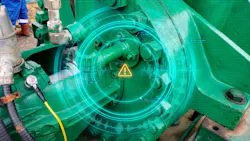
Equipment reliability is key for reducing production losses at chemical manufacturing facilities. Unplanned downtime can potentially cost millions of dollars, primarily from production loss but also from other emergency maintenance costs.
Reliability teams and maintenance personnel use preventive maintenance and work hard to avoid catastrophic breakdowns and unplanned outages. But to really stay competitive, companies need to do better than simply reduce emergency maintenance.
Condition monitoring, which uses sensors to track changes in indicators such as vibration, is an essential tool. Having data to show which assets need attention can help teams that are stretched thin to prioritize maintenance and fix problems before they become emergencies. And when equipment is running better, productivity goes up.
“Condition monitoring is no longer just a maintenance initiative, but it has become an operational performance tool,” said Janelle Armstead-English, industry principal, Chemicals at Seeq.
She explained how equipment health directly affects process performance, even before a breakdown. “A degrading pump can reduce flow stability, a worn agitator can affect mixing performance and compressor issues can introduce process variability long before an actual failure occurs.”
Vibration sensors are useful for monitoring all kinds of rotating equipment. For example, on a mixer, a vibration sensor can detect imbalance, which could be caused by one blade wearing at a different rate than the others, said Cory Ockunzzi, Pepperl+Fuchs product manager for vibration sensors. The sensors can detect changes in vibration in a compressor, which could be caused by misalignment, bearing defects or wear and tear.
Early detection of potential issues is the biggest advantage of using vibration sensors, Ockunzzi said. Predictive maintenance can reduce overall maintenance costs while keeping equipment running at peak performance for longer. An additional, although intangible, benefit is that employees like working in a place where the equipment runs well, he added.
Predictive maintenance based on condition monitoring can extend preventive maintenance schedules by enabling maintenance teams to assess equipment health and make data-driven decisions. It also allows teams to plan their work rather than operating in a reactive mode where failures dictate their schedule, said Julia Romano, customer success manager at AssetWatch, in a webinar on condition monitoring in the chemical industry. Bearing faults, for example, are often detectable weeks before bearing failure occurs, so that teams can schedule work, added Dale Burnham, condition monitoring engineer at AssetWatch, in the webinar.
For rotating equipment, vibration sensors are most often chosen because they can detect the usual mechanical problems before they show up through temperature, pressure or process changes, said Joe Petersen, a training instructor for Emerson’s comprehensive vibration training program.
Vibration Data Helps Prevent Shutdowns
At a gas processing plant in Houston, Texas, failures in the reciprocating compressors used to compress oxygen disrupted the production schedule, prompting the manufacturer to install a vibration condition monitoring system. Emerson and its partner Puffer Sweiven added accelerometers, which detect impact forces, and an eddy current phase probe to measure compressor speed and track trends in vibration severity. Data from these sensors was sent to the distributed control system, condition monitoring software and an external predictive analytics system. Data analysis enabled teams to predict and address issues before the compressors failed again, reported Emerson. This proactive approach was said to save $2 million in prevented production losses, $1.5 million in reduced costs, and $1.5 million by avoiding equipment replacement.
Burnham shared an example in the webinar of a pump in a refinery where vibration sensors detected running-speed harmonics within a critical range, indicating potential impeller wear or damage. Inspection found two failed vanes, and the impeller and stuffing box had to be replaced. If that pump had failed and the depitcher had shut down, ultimately the entire tall oil refinery would have been down, she said.
In another chemical facility, a trend in vibration monitoring data pointed to a potential looseness on a critical centrifugal pump and high-speed motor. The team found a loose bolt and tightened it, preventing eight hours of unexpected downtime and saving more than $64,000 in repairs and production losses, Burnham said.
Wireless Sensing Trends
Wireless sensors have been key to advances in condition monitoring. Wireless sensing eliminates the potential failure point and expense of running a cable, said Petersen.
Today’s installation costs are lower due to the availability of wireless sensors, making it practical to monitor more assets than 10-20 years ago, said Armstead-English.
Most large chemical manufacturers use vibration monitoring, especially in continuous processes where unexpected equipment failures can result in significant production losses, she said. Adoption is uneven across the industry, with smaller plants or batch manufacturing seeing lower adoption.
“Many chemical processing facilities have a long history of manual rounds where technicians visit assets with a portable machinery health analyzer, but today’s workforce shortages are making that more challenging,” Petersen said. Now that it is easier and more affordable, teams can put permanent sensors on equipment for continuous monitoring, freeing them up for more valuable tasks than walking around the plant to collect data, he suggested. For equipment that is remote or in a hazardous environment, permanent sensors are an easier and safer way to get visibility into asset health.
Although continuous condition monitoring via permanent sensors provides good visibility and quick insight into machinery health, some problems require more information and data gathered in the field with portable sensors, Petersen cautioned. “One of the first and most important additional tests the team might perform is phase analysis. This timing test helps distinguish between imbalance, misalignment and looseness,” he explained. Adjusting data acquisition variables, such as increasing the data acquisition duration or using synchronous averaging or peak-hold averaging, can provide additional information useful for analysis.
How and Where to Start
Knowing where to start with condition monitoring can be challenging. Petersen explained that a criticality assessment or a failure modes and effects analysis can help teams identify the impacts of asset failure and the likelihood of a problem, thereby determining which sensors to use on which assets. “Understanding how the equipment fails and what measurements will detect those failures at the earliest point in time can make a significant difference,” he explained.
When installing a vibration sensor, finding the optimal location to best detect vibration is key, said Ockunzzi. Sensors that measure on a single axis should be mounted perpendicular to the direction of the rotation. For a vertical fan, this might be on the top, while for a horizontally rotating mixer, it would be on the side. The location should be convenient but not exposed to someone bumping or walking into it. Ockunzzi suggested using a magnet mount to try different spots prior to installing a permanent mount.
To determine which assets to select first for continuous monitoring, identify the most critical assets, said Burnham. Assets that would cause production loss if they went down are critical. Assets that are difficult to access, because they are in hazardous areas, for example, are also good candidates for continuous monitoring.
“Start small instead of trying to fix everything at the same time,” suggested Burnham. Eventually, as reliability improves, the workload will get easier.
Harnessing AI
Combining equipment health data with AI and process analytics provides additional insight that can improve both reliability and production performance, said Armstead-English.
“One of the most significant advances comes from combining vibration data with operational data, such as flow rates, pressures, temperatures, energy consumption and production rates. Rather than evaluating equipment health in isolation, organizations can understand how operating conditions contribute to equipment degradation,” she explained.
AI-assisted diagnostics, where the system automatically prioritizes alerts, suggests likely failure modes and recommends inspection or maintenance actions, is an emerging capability. This tool can help companies without experienced vibration analysts on their teams.
High-quality data is key. And teams need training to build confidence in AI recommendations, said Armstead-English. “The most successful implementers start with targeted use cases and gradually expand after demonstrating measurable value,” she said.
“Maintaining continuous uptime and safety for real-time operations means using reliability tools teams can trust,” agreed Petersen. He said that rule-based, AI-driven analytics has been part of machinery health software for many years already. “The industrial AI tools built into trusted automation solutions are built on decades of industry expertise and failure modes and effects analysis data, along with first principles guardrails that keep them safe and effective.”
Although AI tools are helpful, it is still people who make decisions and do the work to keep the plant running. These teams need to understand how to best use the tools.
Petersen concluded, “Real success from a condition monitoring program is about more than just putting sensors on everything. It also means culture change in the reliability team to monitor equipment and intervene early during planned outage time to get the most value from automated solutions.”
Monitoring Instrument Health
Condition monitoring today is not only about the health of production assets, such as pumps measured by vibration sensors or buildup in pipes measured by flowmeters. It can also include the health of the measurement instruments themselves, said Julia Grether, product owner, Endress+Hauser Digital Solutions. These devices can experience sensor fouling, buildup or instrument drift that can reduce measurement quality even though the device is still operating, she explained. Poor information can undermine the efficiency and reliability of processes that rely on data quality for control.
“Fixed inspection intervals alone often do not reveal developing issues early enough,” said Fabio Evola, industry development manager for Chemical, Endress+Hauser Group Services. “Condition monitoring closes this gap by continuously collecting and contextualizing diagnostic and operational data from field devices, so maintenance and operations teams can detect emerging problems before they affect production.”
Endress+Hauser’s built-in diagnostic, verification and monitoring technology for field instruments can identify a range of conditions that affect device performance, including buildup, corrosion, abrasion and pressure shocks. Device health data can help users determine whether instrument maintenance is needed.
Evola said that as chemical manufacturers continue to digitalize, reliable data is becoming even more important. “Connected operations, advanced analytics and AI-supported applications all depend on trustworthy information from the field,” he explained.
About the Author
 Jennifer Markarian
Jennifer Markarian
Jennifer Markarian has a Chemical Engineering degree from The Pennsylvania State University. She began her industry career as a technical service and development engineer for Mobil Chemical’s polyethylene group, where she acted as a liaison between manufacturing, R&D, and plastics converters. She has been a freelance writer for more than 25 years, covering a wide range of topics for industry publications.