Topsoe Licenses SAF Technology for BPCL Refinery in India
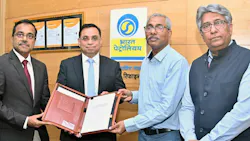
Topsoe has licensed its kerosene hydrotreating technology to Bharat Petroleum Corp. Ltd. (BPCL) for a sustainable aviation fuel (SAF) project at the company’s Mumbai refinery in India. The project will enable SAF production using existing refinery infrastructure rather than a dedicated production unit.
BPCL will revamp its existing 4,000-metric-ton-per-day kerosene hydrotreater to process used cooking oil alongside conventional feedstock. The unit will co-process 5% renewable feedstock with 95% conventional feedstock, producing SAF alongside conventional kerosene.
The project has reached final investment decision, and the revamp is underway. Commissioning is expected by the end of 2026, according to Topsoe. The resulting fuel will be supplied to airlines refueling international passenger flights departing from Indian airports.
Topsoe said its technology enables refiners to begin SAF production without major modifications to existing infrastructure. The companies did not disclose the project’s expected SAF output.
The project comes as India prepares to introduce SAF blending requirements for international flights. The country has announced targets of 1% SAF use in 2027, 2% in 2028 and 5% in 2030. International aviation operators are also preparing for the International Civil Aviation Organization’s Carbon Offsetting and Reduction Scheme for International Aviation (CORSIA), which enters its mandatory phase for participating states in 2027.
Why it Matters
Refinery operators are pursuing different routes to expand SAF production, including retrofitting existing equipment and building dedicated plants. BPCL’s project uses co-processing to introduce renewable feedstock into an existing kerosene hydrotreater, potentially reducing the need for new production infrastructure.
Recent Chemical Processing coverage illustrates the range of approaches. In September, Emerson was selected to supply automation and safety systems for SkyNRG’s planned SAF plant in the Netherlands, a greenfield facility designed to produce about 100,000 metric tons of SAF annually from residual fats and greases. In June, Johnson Matthey and Honeywell technologies were selected for a planned electro-SAF facility in South Africa, which is expected to produce about 35,000 metric tons annually in its first phase. Together, these projects show how producers are advancing SAF through refinery integration, dedicated biofuel plants and synthetic-fuel pathways.