Emerson to Automate Greenfield SAF Plant in the Netherlands
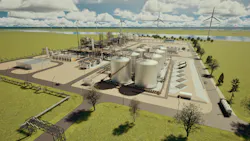
Emerson will provide automation and safety systems for a sustainable aviation fuel (SAF) plant under construction in Delfzijl, Netherlands, that is expected to produce approximately 100,000 metric tons of SAF annually when it begins operations in 2028.
Technip Energies awarded Emerson the automation contract for the SkyNRG facility, which the companies describe as Europe's first standalone greenfield SAF production facility. Technip Energies is serving as SkyNRG's engineering, procurement, construction and commissioning (EPCC) contractor after completing the project's front-end engineering and design (FEED) phase.
The facility will use the hydroprocessed esters and fatty acids (HEFA) pathway to convert residual fats and greases, including used cooking oil, into SAF. The resulting fuel can be blended with conventional jet fuel without modifications to aircraft or fueling infrastructure.
The plant is intended to help the Netherlands meet requirements under the European Union's ReFuelEU Aviation Regulation. The regulation requires aviation fuel supplied at EU airports to contain at least 2% SAF beginning in 2025, with the requirement increasing to 6% in 2030 and 70% in 2050.
Technip Energies' scope includes the SAF process, an advanced feedstock pretreatment unit and an on-site hydrogen plant based on the company's steam methane reforming technology. Technip said the project is its sixth HEFA-based SAF project in Europe.
Emerson's integrated control and safety system will include a DeltaV distributed control system and safety instrumented system for process control, safety shutdown and fire and gas detection. The company will also provide plant asset management software for commissioning and maintenance.
The automation systems will control the plant's process units, including the HEFA process used to produce SAF, the feedstock pretreatment unit and the on-site hydrogen plant. Emerson said the integrated architecture will provide real-time visibility of plant operations and support stable operation and throughput.
Emerson will also provide end-to-end project services and integrate the control and safety system with modular production units. Additional DeltaV components will reduce field wiring requirements and provide flexibility for late-stage design changes, according to the company.
SkyNRG site director Bart Rosendaal said in a statement that working with Technip Energies and Emerson will support safe and reliable operation of the facility.
The project marks a step toward SkyNRG operating its own SAF production capacity. SkyNRG CEO and co-founder Maarten van Dijk said in a statement that the EPCC agreement with Technip Energies will move years of project development toward construction of the facility.
Why it Matters
The Emerson contract comes as SAF projects move through different stages of development and technology selection. Chemical Processing reported in June that Johnson Matthey and Honeywell technologies had been selected for a planned South African eSAF facility, with the first phase targeting approximately 35,000 metric tons of SAF annually and later phases potentially reaching 140,000 metric tons per year.
In August, Chemical Processing also reported that Sasol and Envision Energy were evaluating a green hydrogen system at Sasol's Sasolburg operations that could support future production of e-methanol and potentially eSAF. In September, Axens announced collaborations covering SAF and eSAF projects, including Fischer-Tropsch-based pathways.
The developments span feasibility work, technology selection, project development and construction-stage execution. The SkyNRG project is further along that progression, with FEED completed, Technip Energies under contract for EPCC and Emerson selected for the plant's automation and safety systems.
The European Union's increasing SAF requirements provide a defined regulatory market for new production capacity, with the mandated share rising from 2% in 2025 to 70% in 2050.