When a ‘Closed’ Control Valve Isn’t Closed

Don’t trust control valves to seal completely.
Different manufacturing standards for seal tightness and leak rates mean some control valves seal better than others. But even the highest-quality valve is susceptible to corrosion or other forms of wear. For these damaged valves, leak rates may be much higher than the expected minimum.
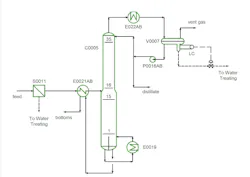
Figure 1 gives a schematic of a recent troubleshooting assignment. The distillation tower was plagued by plugging and intermittent upsets. In the past, we had identified water entrainment in the feed as the culprit in similar units. The entrainment came from an upstream feed drum. When entering the unit, the feed stream immediately passes through a coalescer (S0011) to remove free water.
Trace soluble water remained in the feed. The distillation tower generates two major products: a distillate and a bottoms stream. The soluble water goes overhead. Some of it ends up in the vent gas and most in the water draw from the overhead reflux drum (V0007).
In operation, the water draw rate was zero. In fact, as shown in Figure 1, the level instrument failed to detect a water level, and the water-level control valve was closed at all times. The supposition was that the water vapor pressure was high enough in the overhead drum that all the contained water ended up in the vent gas stream.
Nevertheless, the tower still showed symptoms of tray plugging. Tray plugging may be from bulk water entering the tower with dissolved salts in it. Once the water vaporizes at tower conditions, the dissolved salts in the water are not soluble in the bulk hydrocarbon phase. Hence, they end up as solid deposits on the trays.
Neither the water from the coalescer nor the water from the overhead accumulator had flow meters. The water rate was expected to be so low that no one thought it was necessary to meter it.
Given the temperatures and pressures of the tower, essentially all the water in the feed should be in the overhead boot. The absence of water accumulation in the overhead drum while the control valve was fully closed was suspicious.
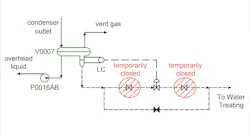
Figure 2 shows the technique used. The control valve had a standard control-valve bypass to enable maintenance on it. The isolation valves were closed. After 10-15 minutes, the level instrument started to show a liquid level. We measured the time for the instrument's level reading to go from 10% to 90%. Using that time and the volume of the boot filled during that interval, we estimated a flow rate.
The flow rate showed a water rate approximately 10 times higher than expected if the upstream coalescer (S0011) was working properly. The water wasn’t visible because even when the control valve was closed, damage to the valve allowed 100% of the liquid water to leak downstream. Additionally, the valve damage was sending additional hydrocarbons to the wastewater plant. The extra hydrocarbons were mostly captured in the wastewater feed tank, but it still incurred an operating cost to recycle.
This effort revealed two problems. First, the coalescer was not working properly. Second, the water control valve was not sealing correctly. Water carryover to the tower is definitely part of the problem. In fact, it may be the entire problem. However, further effort is necessary to ensure other problems aren’t present as well.
In this case, the high leak rate masked the underlying coalescer problem. If control valve leaks are suspected and there is margin on operating levels, consider isolating with block valves and estimating flow from the level change to investigate.
About the Author
 Andrew Sloley, Plant InSites columnist
Andrew Sloley, Plant InSites columnist
Contributing Editor
ANDREW SLOLEY is a Chemical Processing Contributing Editor.