How To Peacefully Coexist with Control Valves
Key Highlights
- Up to 70% of valves pulled for maintenance during shutdowns don't actually need service — while the ones that do are still running.
- The solution to preventing 90% of unexpected valve shutdowns is already sitting dormant in equipment most plants already own.
- Your valves are already telling you exactly what they need. The only question is whether anyone is listening.

It's 3 a.m. during a planned shutdown. Your maintenance crew has just pulled the 15th control valve of the day, a coordinated ballet involving operators, instrument and mechanical technicians, cranes and forklifts. The valve makes its way to the workshop, gets torn down, inspected and ... it's perfectly fine. It didn't need service at all.
Now multiply that scenario by the dozens of valves overhauled during every turnaround. Industry data reveals a startling truth: Up to 70% of valves pulled for maintenance during shutdowns don't actually require workshop service. Meanwhile, the valves that desperately need attention? They're often still in service, quietly degrading until they fail spectacularly between shutdowns.
Welcome to the paradox of control valve maintenance in modern chemical plants. Control valves are the hands of your control system, yet they operate in a hostile mechanical reality that digital devices never experience. While electronic components hum along in climate-controlled marshalling cabinets, valves battle friction, wear, hysteresis, packing degradation, corrosion, erosion, cavitation, vibration and the brutal physics of process fluids under pressure. A valve with increased friction can destabilize an otherwise stable control loop. A deteriorating seat can introduce leaks that compromise product quality or pose safety hazards. Worn packing can be a source of fugitive emissions.
These mechanical workhorses remain the most expensive and maintenance-intensive components, consuming disproportionate resources and serving as the weakest link in your control loop. Any improvement that enhances their performance and reliability directly improves process control and reduces maintenance costs. That is where the maintenance approach for control valves becomes critical.
Unfortunately, the typical maintenance response to these realities has traditionally been binary: fix it when it breaks (reactive) or fix everything during shutdowns (preventive overkill). Neither approach is sustainable in today's environment of tight margins and operational excellence mandates. The results may include unexpected shutdowns caused by valve failures.
But what if 90% of unexpected valve-related shutdowns could be prevented? What if you could confidently defer two-thirds of your planned valve overhauls, focusing resources only where they're truly needed? The solution isn't revolutionary — it's already sitting dormant in equipment many plants already own.
The Untapped Asset You Already Own
The device to focus on is the smart valve positioner. A positioner is a device that controls valve position based on signals from the control system. Today's positioners are "smart," meaning they have diagnostic capabilities. On average, a positioner can detect about 60% of valve problems. Many facilities have already invested in smart positioners with sophisticated diagnostic capabilities, yet in countless plants these features remain dormant — purchased but never fully utilized.
Smart positioners offer two diagnostic modes, each with distinct value:
- Online diagnostics run continuously without process interruption, monitoring supply pressure, actuator pressure, valve friction, pneumatic relay condition, travel deviation, etc. They're your valve's pulse check, running 24/7.
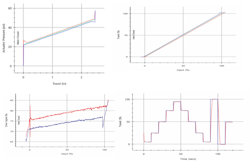
- Offline diagnostics require stroking the valve through its full range but provide deeper insights — the equivalent of an MRI versus a pulse check. These tests can evaluate the overall performance of the valve assembly, detecting even minute irregularities. They are typically referred to as "valve signatures." See Figure 1.
Even more powerful is baseline comparison. By capturing a valve's performance signature when new or freshly serviced, you create a baseline record against which future degradation can be measured. Employing VCMS during Factory Acceptance Testing (FAT) and Site Acceptance Testing (SAT) ensures valves are handed over to operations in optimal condition. The baselines captured at this stage will serve as a valuable reference for comparing valve performance.
Valve Condition Monitoring System (VCMS)
A Valve Condition Monitoring System (VCMS) transforms isolated diagnostic data into plant-wide asset intelligence. Instead of manually interrogating individual positioners, VCMS brings valve health information to engineers' desktops, enabling centralized visibility across hundreds or thousands of valves.
This visibility fundamentally changes the maintenance team's role. Imagine knowing about a developing problem in your valve assembly before production notices any control issues.
The satisfaction of identifying and resolving problems before they impact operations cannot be overstated; it shifts the dynamic from reactive firefighting to confident, proactive asset management.
The Missing Piece: Diagnostics Is Not the Ultimate Solution
As noted earlier, diagnostics can reliably detect approximately 60% of typical valve issues. However, regulatory maintenance requirements, hard-earned operational experience and unique process conditions will always extend beyond what diagnostics alone can capture. These realities demand a strategy to systematically address the remaining 40% of risk — this is where a valve risk-based maintenance strategy becomes essential.
The framework combines two dimensions: likelihood of failure (informed by condition, duty cycle, service severity and history) and consequences of failure (safety, environmental, production, financial and regulatory impacts).
A company can develop the following specific criteria tailored to its own processes and environment:
- Run to Failure: These are valves that are acceptable to replace rather than repair. Typically, they carry low risk, are not part of any vital system redundancy, and their failure will not cause other systems to fail.
- Severe Services: These are valves installed in specific process conditions considered severe in context. For example, valves operating at extreme temperatures (above 250° C or below 1° C), high pressures (above 40 bar), or in services prone to cavitation, flashing or severe erosion require heightened attention.
- High Duty Cycle: These are valves that modulate frequently — for example, with position changes of more than 10% in 24 hours — and are expected to experience accelerated wear, requiring shorter maintenance intervals.
- Maximum Permissible Maintenance Interval: Every valve has a finite lifetime after which it must be replaced. In addition, operational experience, regulatory requirements or safety mandates may require replacement after a certain service interval. The Maximum Permissible Maintenance Interval defines that threshold — it is the maximum delay allowable before a valve must be repaired or replaced. Within this interval, optimization is permitted. Table 1 presents an example of a typical maintenance interval chart.
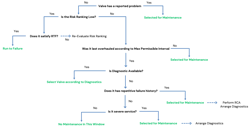
Valve Maintenance Decision Flow
Figure 2 presents a structured flow for selecting a valve for maintenance. This flow provides a risk-based approach that incorporates the company-specific criteria and the valve condition monitoring system. The focus of this structured decision-making process is to ensure that we have an optimized basis for our valve selection, thereby improving the utilization of maintenance windows.
Transforming All Maintenance Windows
The results are revolutionary — a transformation from reactive to proactive, information-based maintenance, as seen in Table 2.
The Path Forward
The formula for peaceful coexistence with control valves is straightforward: a risk-based valve maintenance strategy integrated with a Valve Condition Monitoring System (VCMS).
This approach delivers measurable results — fewer unplanned shutdowns, greater process stability, optimized maintenance spend, stronger shutdown execution, improved safety and environmental performance, and tighter collaboration across operations, maintenance and engineering.
Zero-maintenance plants may be a utopian ideal. Zero-surprise plants are not. The technology already exists in your facility. The methodology is proven across industries. Your valves are already telling their story through the diagnostic capabilities you have invested in.
The only question that remains is simple: Are you listening?
About the Author
 Shaiq Bashir
 Shaiq Bashir
Shaiq Bashir is a global chemical-industry executive and a recognized leader in operations, maintenance, and multi-billion-dollar project management, with more than 17 years of experience supporting high-hazard chemical, power, and gas facilities. He has led large, multidisciplinary organizations that deliver safe, reliable, and high-performance plant operations across complex continuous-process environments.
A Chartered Engineer with Engineers Ireland and Engineers Australia, Shaiq is also a Certified Reliability Leader (CRL), a TÜV Rheinland–certified Functional Safety Engineer, a CCPS Certified Process Safety Professional, and a Lean Six Sigma Black Belt. His expertise spans asset lifecycle management, risk-based maintenance, SIL lifecycle governance, and process safety management, with a strong focus on integrating engineering rigor with operational excellence.
A significant focus of Shaiq’s work centers on automated and actuated valve systems, including control and on-off valves, where he has led initiatives spanning valve specification, sizing, material selection, installation, commissioning, diagnostics, maintenance, and full lifecycle optimization. He brings deep experience managing valve performance in demanding services such as corrosive chemicals, high-pressure applications, safety-instrumented functions, and critical isolation duties.
Based in Qatar and working in one of the world’s largest chemical complexes, Shaiq is widely recognized for advancing data-driven valve maintenance, predictive diagnostics, and digital asset strategies to reduce unplanned downtime, improve safety integrity, and extend equipment life. Through his leadership, technical contributions, and industry engagement, Shaiq is committed to advancing best practices in valve lifecycle management and shaping the future of reliable, safe, and efficient chemical processing operations worldwide.