June 2026 Top Content: Decisions That Shape the Plant
This past month, Chemical Processing covered the decisions that don’t announce themselves. Which gas to specify, whether to remove an alarm, how much invisible work your best engineer is absorbing, whether your digital roadmap is starting in the right place.
Taken together, June’s stories share a common thread: the difference between good outcomes and bad ones often lives not in the technology or the standards, but in whether anyone stopped long enough to ask the right question.
Argon or Nitrogen? The Inert Gas Decision Engineers Keep Getting Wrong
Linda Vidova’s examination of inert gas selection begins with this observation: most facilities don’t choose between argon and nitrogen so much as they inherit whichever one the previous project used. For many applications, that works. For others, it generates yield drift, unexpected reactivity or avoidable cost that never gets traced back to its source. She offers a decision framework: process chemistry first, then system type, then economics — but it requires actually running through those parameters rather than defaulting to habit.
Sodium Softening: The Workhorse of Industrial Boiler Makeup Water Treatment
Brad Buecker, a veteran of more than 300 technical articles on power plant chemistry, returns with the third installment of his makeup water series by getting into the mechanics that plant managers often take for granted. Sodium softening — using ion exchange resin to swap calcium, magnesium and other hardness ions for sodium — has been a standard boiler makeup treatment since synthetic resins were developed in the 1930s, and it remains the workhorse for low- and medium-pressure steam generators today. Buecker walks through the full operational cycle: service, backwash, brine regeneration, slow rinse and fast rinse. He points out that plant managers who are focused on process chemistry often neglect water chemistry monitoring until it’s too late.
The Digital Maturity Roadmap to Energy Savings in Chemical Plants
Thomas Kwan, an energy transition expert at Schneider Electric’s Sustainability Research Institute with a Ph.D. in chemical and environmental engineering, pointed out that for plants running crackers, distillation trains and fired-heater-dependent reaction systems, energy can represent up to 50% of direct production costs. And yet, research suggests that only 5–20% of energy consumed at the equipment level actually supports value-adding work. The rest feeds HVAC, standby states and avoidable waste. Kwan maps a six-stage digital maturity model — computerization, connectivity, visibility, transparency, predictive capacity and adaptability.

When Alarms Stop Warning and Start Failing
David Strobhar has been working on alarm systems since 1980, when his first job out of college was helping improve the alarm system at Three Mile Island following its 1979 accident. Now, more than 45 years later, Strobhar reports that industrial alarm systems are still failing in the same ways. The winning quote of the month: “Alarm management is much like weight loss: everyone knows what to do, but not everyone is willing to do it.” The resistance to rationalization, Strobhar argues, comes from three sources: operator anxiety about removing any alarm; personal identification with the system that was built; and a catastrophizing tendency that assigns worst-case consequences to every alarm, making them all equally urgent, which renders none of them urgent.
Pilot Plants Are Getting Smarter and Smaller
Ioana Floru, a senior energy and chemicals industry professional with more than 20 years of experience across manufacturing, technology and commercial sectors, takes on the persistent challenge of chemical process scale-up. Chemical manufacturers are pairing physical pilot programs with digital twins, modular chemical process intensification and minimum viable pilot plant frameworks borrowed from lean startup methodology to make experimentation more targeted and capital-efficient. Most companies will not rely entirely on digital tools for step-out innovations, because chemical systems are notoriously difficult to predict and fully characterize. Full-scale pilots remain necessary. But the question of how to run them more intelligently is now answered differently than it was a decade ago.
Chemical Processing Notebook: How PPG Is Using AI to Crack Coatings Formulation
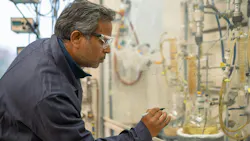
Executive Editor Jonathan Katz visited PPG’s global Coatings Innovation Center in Allison Park, Pennsylvania — a 350-person facility surrounded by woods in suburban Pittsburgh that supports all of the company’s coatings R&D activities — and came back with a ground-level account of what AI-driven formulation looks like in practice
Global technical director Daniel Connor offered what may be the most honest framing of what AI does and doesn’t do: “We see the power of combining experienced chemists with the AI model. We’re still relying on the brilliance of our scientists.” The technology, Keith Moquin summarized, provides “directional accuracy.”
Workforce: How Sites Accidentally Burn Out Their Best People
Lauren Neal, founder of the Valued at Work consultancy and author of a book that reached No. 1 on the bestseller lists, returned this month with a column that reframes burnout as an engineering problem rather than a personal one. Her argument: the most reliable people at a chemical facility gradually accumulate invisible work — absorbing weak handovers, bridging coordination gaps, mentoring junior staff, managing stakeholder tensions — and none of it shows up on a formal task list. They become human single points of failure, carrying historical knowledge, recovery expertise and institutional trust in ways that the operation cannot afford to lose.
About the Author
 Traci Purdum
Traci Purdum
Editor-in-Chief
Traci Purdum, an award-winning business journalist with extensive experience covering manufacturing and management issues, is a graduate of the Kent State University School of Journalism and Mass Communication, Kent, Ohio, and an alumnus of the Wharton Seminar for Business Journalists, Wharton School of Business, University of Pennsylvania, Philadelphia.
Recent Awards:
2025 Eddie Award for her column "Lax Regulations Burn Rivers"
2024 Jesse H. Neal Award for best podcast Process Safety with Trish & Traci