Argon or Nitrogen? The Inert Gas Decision Engineers Keep Getting Wrong
The choice between argon and nitrogen is often made less by engineering judgment and more by habit – defaulting to whichever gas the previous project used, whichever is cheaper on the current contract or whichever the supplier stocks locally. For many applications, this works without consequence. But where it fails, it tends to fail quietly: a reactive intermediate that degrades without obvious cause, a yield that drifts below expectation, a moisture ingress problem that gets attributed to sealing rather than gas density or an argon specification that adds material cost to every production run when nitrogen would have performed identically. An unconsidered gas selection is a difficult root cause to identify because it is so rarely where engineers think to look.
Noble vs Diatomic
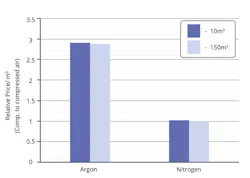
Inert gases are substances that remain chemically nonreactive with other materials under standard temperature and pressure conditions. This property makes them indispensable across a wide range of industrial processes, where excluding reactive species – oxygen, moisture, carbon dioxide – is essential to prevent oxidation, combustion and corrosion. Argon and nitrogen are the two most widely used options, and while they are often treated as functionally equivalent, they differ in a fundamental way: one is truly inert, and the other is not. Both argon and nitrogen can create a highly inert environment, but nitrogen typically costs about a third as much as argon, making it the practical choice for most applications (Figure 1).
Argon is a noble gas – monatomic, with a completely filled electron shell, and chemically inert under virtually all conditions encountered in industrial processing. It does not form compounds, does not react with metals at elevated temperatures and is non-corrosive across a wide range of pressures and temperatures. This makes it suitable for demanding applications such as iron and steel production, where sensitivity to moisture and reactive atmospheres is high, and for arc welding processes – including gas tungsten and metal arc welding – where the shielding gas must remain entirely passive throughout. Where nitrogen cannot provide sufficient inerting, argon is typically the next step up.
Nitrogen, by contrast, is diatomic and, while generally unreactive at ambient temperatures, it is not chemically inert in the strict sense. Under certain conditions, it can react with highly reactive metals to form nitrides, and it can interact with reactive intermediates in ways that argon will not. That said, nitrogen remains an excellent choice for the majority of purging, shielding and inerting applications – it is the largest component by volume and mass of atmospheric air, it is widely available and it performs reliably across chemical processing, oil and gas operations and general industrial use. The distinction matters not because nitrogen is unsuitable for most work, but because the minority of cases where it falls short are precisely the cases where the consequences of a wrong choice are most severe.
Physical Properties and Their Process Implications
The two gases also differ in ways that affect process performance beyond chemistry alone. Argon is approximately 38% denser than air and significantly denser than nitrogen, which has direct consequences for containment: in open or semi-open systems such as glove boxes and inerted enclosures, argon will pool and maintain a stable blanket more effectively, while nitrogen – being closer in density to air – is more prone to mixing and displacement. For applications where consistent atmosphere integrity is critical, this difference in density behavior can matter more than chemistry.
Thermal conductivity is another distinction worth noting. Nitrogen conducts heat more effectively than argon, which can be relevant in processes where temperature uniformity or controlled heat transfer is part of the specification. In powder handling applications, nitrogen atmospheres have also been associated with static charge buildup, which can create process and safety complications that argon’s different physical properties may help avoid. Neither gas introduces moisture intrinsically, but the density-driven differences in how each gas behaves within an enclosure can affect how well the system excludes ambient moisture over time – making what looks like a sealing problem sometimes a gas selection problem instead.
Purity Specifications and What They Actually Mean
Both argon and nitrogen are available across a range of purity grades, with impurity levels – principally oxygen and moisture – expressed in parts per million. At the lower end, standard industrial grades may carry oxygen content in the range of tens to hundreds of ppm; at the upper end, ultra-high purity grades reduce this to single-digit ppm or below. The grade designations vary by supplier and region, but the underlying specification is always the same: how much oxygen, how much water and how much of anything else the process cannot tolerate.
What those numbers mean in practice depends heavily on the downstream system. In a recirculating glove box equipped with a purification train – typically a combined oxygen and moisture scrubber – the inlet gas purity is not the atmosphere purity. The purification system will reduce residual impurities further, meaning that a higher-grade inlet gas primarily reduces the load on the scrubber rather than directly setting the working atmosphere specification. For a well-maintained system operating within its design parameters, the difference between a 5 ppm and a 1 ppm inlet gas may be imperceptible at the working level. For a system running at high throughput, with frequent sample transfers, or with a degraded purification column, the inlet purity margin becomes more meaningful.
The interaction is where over-specification becomes a significant and largely avoidable cost driver. At laboratory scale, the price differential between standard and high-purity grades is modest. At production volumes, where gas consumption is continuous and substantial, specifying ultra-high purity where a standard or high-purity grade would perform identically through the purification stage adds cost to every operating hour without a corresponding process benefit. The correct approach is to specify inlet purity relative to the purification system’s demonstrated performance and the process’s actual sensitivity threshold – not to default upward on the assumption that higher purity is always safer. In most cases, it is not safer; it is simply more expensive.
Decision Framework: Selecting the Right Gas for Your Process
Gas selection should follow process requirements, not convention. In practice, many specifications are inherited – carried forward from a previous project, a lab setup or a supplier's recommendation made without full knowledge of the application. A more rigorous approach starts with a defined set of process parameters, evaluated systematically before a gas is specified.
The first question is material compatibility: does the process involve any substances known to react with nitrogen at ambient or elevated temperatures? This includes lithium metal, certain organometallic compounds and other highly reactive intermediates where nitrogen’s diatomic character presents a genuine chemical risk. If the answer is yes, argon is the appropriate choice regardless of cost. If the answer is no, nitrogen remains a candidate and the evaluation continues.
The second consideration is atmosphere quality – specifically, what internal oxygen and moisture levels the process can tolerate, and how those thresholds interact with the purification capability of the system in use. For a recirculating glove box with an active purification train, the relevant specification is not the inlet gas purity alone but the steady-state atmosphere the combined system can maintain under realistic operating conditions: anticipating transfer frequency, sample load and purification column condition. A glove box operating well within its purification capacity can maintain a high-quality atmosphere from a mid-grade inlet gas; one operating at its limits will struggle regardless of how pure the supply is. Specifying inlet purity without accounting for system performance is a common source of both over-specification and unmet expectations.
System type also shapes the decision. In a fully recirculating glove box, gas consumption is relatively low and the economics of the purity grade matter more than the gas cost per unit volume. In open or semi-open systems – purge boxes, inerted enclosures, flow-through setups – gas consumption is continuous and the cost differential between argon and nitrogen can become substantial at production scale. Over a realistic operating period, the choice of gas in a high-consumption system is a meaningful budget line, and the case for nitrogen wherever it is chemically suitable becomes correspondingly stronger.
Finally, where powder handling is part of the process, static charge generation under nitrogen atmospheres is worth evaluating as a specific risk rather than a theoretical footnote. If that risk is relevant, it should be documented as a selection criterion rather than discovered after commissioning.
A Specifiable Decision, Not a Default
Inert gas selection is an engineering decision with real and measurable consequences – for process chemistry, material integrity and operating cost – yet it is routinely treated as a default. The gas used at bench scale gets carried into pilot production; the pilot specification gets inherited at full scale; and the underlying question of whether the gas was ever the right choice for the process goes unasked. For many applications, this causes no harm. For others, it quietly drives yield loss, unexpected reactivity, or avoidable expenditure that never gets traced back to its source.
The framework is not complex. Process chemistry determines whether nitrogen is viable at all. System type and purification capability determine the appropriate purity specification. Consumption of economics determines whether the cost differential between gases is material at the relevant scale. Working through these parameters takes less time than diagnosing the problems that follow from not doing so.
As sensitive material processing continues to scale – across battery manufacturing, specialty chemicals and advanced materials production – the aggregate weight of these decisions grows. Gas selection affects yield, operating cost and supply security, and the consequences of systematic misspecification of compounds across every production run. Getting it right is not a matter of choosing the more expensive or more cautious option by default; it is a matter of making a considered, documented specification based on what the process actually requires. That is a straightforward engineering task, and one that is worth doing properly.
About the Author
 Linda Vidova
 Linda Vidova
Linda Vidova, scientific writer for Ossila, is currently completing her PhD in cancer genetics and employs her strong research skills to cover topics related to Ossila's areas of expertise. Ossila specializes in lab equipment and materials that are used in device research, driving the development of advanced semiconductors, higher efficiency solar panels, flexible OLED screens, battery technologies, and more.