Chemical Processing Notebook: How PPG Is Using AI to Crack Coatings Formulation
PITTSBURGH – When writer’s block takes hold, my attention usually diverts to a random news site. For this column, it was CNN, where an image of a bespectacled man with an intense, square jaw stood at a podium, pointing in anger at someone. The headline for the streaming segment read, “Data center defiance.”
The community backlash against data centers is rooted in the expansion of artificial intelligence.
To the public, AI is either a doomsday machine or the catalyst for the “next industrial revolution.”
In the chemical industry, the story around AI is more nuanced. At the operations level, there’s a sense of watchful restraint, with some leaders reporting less impactful outcomes. At least a few attendees and speakers expressed this view at a vendor’s user conference that I attended recently in Houston. (I’ll explore that sentiment further in an upcoming article).
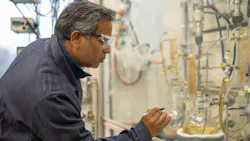
However, at the research and development level, AI is already disruptive. PPG's global Coatings Innovation Center in Allison Park, Pennsylvania, shows what that transformation looks like in practice. The complex, surrounded by woods in suburban Pittsburgh, is home to about 350 workers and supports all of PPG’s coatings R&D activities.
AI and digital twins have become a core component of the company’s R&D efforts. PPG used AI models to develop its Deltron DC7020 clearcoat technology, which the company launched last year. PPG engineers were trying to develop a clearcoat for auto refinishing customers that eliminated the industrial solvent Oxsol, delivered a high-quality finish and dried quickly.
The key tool for identifying the formulation was an AI platform the company developed in the fall of 2025 called Knowledge Navigator, built specifically for the science and technology group. The platform has grown from about 100 to 500 internal users per month since its launch in October 2025, Keith Moquin, global science and technology digital leader, explained before a tour of the R&D facility.
It’s a generative AI system that takes source data from different repositories across the company, like electronic lab books, product data sheets, formal reports and quality-management data. Various groups across the organization have access to Knowledge Navigator, but it’s secured with access restrictions, Moquin said.
The AI models link formulation and performance attributes. All the results are fed into a digital twin model built on historical data, said GK Cheong, a senior data scientist, during a visit to the Deltron refinish lab. The models can then generate thousands of formulas at once, which the team can downselect based on desired outcomes, added Cheong. For the Deltron project, the AI system produced four models, and three of them met the specifications for the product the team was seeking, Moquin said.
The modeling process involved some intervention from the team.
“We try to teach the model some rational bounds to reduce the number of formulations, and that’s where chemist knowledge comes in,” said Daniel Connor, global technical director, automotive refinish. “We see the power of combining experienced chemists with the AI model. We’re still relying on the brilliance of our scientists.”
But like machines, humans have limitations. They come with biases that can impede progress. AI can show even the most adept engineers things they couldn’t or wouldn’t have considered, Connor said.
“It allows us to land in a space that we haven’t been in,” he said.
With each project, the PPG scientists expect the digital twin to build on past experiences to suggest new products. A second low-VOC clearcoat project is underway by building on the success of the Deltron model.
The new data was easily incorporated into the model, further expanding the prediction space. Using the model, the team landed on three resins and a suggested formulation window that produced desired performance properties.
The AI-enabled R&D also is a learning process for PPG’s Allison Park workforce.
Some newer chemists don’t understand the value of AI, said Jun Deng, refinish clearcoat center of excellence lead.
“We show them how it can help them screen different formulations,” she said.
When the chemists see verifiable results, they gain confidence in the AI system, Deng said.
AI will need to demonstrate more quantifiable wins beyond the R&D lab to gain the trust of workers at the operations level. And while it’s fair to debate AI’s impact on the power grid, many of the new innovations coming out of these R&D centers are replacing less-sustainable legacy products.
Throughout my visit to the Allison Park facility, members of the science and technology group stressed that AI isn’t replacing workers. It’s helping them innovate faster.
“We will never get away from people. What we do is too complex,” Moquin said. “What AI can do is give us directional accuracy.”
About the Author
 Jonathan Katz
Jonathan Katz
Executive Editor
Jonathan Katz, executive editor, brings nearly two decades of experience as a B2B journalist to Chemical Processing magazine. He has expertise on a wide range of industrial topics. Jon previously served as the managing editor for IndustryWeek magazine and, most recently, as a freelance writer specializing in content marketing for the manufacturing sector.
His knowledge areas include industrial safety, environmental compliance/sustainability, lean manufacturing/continuous improvement, Industry 4.0/automation and many other topics of interest to the Chemical Processing audience.
When he’s not working, Jon enjoys fishing, hiking and music, including a small but growing vinyl collection.
Jon resides in the Cleveland, Ohio, area.