Flow-Accelerated Corrosion: Don’t Wait for a Failure




In this episode of Chemical Processing’s Distilled Podcast, Brad Buecker, senior technical consultant with SAMCO Technologies, explains flow-accelerated corrosion (FAC). This gradual process thins carbon steel feedwater piping at elbows and other flow changes until the pipe can rupture. FAC was first recognized after a fatal failure at a nuclear plant in 1986. It’s driven by reducing chemistry, pH below 9 and temperatures near 300 degrees Fahrenheit. Buecker discusses ultrasonic wall thickness testing, monitoring both particulate and dissolved iron, oxidizing all-volatile treatment (AVTO) for copper-free systems, and chrome-alloy steels. He also stresses the value of trained chemistry staff and warns against budget-driven complacency.
Transcript
Welcome to Chemical Processing's Distilled Podcast. This podcast and its transcript can be found at chemicalprocessing.com. You can also download this podcast on your favorite player. I'm Traci Purdum, editor in chief of CP, and joining me for more Water Talk is Brad Buecker, frequent contributor and podcast guest. He'll also be our guest speaker for the Field Notes LinkedIn Lunch and Learn series on Nov. 19, talking about corrosion.
Brad is a senior technical consultant with SAMCO Technologies and has many years of experience in or supporting the power industry, much of it in steam generation chemistry, water treatment and air quality control. He has a chemistry degree from Iowa State University, with additional coursework in fluid mechanics, energy and materials balances, and advanced inorganic chemistry. Welcome back, Brad.
Brad: Thank you, Traci. It's great to be back.
Traci: As we were putting together today's episode, we talked about boilers that produce the high-temperature, high-pressure steam that drives turbines and feeds industrial processes around the world. But inside that piping, a slow and nearly invisible process can wear the steel away. When it finally fails, the results can be deadly. Today, you're going to walk us through how this happens and what can be done about it.
Why is chemistry control in steam-generating units so important?
Brad: I'm going to focus on one issue in particular, but let me start with some general comments. Industrial and power-generating boilers produce steam at high temperatures and pressures — whether low, medium or high pressure — either for process heat exchange or, in many cases, to drive turbines for power production. Impurity ingress and poor chemistry control in the steam-generating network can cause equipment failures that are often very expensive and, in some cases, can jeopardize employee safety.
That's the example I want to discuss today. It has been an important issue for decades, but many people still don't understand it, and I don't know how extensively it has been discussed in industries other than power.
I started my career in the power industry in 1981. The issue I want to talk about is known as flow-accelerated corrosion, or FAC, and it was first recognized in 1986, so I'd been in the industry for five years at that point. Then, of course, it had to be investigated and tracked.
To understand it, think of the steam-generating network. All the pieces are interlinked, but you need to look at them piece by piece to understand the chemistry and the programs to use. Exhaust steam from the turbine is converted back to liquid in the condenser. That condensate goes through the feedwater network to the boiler, where it is converted to steam, which then goes to turbines or heat exchangers. Today, I'm going to focus on the feedwater network.
In 1986, an FAC failure occurred at a nuclear plant. The Electric Power Research Institute (EPRI) has done a great deal of research on this issue over the years, and I rely on some of its reports. That failure released high-temperature, high-pressure feedwater that instantly flashed to steam and killed four workers.
This issue is personal for me. About 20 years ago, a sister plant to the plant where I worked had an FAC-induced failure that killed two people. That really brought the issue close to home. We had already addressed it at our plant, and the failure at the other plant was a fairly obscure one, but it nonetheless had catastrophic consequences.
Beyond power-generating units, FAC can potentially affect other steam generators, including high-pressure units at industrial plants — and even lower- and medium-pressure systems. A number of years ago, I consulted with a friend who was responsible for the steam-generating, chiller and heating systems at a university campus and one of its two hospitals. He had become concerned about FAC and wanted to make sure it wasn't happening in those systems, so he had ultrasonic thickness testing done on some of the condensate return and feedwater lines. They found some FAC, but it was mild, and no immediate action was required.
In higher-pressure units, though, experts have reported going in to look over a unit — even a new one only two or three years old — and finding extensive FAC because the wrong chemistry was being used. It really is a critical issue.
What Causes FAC?
Traci: Let's dig into the fundamentals of FAC. You alluded to the wrong chemistry and noted that newer systems can be affected. Can you describe the factors that cause this corrosion?
Brad: Certainly. As I mentioned, the 1986 failure was the first indication of FAC. But let's go back to early in the last century, when boilers started to increase in size and pressure as they were used for power generation. As electricity expanded across the country, everybody wanted power, and coal- and oil-fired boilers came online to generate the steam that drove the turbines. Everyone was looking for higher pressures and temperatures because, thermodynamically, that improves the efficiency of the entire process.
The feedwater systems of these power-generating units had feedwater heaters, another efficiency improvement. These heaters used extraction steam from the turbine to heat the feedwater going back to the boiler. Many of them had copper-alloy tubes because copper conducts heat very well. So, by the mid-1950s, chemists and researchers were looking for a program that would minimize corrosion not only of the carbon steel feedwater piping and feedwater heater shells but also of the copper-alloy tubes.
What they came up with was all-volatile treatment reducing, or AVTR. On the mechanical side, it involved a deaerator to remove dissolved oxygen from the water. Chemically, it involved feeding ammonia, or what was then known as a neutralizing amine, to raise the pH to the upper-8 to low-9 range, plus a chemical oxygen scavenger to knock the oxygen down to zero. The program also passivated the metals. If some of the carbon steel had oxidized, it would passivate it to magnetite — the gray-black coating you see in steam-generating units — and it would passivate copper as well. AVTR was considered the cat's meow for feedwater treatment, and when I came into the industry in 1981, it was the standard pretty much throughout the country.
What people didn't realize until the 1986 failure was that this chemistry contributes to FAC. It's called flow-accelerated corrosion because it occurs at changes in the flow path, such as economizer elbows, feedwater heater elbows and reducing fittings. That's the critical aspect of FAC, but other factors influence it, too. One is the reducing environment produced by the oxygen scavenger feed and the deaerator removing all of the dissolved oxygen. Another is pH: As pH drops below 9, FAC accelerates. Then there's temperature, which follows a bell curve, as it does in many other applications. FAC peaks at around 300 degrees Fahrenheit and tails off on either side, but it can still be a problem within roughly 100 degrees in either direction.
That range is right where feedwater systems operate. In today's power industry, with combined-cycle units and heat recovery steam generators (HRSGs), the feedwater systems — the economizers and the low-pressure evaporator — are also very susceptible.
Once researchers figured out what was causing FAC, they had to determine how to correct it, which I'll get to in a moment. But first, the obvious question: How do we know if it's occurring at our plant?
Today, if you're worried that piping has worn away to the point where you could see a failure soon or in the future, a number of reputable companies can come in and perform nondestructive testing at various locations in the feedwater network. Ultrasonic wall thickness testing is one method, and there are others.
This was done at one of the units at the power plant where I worked. I wasn't overseeing the project, but the work was done while the unit was down, not while it was operating under extremely hot, potentially dangerous conditions. Crews had to strip insulation off the lines in the areas identified as potential trouble spots and then perform the testing. They found some locations with minimal attack, but we had already switched that unit to another program, which I'll discuss shortly, so it was in good shape. Other units, however, might find something totally different.
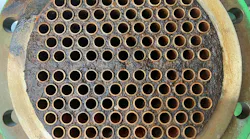
In some of my presentations and articles, I've used classic illustrations showing a cutaway section of an elbow that suffered from FAC. On the inside bend, the wall thickness is the same as if it hadn't been touched at all, as is the piping leading into and out of the elbow. But on the outer bend — in one classic photo in my files — the wall thickness was perhaps a quarter of normal. That location was very close to failure, to burst pressure. That's what FAC does: It gradually erodes the material over time, and depending on the chemistry, it can be accelerated.
As we've seen, the costs of these failures can be both economic and life-threatening. And I've seen too many instances — not just with FAC but with other chemistry issues — of plant management wanting to save a buck here and there. When ideas are put in front of them, the response is, "We don't really have room for that in the budget."
Here's a case history. It wasn't FAC-related, but it was chemistry-related. In one case, a chemistry problem required a huge expenditure to repair a boiler. In another, some of my colleagues in the chemistry lab caught a situation that, had it gone any longer, could have caused similar damage in a much larger and more expensive unit. Those two instances opened management's eyes at my plant. They made me project manager for installing a comprehensive online water/steam chemistry monitoring system. We put display stations in the control room, the main laboratory and the management office so anyone could access data from the plant's three principal units at any time. If something came up suddenly — which happens so often — someone could catch it quickly, and we could address it. It was a really good project and a real benefit to the plant.
One thing we didn't do at the time, but that has become much more recognized now, especially for detecting FAC, is to include some form of iron monitoring in online systems. You have to look for both suspended and dissolved iron. Typically, about 90% of the iron generated by corrosion is particulate, and only about 10% is dissolved, so measuring dissolved iron alone isn't a good indicator at all. Iron analyzers of some type in the system help you monitor for FAC and track and correct any problems.
How Do We Correct FAC?
Traci: Let's talk more about that. If monitoring shows that FAC is the problem, how do we correct the situation?
Brad: First, as I mentioned, set up proper monitoring and install the necessary analytical instrumentation. It may seem costly at first, but the problems it can prevent are amazing. Also, have an expert or two on staff who understand what the data means.
Here's an example I've used for many years. It wasn't FAC-related, but it makes the point. A colleague and I were called to an organic chemicals plant that was having a lot of problems with the superheaters in its boilers. Foam was getting into the superheaters and causing overheating, and the plant had to keep replacing them. As we walked around, inspected and talked with people, we found that the cause was impurities in the condensate return from the chemical processes.
But here's the point: The plant had only operators monitoring the chemistry. These fellows were intelligent, but they had no chemistry training. When there was a chemistry upset in the condensate return — which was a regular occurrence — they couldn't tell what was causing it. Instead of having someone on staff who could analyze the situation and trace it back, they had personnel who ran a few lab tests and said, "Yes, we have a problem, but we don't know what it is." Instrumentation and educated staff can be very beneficial.
Now, on to treatment programs. Combined-cycle units have replaced many of the coal-fired units in the power industry, so most new steam-turbine generation comes from combined-cycle plants. Their HRSGs contain no copper alloys at all. They don't have feedwater heaters, except perhaps a deaerator, and then the economizer. So, it's essentially all carbon steel.
For these systems, EPRI developed a program known as all-volatile treatment oxidizing, or AVTO, which we implemented at my second power plant. It runs counter to what chemists learned in the middle of the last century and even in the 1980s, when I started.
The requirements are high-purity makeup water — from a demineralizer or reverse osmosis/demineralizer system, for example — which leads to high-purity feedwater, with a guideline cation conductivity of less than 0.2 microsiemens per centimeter, and no copper alloys in the feedwater system. Based on earlier programs developed in Europe for supercritical boilers, AVTO uses a small amount of dissolved oxygen to form a stronger passivating layer than the magnetite formed under AVTR. If you get good coverage throughout the system, it can really minimize FAC. There are important details I can't go into in this podcast, but the program has proved very beneficial at a number of plants.
A word of warning for industrial units: If returned condensate doesn't have the purity required for the feedwater, AVTO is not possible, and AVTR chemistry is still needed. Either way, it's important to have the correct analytical instruments and trained personnel to monitor the chemistry and make sure it's correct and not causing problems.
There's one other aspect, and it's on the materials side. Adding a little chromium to steel greatly inhibits FAC; common alloy steels include 1 1/4 and 2 1/4 chrome. Some recommendations say that in FAC-prone locations where AVTR treatment will be needed, you should use 1 1/4 or 2 1/4 chrome materials to minimize the problem. Of course, that brings up cost again. Design firms and owners want to save money wherever they can, so they'll say that material is more expensive and they don't want that expenditure. But it is a way to address FAC, at least at particular locations.
Finally, something I've seen with FAC and other issues: When management or operators are approached about implementing a chemistry change or addressing a potential problem, they'll say, "We haven't seen any problems for years. Why should we be worried? Why do we need to do anything now?" But as I pointed out, FAC — like many other damage mechanisms — is a gradual process. You may not have seen anything for years, but you could see something within a few months. Using that as a reason not to act can be very problematic.
Traci: Problematic, for sure. You mentioned having educated staff on board to help mitigate issues, and I want to thank you for taking the time to educate us and explain FAC in greater detail. Is there anything else you'd like to add before we close?
Brad: No, I think that'll do it for today, Traci.
Traci: Well, folks, if you want to stay on top of best practices in the chemical industry, subscribe to this free podcast via your favorite podcast platform. You can also visit us at chemicalprocessing.com for more tools and resources aimed at helping you achieve success. We also hope you'll join us for our next Field Notes LinkedIn Lunch and Learn on Nov. 19 at noon Eastern time. On behalf of Brad, I'm Traci, and this is Chemical Processing's Distilled Podcast. Thanks for listening. Thanks again, Brad.
Brad: Thank you, Traci.
About the Author
 Traci Purdum
Editor-in-Chief
Traci Purdum, an award-winning business journalist with extensive experience covering manufacturing and management issues, is a graduate of the Kent State University School of Journalism and Mass Communication, Kent, Ohio, and an alumnus of the Wharton Seminar for Business Journalists, Wharton School of Business, University of Pennsylvania, Philadelphia.
Recent Awards:
2025 Eddie Award for her column "Lax Regulations Burn Rivers"
2024 Jesse H. Neal Award for best podcast Process Safety with Trish & Traci