Chemical Processing Notebook: ACD's Eric Byer on Iran, Tariffs and the Fight Over Rail
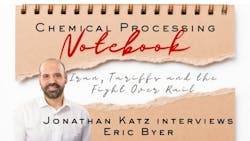
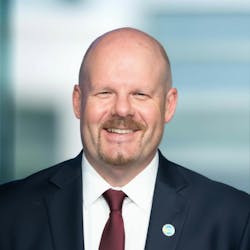
As the Iran war escalated, Eric Byer asked members of the Alliance for Chemical Distribution how the conflict was impacting their supply chain. Byer, CEO of the organization, has been a leading voice in Washington, D.C., for the 400-plus chemical distributors that comprise ACD. He regularly issues updates on the latest legislative issues and trends impacting the industry.
He also has testified before Congress on several key issues, including the Chemical Facility Anti-Terrorism Standards program and rail reform. I recently spoke with Byer about the pressures the chemical industry faces and how ACD’s members are responding. The following is an edited version of that conversation.
On LinkedIn, you asked your members for feedback on how the war in Iran is affecting them. What are you hearing regarding product availability and potential shortages?
EB: I think right now the strain is starting to hit our guys, especially on the availability of crude that goes into manufacturing. Getting oil to the bigger manufacturing countries like India and China is a bit of a concern. I talked to a bunch of our folks over the last two days and over the weekend, and they got through the last week, but for every week or so, you're probably talking a month-out-plus of recovery time. That means, if this goes on for another four, five or six weeks, we're looking at a six- to nine-month recovery window before we get back to where we were before we launched into [the Iran war].
The oil price side is obviously a big concern, and the availability of oil to manufacture a variety of different chemicals is a big concern, and it'll become more of a concern over the next couple of weeks. Yesterday was a great example. The president is down in Miami talking to House Republicans and saying, “We're going to get this war wrapped up fairly soon.” Markets are down by 900 points, and all of a sudden they shoot back up because Trump is saying they're going to be out [of Iran]. And then this morning he's on Truth Social saying they're going to bomb the hell out of [them] more aggressively than they have in the last 10 days. It is a bit of a roller coaster for our guys, and all businesses want certainty, and it is about as uncertain a short-term future as they can possibly look at.
If this goes on six to eight weeks, then I have to recalibrate with my supply-chain providers, whether it's an ocean carrier or through rail. It's eerily like COVID, where the surcharges that are being thrown at our guys from the steamship lines are right in line with what they did during COVID.
We’re seeing now $7,000 surcharges on containers that must be moved from where they are now, potentially going through the Red Sea to alternative routes. We're sure we're going to see blank sailing thrown out there soon, but the carriers are very, very good at adding surcharges in all routes, not those that are just affected by the traffic flow through the Middle East. We're paying real close attention to those types of things because I think we can control that to some degree by letting the regulatory folks know that this is happening and have those folks weigh in with those carriers to say, "What are you doing here?"
What happens if the price of oil continues to rise, say, above $100 per barrel? What does that mean for your members?
EB: It’s a cost that they incur partly and have to pass on to their customers. If you remember COVID, we were between $150 and $200 a barrel at one point, and we managed to get through that. Now, that means, ultimately, the consumer is going to end up paying more. We're already starting to see it at the gas pump. A lot of that is a political reaction. Yesterday (March 9), oil went up to $105, bounced back down to $84 by the end of the day. It’s not unlike what we're seeing with the tariffs. A lot of our guys are trying to figure out ways to either pass that customer cost along a little bit and absorb some of it themselves. It's going to be a multi-pronged approach.
How are the tariffs hitting your members right now?
EB: It’s a dicey conversation to have in this town [Washington, D.C.] as someone who runs a trade organization because I get where the president was coming in terms of negotiation strategy and his basis for being candid. Other countries screwing the United States on trade agreements is spot on.
There's no doubt. I think there could have been a better approach to how he handled it, but it is what it is, and we're at a point now where the Supreme Court has deemed the IEEPA tariffs illegal unless there's going to be a refund process. The fact that the Court of International Trade so quickly designated a judge to get that process in place is a good thing for our guys if they all file under ACE (Automated Commercial Environment) and CBP (U.S. Customs and Border Protection) to get their money.
I think the president has some other things up his sleeve when it comes to tariffs that we'll deal with as they unfold, but ultimately I think the uncertainty of what has been happening in the last 12 months with the IEEPA tariffs is going to go away and a lot of money is going to be pocketed back by our guys who can then dump it back into infrastructure development, hiring people, investing in the future of their companies and new lines of products for their customers — all the stuff they wanted to be doing over the last 12-15 months.
I wanted to turn to rail. You've talked quite a bit about rail reform. STB rejected the Norfolk Southern/Union Pacific merger application in January. What's your biggest fear if this merger ultimately gets approved?
EB: Well, I think the biggest fear is it prices our guys out of the market of using rail. And as much as I rant and rave or rail against rail, it’s the safest way to move product. One of the things that frustrates me is the American taxpayer has set up the infrastructure for railroads over decades. Now the railroads have a monopoly over that infrastructure and can charge fees accordingly. And it can sometimes put a real burden on our smaller guys. The fact of the matter is it's inherently safer to move chemicals on railroads than it is by truck. And even though the railroads have had a host of issues—we don't have to rehash East Palestine and some other things—the fact that they have two to three incidents or accidents almost every day is one of those things where they're still safer than putting it on the road. For us, my frustration has been the impact on our guys, like the costs that are associated with demurrage fees, holding product and surcharges and the lack of communication that comes out of some of the railroads is very frustrating, too. As we all know, half the battle in today's world is communicating with one another. If you can't do that effectively, you can't keep the customer in the loop, and thus, your ability to keep that customer happy and then not jump and ship to somebody else is higher.
A merger that is going to put two of the biggest providers together and control nearly 50% of the marketplace is a non-starter. What STB ruled was more of an administrative rejection, and we'll see in the next few weeks if Mr. Vena [Union Pacific CEO Jim Vena] and the folks at UP are going to put in their application here and plug in the holes that STB asked them to do. I will tell you that I'm not a Vegas gambling person, but I thought we had 1-in-10 odds of winning this fight back in January. I think those odds have gotten significantly stronger in the last two months. There's a lot of political pushback, both Democrats and Republicans, in the House and Senate. Let's not forget, we have a vice president who led the charge on the Railway Safety Act from Ohio.
I think he's quietly engaged in this conversation, so I think there's a lot of factors there that are definitely going to be in our favor.
You mentioned East Palestine. You've also thrown your support toward the Railway Safety Act. What are you hopeful of with that particular legislation?
EB: I've not seen a vast amount of improvement from NS [Norfolk Southern] in the last two and a half/ three years since the [East Palestine] accident happened. I would say that there's no reason if you and I can order on Amazon paper towels this morning and get them in the afternoon, that we can't do a better job giving the railroads or forcing the railroads to improve their infrastructure and their technology so some of these mishaps don't happen. That also includes making sure they keep the union presence happy. I am the first to admit that I'm not the biggest union supporter, but I am absolutely supportive of the railroads when it comes to making sure that their folks are handled properly because they are the boots on the ground doing the work. They need to be treated fairly.
Is there anything you want to say from the distributor perspective on these issues we’ve discussed and that ties in with chemical manufacturing?
EB: Well, there's nothing Earth-shattering to be said. I think the biggest thing is the distributors that we represent work very closely with the manufacturers, especially in times of crisis. They did it during COVID, especially in getting recognition by the DHS [U.S. Department of Homeland Security] to move products safely from manufacturer to distributor to the end customer. I mentioned that communications is 50% of the battle. Our guys work very closely with the manufacturers. That communication is usually not an issue, thank God, because it really does help the flow of moving products and troubleshooting very efficiently.
Manufacturers have been great partners. They're the boss in many ways of moving product because they're the ones that are manufacturing, and we want to make sure that the customers get what they need at the end of the day. I just had a board meeting last week and there was lots of communication about working with the manufacturer supplier to make sure that whatever hiccups are happening because of Iran or tariffs can be resolved.
I would say to all your manufacturer listeners, keep it up because we appreciate what they do and vice versa. We'll make sure we get through this as we have with many other crises that have happened before.
About the Author
 Jonathan Katz
Jonathan Katz
Executive Editor
Jonathan Katz, executive editor, brings nearly two decades of experience as a B2B journalist to Chemical Processing magazine. He has expertise on a wide range of industrial topics. Jon previously served as the managing editor for IndustryWeek magazine and, most recently, as a freelance writer specializing in content marketing for the manufacturing sector.
His knowledge areas include industrial safety, environmental compliance/sustainability, lean manufacturing/continuous improvement, Industry 4.0/automation and many other topics of interest to the Chemical Processing audience.
When he’s not working, Jon enjoys fishing, hiking and music, including a small but growing vinyl collection.
Jon resides in the Cleveland, Ohio, area.