Circularity Fuels Raises $7M for Dairy Biogas Jet Fuel
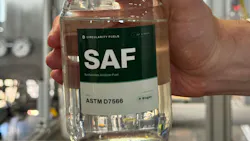
Circularity Fuels, a Redwood City, California-based renewable fuels developer, said Nov. 5 it closed a $7 million seed funding round to advance its process for converting dairy biogas into sustainable aviation fuel (SAF).
The financing will support an 18-month development program that includes building and operating a demonstration plant, completing engineering design for a proposed 75-barrel-per-day commercial facility and securing airline fuel supply agreements. The company also plans to license its processing technology to other developers. Circularity said it has raised approximately $17 million in total funding, including nearly $7 million in grants.
The process uses raw biogas from dairy manure digesters as feedstock. An electrified reforming step converts methane and carbon dioxide in the biogas into synthesis gas, a mixture of carbon monoxide and hydrogen. A subsequent Fischer-Tropsch synthesis step converts the gas into liquid hydrocarbons, which are processed into jet fuel and other products.
In June, Circularity completed a six-month pilot at a dairy near Madera, California, using biogas drawn directly from a manure digester. The company said the integrated system produced an FT-SPK blending component meeting ASTM D7566 Annex A1 specifications. The approved pathway allows the synthetic component to be blended at up to 50% with conventional jet fuel.
Circularity's next phase will move beyond the pilot demonstration toward continuous production and commercial plant engineering. The company did not disclose a location for the planned demonstration facility or a target date for completing it.
The company also said the U.S. Department of Agriculture advanced its application to Phase 2 review for a potential loan guarantee under the Section 9003 Biorefinery, Renewable Chemical and Biobased Product Manufacturing Program. The program provides loan guarantees for development, construction and retrofitting of commercial-scale biorefineries. The announcement does not indicate that a loan guarantee has been approved.
Why it Matters
SAF remains a small portion of the aviation fuel market. The International Air Transport Association estimates global production will reach approximately 2.4 million metric tons in 2026, equivalent to 0.8% of annual jet fuel consumption. High feedstock costs, developing production technologies, infrastructure limitations and substantial upfront investment continue to constrain expansion.
Circularity's approach differs from conventional SAF production pathways that rely on oil-based feedstocks such as used cooking oil. Its proposed modular systems are designed to process agricultural biogas close to its source, potentially allowing dairy operators to convert digester gas into liquid fuels without transporting the raw feedstock to a centralized refinery. The proposed commercial facility would need to demonstrate production economics and operating reliability before the approach's potential for broader deployment can be assessed.
Other recent SAF projects illustrate different approaches to expanding production. In September, Emerson received an automation and safety systems contract for a greenfield SAF plant under construction in the Netherlands, designed to produce approximately 100,000 metric tons annually. Last month, Topsoe licensed technology to Bharat Petroleum for a project at its Mumbai refinery that will co-process used cooking oil with conventional feedstock in an existing kerosene hydrotreater.