Outwitted by a Beagle: A Lesson in Critical Controls

In process safety, we talk a lot about identifying critical controls and making sure they keep working. I recently got a crash course in both, courtesy of a very determined beagle.
Have you ever been completely outwitted by a dog?
I have, more than once.
One of my beloved beagles needed some minor surgery to remove some skin lumps. Surgery went well; he just needed to be kept from licking the wounds on his hips. Sounds simple enough: put him in an inflatable collar, problem solved. He could still come and go through the dog door, but he couldn't reach the wounds.
If only it was that easy.
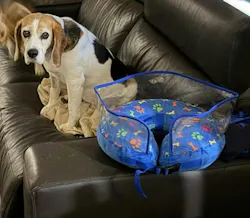
First attempt, we tried the inflatable collar. For an old dog, he was very flexible and could reach one of the wounds.
The score was Mac 1, Trish 0.
On the second attempt, we inflated the collar higher to try to block the movement. He quickly figured out how to force the collar off.
The score was Mac 2, Trish 0.
Third attempt, we tightened the collar that was holding the inflatable collar on as tight as we could go without choking him. He somehow still managed to get the collar off.
The score was Mac 3, Trish 0.
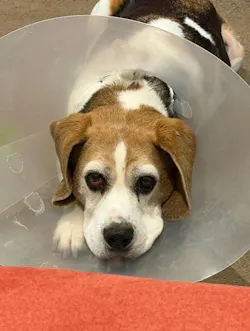
On the fourth attempt, we resorted to the cone of shame. It would mean he could not get through the dog door, but we would be happy to let him out if this solution worked. It was held on by his collar, which was still fitting very snugly. He still managed to force the cone off.The score was Mac 4, Trish 0.
A pattern was forming.
Fifth attempt, we changed tactics. We ordered a little suit for him to wear. The next day the suit arrived, and I tried to dress him. Mac does not like clothes. Getting him in the suit was like trying to make cooked spaghetti stand on end. But I got him in the suit, eventually. When we woke up the next morning, the suit was lying on the floor, and Mac was not in it. He managed to get the zipper undone and wriggle out of it. We even tried combining the inflatable collar and suit.
The score was Mac 5, Trish 0.

We consulted with the vet. She suggested a different type of cone: an inflatable collar combined with a clear cone. Next-day delivery, and we put him in the new inflatable cone. It was attached to his tight collar. Within 15 minutes, he had managed to remove the cone.
The score was Mac 6, Trish 0.
We had run out of ideas. Then we realized he was getting out of the suit because it was slipping down past his shoulders, and he was unzipping it. So, we tried the suit again. But this time we used some bulldog clips, or as we called them “beagle clips,” to hook the suit onto his collar. We finally had some success.
The score was Mac 6, Trish 1.
It took him two days to dislodge the beagle clips and get out of the suit again. But for those two days, we had won.
Now we had the solution. The beagle clips were our critical control. We needed to put an assurance program around them to ensure they functioned as intended. Each day we checked the beagle clips and adjusted them. His wounds started to finally heal.
When our assurance processes slipped and we didn’t check the beagle clips, he managed to wriggle out a little. Fortunately, we noticed before he fully took off his suit, and we could intervene.
The easiest path during these challenging weeks would have been to just give up and let him lick the wounds. But that had some long-term risks of infection and slow healing. We had to overcome the challenge; it was the right thing to do.
Doing what is right is often not easy. But it is imperative that we do what is right, because the short-term, easy path may lead to longer-term pain. Process safety decisions often fall into this category. It is easier to ignore the issue than to invest the time and money to fix it.
Think about how often this plays out on a site. A relief valve inspection gets deferred one more cycle because the shutdown window is tight. An alarm that keeps nuisance-tripping gets shelved rather than investigated. A temporary bypass stays in place for months because removing it means stopping production. A small leak gets a clamp instead of a proper repair. Each of these decisions makes sense in the moment. Each one saves time, money or hassle today. And each one quietly erodes the barriers standing between normal operations and a major incident.
Just like with Mac, finding the right control is only part of the job. The beagle clips worked, but only while we checked them every day. The moment we got complacent, he started wriggling free. Our critical controls are no different. A barrier that isn’t maintained, tested and verified is a barrier we are only hoping will work.
The hard path, whether it’s funding the repair, taking the shutdown or challenging the workaround everyone has accepted, rarely feels rewarding at the time. No one celebrates the incident that didn’t happen. But that is exactly the point. We do the hard work now so that we, our colleagues and our communities don’t pay a far higher price later.
So what decisions are you facing where the easy path may be simpler now, but harder in the long term? And what will it take for you to choose the right one?
About the Author
 Trish Kerin, Stay Safe columnist
Director, Lead Like Kerin
Trish Kerin is an award-winning international expert and keynote speaker in process safety. She is the director of Lead Like Kerin Pty Ltd, and uses her unique story-telling skills to advance process safety practices at chemical facilities. Trish leverages her years of engineering and varied leadership experience to help organizations improve their process safety outcomes.
She has represented industry to many government bodies and has sat on the board of the Australian National Offshore Petroleum Safety and Environmental Management Authority. She is a Chartered Engineer, registered Professional Process Safety Engineer, Fellow of IChemE and Engineers Australia. Trish also holds a diploma in OHS, a master of leadership and is a graduate of the Australian Institute of Company Directors. Her recent book "The Platypus Philosophy" helps operators identify weak signals.
Her expertise has been recognized with the John A Brodie Medal (2015), the Trevor Kletz Merit Award (2018), Women in Safety Network’s Inaugural Leader of the Year (2022) and has been named a Superstar of STEM for 2023-2024 by Science and Technology Australia.