Mobile Bulk-Handling Equipment: Plants on Wheels
Key Highlights
- Engineer, don't just procure: Stackers, reclaimers, ship loaders/unloaders aren't vehicles OEMs can be left to handle alone — purchasing and operations teams must actively review every major system and subsystem before production begins, specifying redundancies for critical components to meet demanding targets like 98%+ availability over 18-20 hour daily operation.
- Design for the full operating envelope: Bearings, protection/condition monitoring, power sizing (including restart under full load), and safety factors for wind, self-weight and shock loads all require rigorous upfront calculation, including defining maximum working wind speeds and every extreme boom position/configuration the machine must safely handle.
- Critical subsystems need built-in redundancy and reliability: From dual hydraulic pumps and 1+1 lubrication systems to interlocked traveling/clamping mechanisms and enclosed, ergonomic operator cabins, these machines demand the same rigor as fixed processing plants as illustrated by a real 1,600 t/h reclaimer/stacker weighing 1,500 tons and drawing 1.8 MW of power.
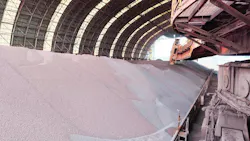
Stackers, reclaimers, ship loaders and ship unloaders are not vehicles. While they are mobile like cars or trucks, you can’t rely on OEMs to handle the engineering, design, fabrication and commissioning of the equipment.
This practice often leads to poor operation and reliability issues. Instead, the purchasing and operations teams should take an active role in reviewing all equipment details before the OEM begins production.
Without careful planning, process plants often deal with unscheduled shutdowns and repairs on mobile bulk-handling units. Ensuring proper operation can be a painstaking yet necessary process. For instance, it’s important to specify every major item and subsystem of the unit clearly to ensure optimal performance and to include redundancies of critical systems.
The reason is that mobile equipment is often expected to run continuously at its specified capacity with more than 98% availability based on 18-20 hours of daily operation. That’s a demanding target for such complex machinery.
Initial Design Considerations
The expectation of high availability means purchasing and operations teams must consider measures such as dual subsystems (one operating and another on standby) to ensure that a failure doesn’t cause a shutdown or damage to a major subsystem. Other key design considerations:
Bearings: Mobile equipment consists of many bearings, seals and rotating equipment. Rolling-element bearings, common in this type of equipment, are among the most reported reliability problems and causes of failure for such machines. It’s important to consider the bearing type, sizing and expected life to ensure long-term operation and bearing reliability.
Protection and condition monitoring: Optimum protection, alarm, trip and condition monitoring systems are essential. The protection/condition-monitoring systems should be sufficient to safeguard such a complex machine and provide data on its health, operating conditions and potential developing problems. This includes vibration, thermal, measurements, temperature and oil analysis.
Power and load requirements: Sizing and selection of all electric motors, hydraulic systems, drivers and power systems for all operating cases, including restart of a fully loaded machine, require particular attention. Each subsystem should be capable of being started and operated under all load conditions, boom angles and machine configurations. It’s important to consider all applicable start-up, shutdown and transient cases.
Safety considerations: The boom(s), frames, structures and traveling systems of moving equipment and mobile machines should have a sufficient safety factor for self-weight, operational loads, wind force and shock loads. They should be simple in structure and free from rainwater and material dust. Also factor in wind speeds for different operating scenarios. Mobile equipment can be destabilized and destroyed by high-speed winds. Calculate the machine’s maximum working wind speed and the recommended range during operation.
In some cases, operators may need to stop the equipment and any associated operations due to weather. For this reason, equipment planners may want to consider increasing the working wind speed. For instance, if you’re in an area where 56 mph wind speeds (25 m/s) are common, you might want to design the machines to work in these conditions. This means at a wind speed of 56 mph, all potential positions and modes of operation should be safely and reliably achievable. This requires calculations, studies, simulations and technical details to design the machine to handle the specified maximum wind speed.
Any mobile machine has its own set of limits. All extreme positions, maximum/minimum positions, such as boom angles, height and coverage, for each mode of operation should be clearly indicated.
Movement Mechanisms for Mobile Equipment
The luffing and slew systems are two common mechanisms for moving the booms vertically or horizontally. The luffing system moves the boom up or down, while the slew system enables horizontal turning. Many mobile continuous bulk material handling units have a moving boom. The boom moving speed should be variable and adjustable. A linear low-speed-to-full-speed adjustment mechanism is preferable.
Various accessories are available for reliable boom operation. For example, a manual operation stopper halts the boom at a specified position. An emergency brake and stopper should be equipped with an interlock with the luffing-system driver, usually a hydraulic system using two hydraulic cylinders and a hydraulic pack. The emergency brake might also serve as the parking brake, which employs a hydraulic or magnetic disk brake. Or, alternatively, a separate brake should be included for this purpose. The boom-movement system should include a limit switch or sensor to prevent collisions with surrounding facilities.
The slew mechanisms usually use variable-speed drive (VSD) electric motors with a gear unit that drives a large slew gear, similar to a pinion-curved-rack gear system. Another option is a hydraulic system with a slew gear.
Traveling Devices
Mobile or moving equipment requires a reliable and safe traveling system. Mobility options include crawling mechanisms, rail systems and wheel systems. Rail-mounted machines are typically more popular because they have a better engineering concept and are generally more reliable. Rail systems also are considered more stable, safer and cost-effective than other options. The traveling device should be capable of moving the mobile equipment operating under the rated load against the operating loads, wind loads or other adverse effects.
Plants can choose from several types of configurations for traveling systems. A common approach is to equip each of the four corners of the traveling legs with an electric motor driver and a speed-reducer gear unit to drive the wheels. Rocker beams are usually employed to equalize the wheel load. The rail wheels are usually double flanged and should be accurately machine-finished to identical diameters. Jack-up points are needed on the legs to simplify wheel maintenance. Speed-reducer gear units typically use bevel gears and are lubricated by an oil bath. However, other gear types and lubrication methods have also been used.
Another important consideration is the use of a sophisticated control system with a soft start and stop to prevent a shock from a sudden start-up or shutdown. Typically, a VSD can feed all electric motor drivers in the system. The traveling device should be interlocked with the rail clamp, anchoring device and other safety systems.
Suitable brake types include electromagnetic or electrohydraulic servo lifters (thruster). The traveling system also requires a clamping mechanism, often electro-hydraulically operated to maintain stability in the stop position.
They should automatically clamp when the mobile equipment stops and release when the equipment starts traveling. Proper operation may require various sensors or switches, such as a limit switch to ensure the clamps have opened or fully released before the electric motors are energized.
In terms of rail sizing, wide rails with a 16-20m or more rail span are common for larger-sized mobile equipment. These wide-span rails are necessary to improve stability and operation. The rail fastening should be provided with an elastic suspension. These should be vibration-proof and soundproof.
Hydraulic Units
Mobile machines typically have one or two central hydraulic systems. But some machines may employ three or even four hydraulic units for different functions.
These units should be highly efficient, simple, compact, lightweight, reliable and safe. Typically, it consists of hydraulic oil pumps, oil tanks, oil coolers, piping and valves. The oil pressure on hydraulic systems is high, and piston-type variable-discharge-rate hydraulic pumps are often employed for the main circuit. Hydraulic pumps, one operating and another on standby, should be installed in the machinery house of the mobile equipment. Install a valve block directly on the hydraulic actuator or cylinders to prevent a sudden fall of the boom or machine component if the hydraulic piping or tubing breaks.
Machinery House
The machinery house contains critical systems such as the hydraulic unit, electrical/control units and other key systems. The layout and structure of the machinery house should be conducive to inspection, lubrication, servicing and maintenance of the contained subsystems. Good lighting, protection, ventilation and access are important. They should be waterproof and dust-proof.
Machinery houses often operate at positive pressure via forced ventilation using stationary blowers or fans with filters. The entrance should come with a strong, tight and sealed door with locks and a door checker. Often, one or two electrically driven hoists are provided for service and maintenance purposes to handle the largest and heaviest parts. Proper fire extinguishers should also be provided as accessories.
Lubrication Systems
Mobile equipment also should come with automatic centralized lubrication systems for all bearings, hinge-pins and moving parts requiring lubrication. The lubrication system of the entire equipment is usually divided into areas, with each area consisting of lubrication points being supplied by an individual lubrication pump system. Each area system should consist of a lubricant reservoir, two lubrication pumps (ideally 1+1), distribution valves and all necessary interconnecting piping and tubing. Distribution valves should be located so indicators are clearly visible from easily accessible parts of the mobile machine. This allows operation and maintenance personnel to check that all units are operating and to detect malfunctioning units or blocked lines. Lubrication is particularly critical for gearboxes, which should be completely enclosed, and bearings, which should be sealed.
Operator’s Cabin
All control functions should be carried out in the operator's cabin. A stationary cabin is preferable, but other options such as an operator's cabin with a stabling system (usually a hydraulic system) also are available.
It should be held vertically regardless of the boom angle or operational position. The cabin should be totally enclosed and the operator has 360-degree visibility. Proper air-conditioning systems and suitable thermal insulation are necessary. Ergonomic practices should be fully implemented, as the cabin is intended to provide optimal comfort.
Final Thoughts
The scale of these considerations becomes clear in practice. In one real-world example, a 1,600 t/h mobile bucket reclaimer/stacker traveled on a 260m rail, weighed some 1,500 tons, stood more than 50m tall and drew an installed power of 1.8 MW across its various drivers and mechanisms. This serves as a reminder that these are not simply large vehicles, but complex, purpose-built processing plants that happen to move. Treating them as such — from initial specification through operation and maintenance — is what separates a reliable asset from a recurring source of downtime.
About the Author
 Amin Almasi
Amin Almasi
rotating equipment consultant
AMIN ALMASI is a mechanical consultant based in Sydney, Australia. He specializes in mechanical equipment and offers his insight on a variety of topics including pumps, condition monitoring, reliability, as well as powder and fluid handling and water treatment.