Bulk Solids and Powders: Flow, Storage and Conveyor Design in Chemical Plants
Key Highlights
- Accurate understanding of bulk density is essential to prevent errors that can lead to costly operational failures.
- Angles of repose and surcharge determine the flowability of bulk materials and influence conveyor and hopper design to ensure safe and efficient transport.
- Flow problems such as arching, ratholing, and funnel flow can be mitigated through proper equipment design, steep and smooth walls, and flow-assisting devices like vibrating hoppers.
- Estimating bulk material properties without thorough testing introduces uncertainties; real-world testing and sensitivity analysis are vital for reliable system performance.
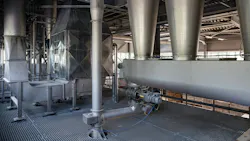
The unique behavior and flow of bulk materials when compared to liquids and gases presents handling, transportation and storage challenges.
Operators must understand the fundamentals of bulk-material behavior at the design stage to avoid problems, such as unscheduled downtime due to poorly operating material-handling equipment, such as hoppers, silos, bunkers and bins. Flowability of a bulk material depends on many factors, including particle density, size, shape, consistency, moisture content, surface texture and coefficient of friction.
Density is among the most consequential and commonly misapplied factors in bulk-material processing.
The bulk density measures the average density of a large volume of bulk material, solid or powder in a specific medium, which is almost always air. The bulk density is different from particle density or true density. There are specific densities associated with each piece of equipment or application. These densities are typically a fraction of the bulk material’s particle density.
For instance, for belt conveyors, there are several densities to consider. The settled bulk density is the state of the bulk material as it is normally carried on the belt. This density is used with the belt’s cross-sectional area of the load to determine the conveyor’s nominal carrying capacity. When bulk material is flowing, it takes up more volume and its density reduces further. Loose bulk density can be as little as half the settled bulk density.
Using particle density, inexperienced engineers can misestimate the operational parameters of material-handling equipment. For example, using the particle density for a belt conveyor, the estimations might be 30%-80% wrong. This error will have serious consequences and unnecessary costs. The bulk material flowing from one belt conveyor to the other takes up more room. This means a conveyor transfer point design calls for an appropriate loose density rather than a settled bulk density.
Angle of Repose and Angle of Surcharge
The angle of repose of a bulk material or solids is the acute angle that the surface of a normal, freely formed pile makes to the horizontal. The angle of surcharge of a bulk material, either solids or powders, is the angle to the horizontal, which the surface of the bulk material assumes while it’s at rest on a moving conveyor belt. This angle usually is 5°-15° less than the angle of repose, though in some bulk materials or solids it may be up to 20° less. The angle of surcharge is often known as the dynamic angle of repose.
The flowability of a bulk material, as measured by its angle of repose and angle of surcharge, determines the cross-section of the bulk material load that a belt conveyor can safely carry. It also is an index of the safe angle of incline or decline of the belt conveyor. Engineers can determine flowability based on material characteristics, such as the size and shape of fine particles and lumps, roughness or smoothness of the material particle surface, proportion of fines and lumps present, the material’s moisture content and other similar characteristics.
Bulk materials primarily fall into various categories identified in textbooks and other reference materials. Two of the more commonly used types include free-flowing and average-flowing bulk materials.
Free-flowing materials are typically rounded, dry-polished particles of medium weight, such as industrial solids or chemical product grains that would behave like whole grains or beans. These bulk materials have an angle of repose around 20°-25° and an angle of surcharge of about 10°-12°.
Average-flowing materials are typically irregular, granular or lumpy materials of medium weight, such as different types of coal and most ores. They typically behave like stones with an angle of repose of about 28°-38° and angle of surcharge of approximately 18°-24°.
Behavior of Materials on a Moving Belt
Normal characteristics of bulk materials are considerably influenced by the movement, slope and speed of the conveyor belt that carries them. As the conveyor belt passes successively over each carrying idler, the bulk material on it is correspondingly agitated. This agitation tends to work the larger pieces to the surface of the load and the smaller particles or fines to the bottom. It also tends to flatten the slope of the bulk material surface. It explains why the angle of surcharge is less than the angle of repose.
The loading and unloading of bulk material significantly impacts its behavior. Any difference between the forward velocity of the bulk material and the receiving conveyor belt velocity should be equalized by the acceleration of the bulk material by the belt. This acceleration causes turbulence in the bulk material. The goal is to reduce this difference in velocity when designing the system. The vertical velocity difference should be absorbed by the belt and the impact idlers used under the loading point. The turbulence effects are more profound when the conveyor belt is on an incline or decline, or when the conveyor belt is operating at high speeds.
The sizing, details and configuration of a belt conveyor depend largely on the bulk material characteristics, particularly the angle of surcharge. For instance, free-flowing bulk materials require a different conveyor belt configuration than average- and sluggish-flowing bulk materials. The angle of incline or decline of a belt conveyor for free-flowing bulk materials is relatively limited, sometimes less than 10°. For many average-flowing materials, the angle of incline or decline of the belt conveyor might be limited to somewhere around 12°-14°.
Speed, Angle and Overall Operation
When transporting bulk materials on incline belt conveyors, speed will be an important factor. If the bulk material is moving slowly, up a 4° incline, it will be much more stable than if it is quickly moving up to a 13° rise. Higher speeds create vibration and greater acceleration at certain points and bring the angle of surcharge into play. This affects the load capacity and overall operation. If the applicable angle of surcharge is less than the angle of the conveyor, special provisions are necessary, such as a cleated-belt or sandwich-belt conveyor.
Speed and incline angle are not the only factors — the nature of the bulk material itself plays an equally important role. If a bulk material is slick or polished, it will flow relatively easily, whereas rough objects, like rough solids, will stay put. Density directly affects the operation. Heavier pieces create greater surface friction with one another, leading to a more stable bulk material.
Challenges of Estimations
A key challenge is the accuracy of estimated bulk-material properties relative to behavior of the bulk material. In other words, actual testing on every bulk material service is neither possible nor feasible. Therefore, the properties of bulk materials for each service are estimated based on assumptions and simplifications derived from available bulk-material properties, such as those tabulated in textbooks and handbooks. This common practice may lead to some errors and mismatches. In fact, many bulk material handling systems have been designed for typical or average material properties, and some have failed to deliver their intended capacity and performance as a result.
Another challenge arises when bulk material properties shift over time. Raw materials may arrive from different sources with varying characteristics, and the properties of semi-finished or final products may also change. For this reason, a thorough sensitivity analysis with parametric studies is essential to account for all assumptions, simplifications and potential variations.
Unloading and Storage for Bulk Materials
Traveling-type and fixed-structure unloaders are two common types of equipment for receiving bulk materials, whether it’s via ship, train or truck.
The initial storage system after unloading must have sufficient capacity to handle any shipping delays or unexpected issues. The storage time might range from a few days to several weeks depending on the delivery timeframe. Common types of storage systems include hoppers, bunkers, open-yard storage areas, stockpiles and silos. For large capacities, open-yard storage is often a good option. Belt conveyors usually transport material to and from such a storage area. Enclosed storage piles are employed where bulk materials can be eroded, affected or damaged by environmental effects such as wind and rain.
Mass Flow, Angles, Ratholing and Arching
The behavior of bulk material can be complex. This is why theoretical predictions or generalized rules do not always apply. The most common bulk-flow problems are stoppages or restrictions in the form of funnel flow, arching (also called bridging) or ratholing. In funnel flow, an active flow channel forms above the equipment outlet with stagnant bulk material at the periphery. When the bulk material has sufficient cohesive strength, the stagnant portion doesn’t slide into the active flow channel, which results in the formation of a stable “rathole.” This can cause other problems, such as the degradation and oxidation of bulk materials.
Ideally, all bulk materials stored should move whenever there is a discharge from the outlet. This is known as mass flow. However, if only a portion of the bulk material moves, problems may arise. For the mass flow, the equipment walls should be steep and smooth enough, as per the characteristics of the bulk material. In addition, the outlet should be large enough to prevent cohesive arching and to achieve the desired steady-state discharge rate. The mass-flow regime prevents the formation of a rathole and facilitates a first-in-first-out flow sequence. It also eliminates stagnant bulk material, reduces sifting segregation and provides a steady discharge with a consistent bulk density and a uniform, well-controlled flow.
The cohesive strength of a bulk material determines its potential to form a stable arch or rathole. This is a function of consolidating pressure. Moisture content, temperature, storage time and are other characteristics that can impact stability.
In addition, wall friction between the bulk material and the wall surface of the equipment has a critical influence on bulk-material flow.
As a rule of thumb, the minimum wall angle in hoppers, bunkers, silos and other types of equipment is defined somewhere between 65° and 70° to safely handle many bulk materials and operational conditions.
By far, the most common problem with the bulk material equipment is plugging. The storage equipment should be sufficiently steep and smooth to permit sliding and clean-off of the most frictional material that they will handle.
The compressibility of a bulk material measures the change in its bulk density as a function of consolidating pressure. It is used to determine the capacity of storage equipment, such as silos and bunkers and to calculate bulk-material-induced loads.
Flow-Assisting Devices
Flow-assisting devices and feeders might be needed to overcome flow problems in silos, bins and similar types of equipment. One of the many types of flow-assisting devices available is the vibrating hopper. This specific device uses vibration to loosen bulk material and make it flow. Two common categories of vibrating hoppers are gyrating and whirlpool devices. The gyrating vibrating hopper applies vibration perpendicular to the flow channel. Whirlpool devices apply a twisting motion and a lifting motion to the bulk material, thereby disrupting any ratholes or bridges that might form. Although these devices are widely used, they’re not recommended as the first option. It’s preferable to first look for a robust design that allows for smooth operation and proper bulk material flow without the need for flow assistance. On the other hand, in many existing old-fashioned silos or hoppers, the configuration is so ineffective that the only way to use such existing equipment is with the installation of flow-assisting devices.
Final Notes
Particle size, temperature, age and oil or moisture content of the bulk materials affect their flowability and their behavior. This impacts the design, performance and operation of material-handling systems. Specific characteristics to consider when engineering bulk material handling systems include cohesive strength, wall friction, compressibility, angle of repose and angle of surcharge.
Also, testing specific bulk materials is very expensive and time consuming but necessary. Estimated data leads to uncertainties in the overall design, engineering and operation. This type of guesswork is no substitute for testing bulk materials under anticipated handling conditions.
To achieve the desirable mass-flow regime, the outlet should be sized large enough to prevent arching, and the walls of the equipment, such as silos, bins and hoppers, should be steep enough and have sufficiently low wall (material/surface boundary) friction.
The gap between estimated and actual material behavior is where most bulk-handling failures begin, which is why sound design and real-world testing are not interchangeable.
About the Author
 Amin Almasi
Amin Almasi
rotating equipment consultant
AMIN ALMASI is a mechanical consultant based in Sydney, Australia. He specializes in mechanical equipment and offers his insight on a variety of topics including pumps, condition monitoring, reliability, as well as powder and fluid handling and water treatment.