
Chemical Processing Notebook: AI Dominates CIEX 2026 Discussion
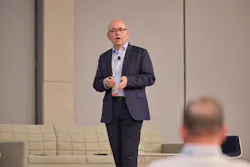
Article Updated Oct. 1 at 2:53 p.m. EST
When Jayshree Seth became a corporate scientist at 3M, her daughter said, “Mommy, you’re not getting promoted anymore.”
Seth had just reached the highest level a scientist could attain at the company. She mentioned the interaction with her daughter while presenting at the CIEX Chemical R&D and Innovation Summit in Indianapolis Sept. 9-10.
I wanted to interview Seth while attending the event because of her unique background and openness as a public speaker, a rare thing in this otherwise tight-lipped industry. Earlier this year, Seth was inducted into the National Academy of Engineering for innovations in commercial adhesive systems and STEM education advocacy. She is also a member of 3M Carlton society -- 3M's innovation hall of fame -- the fourth woman and first female engineer to be inducted.
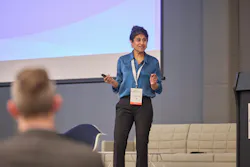
As she explained in her 2020 book, “The Heart of Science,” Seth was first exposed to engineering as a child in Roorkee, India, where her father served on the faculty of a nearby technical engineering institute. She later attended a college thousands of miles from home to pursue an engineering education, an unusual path for women in India.
My plan was to veer from the conference R&D-focused themes and instead discuss her personal journey and hot-button issues like environmental justice (she touches on systemic racism in “The Heart of Science”) and 3M’s transition away from per- and polyfluoroalkyl substances (PFAS).
Seth declined to discuss environmental justice, saying PFAS was outside her area of the company and she wasn't qualified to comment. But she did offer some insight into the implementation and use of AI within a major chemical R&D organization, like 3M. Company CEO William Brown has set a goal to introduce more than 1,000 new products by 2027, and generative AI will play a role in helping researchers develop those innovations, Seth said. Generative AI helps the company efficiently parse through volumes of patents and literature and to identify internal subject matter experts during the discovery process, she said.
3M uses various AI models, including an enterprise system developed in 2024, to accomplish these tasks internally.
While AI is helping researchers perform tasks more efficiently, Seth prefers to use the term “artificial diligence” over intelligence because the company still relies on people to interpret the data.
“It's a word generator. We all know that,” Seth told the CIEX attendees. “It is not intelligent. It's diligent, though. If you don't want to read 200 patents, it will. It'll even read a thousand, 10,000. But we need to call it like it is. It can compute consistently without any conscious contemplation.”
That’s an important distinction for scientists because AI can create an “illusion of wisdom.” AI-generated content must be verified with evidence and facts, she said.
“It requires us to be even more critical thinkers,” Seth told me. “And the scientist community is poised for that because by nature and virtue of what we do, we're critical thinkers, so this is really the era where critical thinking and questioning and checking and looking for facts and evidence and data becomes even more important. And we have to keep that in the forefront.”
CIEX Session Highlights
Several people attending CIEX remarked that the event was almost like “the AI conference” since that seemed to be the running theme throughout the show. About 130 people, mostly C-level executives and VPs working across technology, R&D and innovation, attended the event organized by the Merlien Institute. The conference took place at the headquarters and R&D center of the Heritage Group, which owns more than 50 companies across various industries, including highway construction and materials and chemicals refining.
However, several speakers also addressed operational and macroeconomic challenges facing their business.
AmSty and Hexion Focus on Customer Value
Venki Chandrashekar, CEO of polystyrene and styrene monomer producer AmSty, discussed the need for large commodity producers, like his company, to differentiate themselves through operational excellence. In the past, when growth was strong, the company would invest in new production plants. But with commodity markets slowing, the company needed to adopt a new strategy. Instead, AmSty, which stands for Americas Styrenics, is focusing on creating value through its existing assets, including a focus on reliability and equipment availability and developing customer-centric products.
“If your operations don’t work well and you’re fighting fires, there’s no way you’re going to focus on innovation,” he said. The company now emphasizes operating within boundary conditions, Chandrashekar said. “We have a lot of operational discipline books on how processes have to be executed and how manufacturing has to perform, and you can’t go outside that box,” he told Chemical Processing. AI is a key productivity differentiator, Chandrashekar said. This includes the use of simulations for scenario planning. The technology has helped streamline the decision-analysis process, he said.
Part of the company's focus on product differentiation involves sustainability. He cited an example of rail cars returning from customer facilities with a small amount of plastic pelletized material remaining in the bottom, or heels, of the cars. A member of the company’s logistics team proposed taking that waste and reprocessing it into new products. "An idea as simple as that … has generated hundreds of thousands of dollars," he said.
Meanwhile, Hexion is using AI to transform its entire business ecosystem, said company CEO Michael Lefenfeld. The company faced increasing economic challenges, including more regulations and worker turnover, with 20% of its exempt workforce expected to retire by 2032.
The 170-year-old producer of formaldehyde-based glues decided to link AI to customer data to formulate products based on their partners’ needs, Lefenfeld said. This includes the company’s largest market, the wood-panel industry, which faces several challenges, including variations in timber quality.
Lefenfeld explained that Hexion shifted to a “chemistry-as-a-service model,” starting with its wood-products customers. The goal was to make transformational changes in the structure of products. As Lefenfeld said, the company “took a grenade to every process” with the goal of designing Hexion for modern technology. The company wanted to look at how businesses operate from start to finish and bring that information from the customer back to the plants and then formulate that product for the customer in the best way possible.
He further explained that focusing on service over volume would reduce the company’s revenue because it’s making fewer products but would differentiate the company from commoditized competitors. The company used cross-functional steering committees to accomplish its goals because, as Lefenfeld said, “R&D can’t do it without operations.”
Hexion began looking at the tree at the customer’s site until it became furniture, installing sensors at every unit operation so it could get that info and then create models. To get that data, Hexion built AI systems on models linked through secure channels into a central data lake.
“We get that collaborative back and forth because they’re getting the value,” he said. Hexion’s customers likely have a higher trust level for sharing data with the company because of its well-established relationships with its partners over its 170-year-history, he added.
Lefenfeld highlighted several wins from the AI project, including a $30 million in annual savings for wood-products customers by reducing the amount of methylene diphenyl diisocyanate, or MDI, by 60% in the wood panels.
More Key Talking Points …
During a panel discussion, Brittany Enever, senior manager of digital transformation and product strategy at Deloitte, mentioned that one case study involving a company that’s using computer-aided vision to monitor how technicians perform certain tasks and is then capturing that manual work to generate standard operating procedures automatically. In the future, technicians will be able to measure against that SOP, using computer-aided vision to validate they’re performing the task correctly, she said.
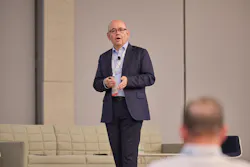
Responding to a question from the panel moderator about why the chemical sector lags behind on digitalization, David Hatrick, vice president of strategic marketing and innovation at Huntsman, said current market challenges mean being first to market matters more now than in the past. Hatrick admitted that five years ago, he was a skeptic himself, calling himself a “Luddite.” At the time, he couldn't see a use case that justified implementation across the whole organization. It took pressure from junior chemists on his team to convince him he was about to miss a major shift in the industry. Huntsman started small, running focused pilots before eventually committing to a full-scale digitalization platform, a process he summed up as needing “a little bit of show me the money.”
Dow R&D executive Jamie Cohen briefly discussed how the company incorporates AI into its lab safety processes.

“One of the first places Dow adopted some of the transformation into AI and into digital in our safety space,” she said. “Digital tools and AI tools can bring you a wealth of information in a very fast way when it comes to safety.” AI helps bring more efficiencies to safety procedures, sifting through MSDS information and regulatory information, said Cohen, vice president of R&D and industrial intermediates and infrastructure.
AI is playing an increasingly important role in enabling standard operating procedures, she said. “It gives people access to a fuller suite of information to assess hazards more fully, more quickly,” she told me during a session break, while still working within safety boundaries.
Is Humanity Doomed?
As the first day of the conference wrapped up, I tried catching up on some of the day’s news. Making the rounds was a comment by an Anthropic researcher who quit his job over safety concerns related to AI development. The former researcher, Jacob Coxon, posted on the social-media platform X that there’s a more than 10% chance AI could kill all humans within the next decade. Following his doomsday announcement, several AI executives called for an industry slowdown. When I returned from the conference, I emailed some of my networking contacts from the event to ask for their opinion on the AI flap and whether they had concerns about its use in chemical manufacturing.
The only industry executive who responded was Marc Block, vice president of Wanhua Chemical America’s performance chemicals business unit. Here’s what he had to say:
“Regarding AI, I am less concerned about the pace of development itself. Much of the chemical industry is still at an early stage of translating AI into practical business value, so our challenge is not excessive adoption and going too quick but turning the technology into practical business value. The industry should focus on identifying use cases, including product and formulation development, process optimization, commercial decision support, and more efficient access to technical knowledge. At the same time, companies need clear boundaries for where AI can and cannot be used, particularly in process safety, regulatory compliance and other high-consequence decisions.
“Cybersecurity, confidential-data exposure and intellectual-property leakage are more immediate concerns. It should also be transparent when analysis or content has been generated or materially influenced by AI. In safety-sensitive applications, AI should support qualified experts rather than replace their judgment and accountability.
With appropriate safeguards and clear accountability, I see greater risk in failing to adopt AI effectively than in the pace of development itself.”
About the Author
 Jonathan Katz
Jonathan Katz
Executive Editor
Jonathan Katz, executive editor, brings nearly two decades of experience as a B2B journalist to Chemical Processing magazine. He has expertise on a wide range of industrial topics. Jon previously served as the managing editor for IndustryWeek magazine and, most recently, as a freelance writer specializing in content marketing for the manufacturing sector.
His knowledge areas include industrial safety, environmental compliance/sustainability, lean manufacturing/continuous improvement, Industry 4.0/automation and many other topics of interest to the Chemical Processing audience.
When he’s not working, Jon enjoys fishing, hiking and music, including a small but growing vinyl collection.
Jon resides in the Cleveland, Ohio, area.