Makeup Water Treatment Series, Part 5: Condensate Return Can Undo Your Boiler Gains
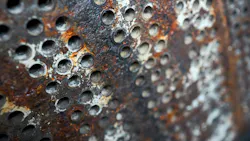
In Parts 3 and 4 of this series, we examined the evolution of makeup water treatment technologies that have improved conditions in steam generators; improvements that reduce blowdown, minimize corrosion or scale formation, and reduce carryover of impurities to steam. But these gains can be emphatically offset by impurity ingress to boilers from condensate return, of which multiple sources may exist at a facility. This installment illustrates important issues in this regard and discusses potential treatment methods for some troublesome impurities that may enter condensate.
Well-Known Bad Actors
Industrial plants typically have extensive networks of carbon-steel condensate return piping. Two atmospheric gases that solubilize or physically dissolve in water and can be corrosive to carbon steel are carbon dioxide and oxygen.
Carbonic Acid Corrosion
A common issue in condensate systems is carbonic acid corrosion. Carbon dioxide that enters systems through air in-leakage or comes from carryover of decomposed bicarbonate alkalinity with steam will dissolve to form carbonic acid.
CO2 + H2O ⇌ H2CO3 (1)
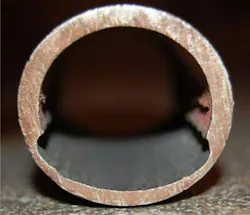
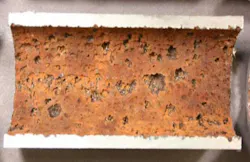
While H2CO3 is not a strong acid, it can cause considerable damage, as evidenced in Figure 1.
Not only is direct corrosion a result, but iron oxide particles generated by the attack will travel to steam generators and precipitate on boiler tubes. The precipitates increase the potential for under-deposit corrosion.
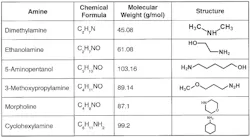
Alkalizing (formerly known as neutralizing) amine injection is a straightforward method for pH adjustment in industrial boiler feedwater and condensate systems. The amines are small-chain organic molecules with an ammonia group attached to or embedded within the compound. The most well-known are shown in Figure 2.
Injection of an alkalizing amine at strategic locations can neutralize acidity and bring pH within the range that minimizes carbon steel corrosion. The general reaction is:
R-NH2 + H2O ⇌ R-NH3+ + OH- (2)
“R” represents the organic backbone of the compound
These same compounds also serve for pH control in industrial boiler feedwater (as compared to power boilers where non-organic ammonia is preferred)2, with pH typically adjusted within a moderately alkaline range (9.1-9.3 for systems with copper alloys and 9.2-9.8 for all-ferrous feedwater systems)2 to provide protection from general corrosion.
Factors that influence amine properties and efficacy include volatility, basicity and, in high-pressure boilers with superheaters and reheaters, the tendency to decompose at high temperatures.3 Every application must be evaluated individually to select the correct program for protecting both the water and steam sides of the steam-generating network. In some cases, the amine concentration in steam may be limited to a low parts-per-million (ppm) level per concerns about the potential for contamination of food or consumer products. Consultation with a reputable water-treatment vendor is critical for selecting the correct treatment program.
Reference 4 provides a real-world example of some of these improvements, made at a major college campus (with two hospitals), which included installation of alkalizing amine feed systems for condensate return pH conditioning and replacement of makeup treatment sodium softeners with reverse osmosis (RO) units.
In some cases, ion-exchange polishing can provide the required protection for condensate return streams.
IX condensate polishing is an absolute requirement for some facilities such as supercritical power plants, while other applications may require specialty resins to remove unusual ions.
Dissolved Oxygen on the Attack
Oxygen attack in industrial water systems induces localized corrosion that can generate through-wall penetration of tubes, piping, and vessel walls.
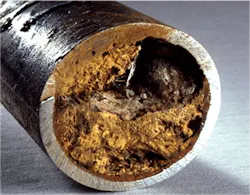
In water networks, the rust may deposit at corrosion sites to form tubercles that restrict flow and increase corrosion rates underneath the deposits.
Obviously, corrosion control is immensely important to maintain equipment and performance reliability. The root-cause method to prevent attack is to eliminate oxygen ingress to steam/condensate systems. But with the extensive piping and myriad equipment connections typical at large plants, complete elimination of air ingress is often a practical impossibility. Two primary options to protect carbon steel and copper alloys are:
- Mechanical and chemical methods to remove dissolved oxygen
- Chemical programs to treat metal surfaces and reduce the corrosion potential
For boiler feedwater networks, the mechanical control device is the deaerator.
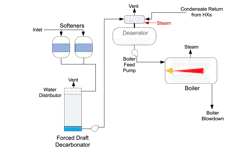
Makeup water and return condensate enter near the top of the deaerating compartment, and, via a series of headers/nozzles, the condensate is sprayed counter-currently onto steam injected from below. Frequently, the compartment will include trays to enhance steam-water contact. The deaerator and deaerator storage tank are typically placed far above the boiler feed pump to provide adequate suction head for the pump and minimize cavitation. A properly operating deaerator will bring the condensate temperature to within a few degrees of saturation, with a standard goal of 7 parts-per-billion (ppb) D.O. in the deaerator storage tank.
Supplemental oxygen scavenger/reducing agent feed is typical to reduce D.O. concentrations to near zero and to passivate metal surfaces. Some of the most common compounds include catalyzed sodium sulfite (Na2SO3), carbohydrazide [(NH2NH)2CO], diethylhydroxylamine [DEHA, (C2H5)2NOH] and erythorbate. Factors that influence the choice of reducing agent include boiler pressure, ease of application, and safety.
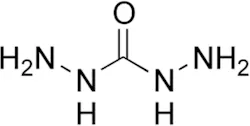
For example, sodium sulfite is an inexpensive, non-toxic compound, but it adds dissolved solids to boiler water, and, at pressures above 600 psi, begins to decompose into corrosive products that include sulfur dioxide (SO2) and hydrogen sulfide (H2S). It is also not a good passivating agent. Carbohydrazide is a volatile oxygen scavenger/reducing agent; developed as a replacement for hydrazine (N2H4), which was straightforward and effective to use but became a suspected carcinogen. Carbohydrazide is a safe-to-handle chemical that breaks down to hydrazine with rising temperature in the feedwater system.
At plants where steam could potentially contact food or consumer products, many of the common reducing agents are prohibited. A potential alternative is erythorbate, where erythorbic acid has an almost identical structure to ascorbic acid, Vitamin C.6
Another approach, which is enjoying a renaissance due to improved chemistry, is the use of film-forming products that directly protect metal surfaces.
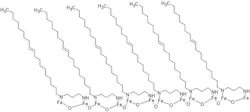
The figure illustrates how a modern film-forming amine (with two nitrogen atoms at one end of the molecular chain) bonds to carbon steel. The hydrophobic tail of each molecule extends outwards, protecting the metal. Other products, with non-amine active sites, are also available. Careful evaluation is necessary to select the most effective compound. Not all applications have resulted in success stories, which makes rigorous evaluation of system conditions imperative. An important issue is accurate monitoring of product concentrations in the condensate and feedwater. Analytical instrument manufacturers and water-treatment chemical suppliers diligently continue R&D efforts in this regard.
Another important concept to keep in mind is that many steam/condensate return systems have mixed metallurgies, with copper alloys being a common material for heat-exchanger tubes. Dissolved oxygen, especially in the presence of ammonia, can cause serious corrosion of copper alloys. Direct monitoring of iron and copper concentrations is of great practicality in allowing plant personnel to track the performance of, and make adjustments to, chemical treatment programs. For example, when I worked on a power plant project as part of a consulting team, we helped plant management install a corrosion product sampler on the condensate/feedwater line. The data clearly revealed substantial corrosion of carbon steel and, to a lesser extent copper alloys, in this network. Tighter control of feedwater chemistry was clearly necessary.
Influence of Process Impurities
A number of years ago, I visited an organic chemicals plant with a colleague. The plant had four 550 psi package boilers with superheaters. The steam provided energy to multiple plant heat exchangers, with recovery of most of the condensate. Each of the boiler superheaters failed, on average, every 1.5–2 years from internal deposition and subsequent overheating of the tubes. Our inspection of an extracted superheater tube bundle revealed deposits of approximately ⅛–¼ inches in depth.
Additional inspection revealed foam issuing from the saturated steam sample line of each boiler. The cause of the foam formation became quickly apparent, as water/steam chemistry analyses performed by the facility’s water treatment vendor included data showing total organic carbon (TOC) concentrations of up to 200 mg/L in the condensate return. Contrast that with the <0.5 mg/L feedwater TOC recommendation from the American Society of Mechanical Engineers.8
No treatment processes or condensate polishing systems were in place to remove these organics (five phenol derivatives) upstream of the boilers.
Based on the TOC data alone, it became quite understandable why foam was issuing from the saturated steam sample lines and why the superheaters rapidly accumulated deposits and then failed from overheating. Furthermore, the facility’s rudimentary water laboratory did not have the instrumentation for differentiating between the five compounds, making it more difficult to find the source of leaking equipment.
The frequent superheater replacements represented a reactive not preventive approach. Admittedly, proactive solutions would have been expensive, starting with a root-cause effort to find leaks and make repairs. Condensate dumping would have required retrofit of a much larger makeup water production system and an upgrade to the plant wastewater-treatment system. Activated carbon filtration, which is quite common for makeup water treatment may have been viable, per issues related to molecular characteristics of the impurities and reaction kinetics, but laboratory and pilot testing were warranted, in our opinion. Several raw materials serve as the starting source for activated carbon, including coal, coconut shells and others. One or more of these materials may have been effective as determined by test results. We were not involved in any test development because it became clear that management was looking for a “magic pixie dust” solution and did not want to spend the money, at least at that time, for thorough investigation.
Other Return-Condensate Impurities
While the condensate impurities in the above case history were all within the same chemical family, a much larger variety may exist at other facilities such as refineries and petrochemical plants. The figure below outlines, in schematic format, typical refinery unit operations.
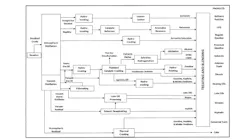
Steam provides energy to many of these processes and with the wide variety of raw, intermediate and final products, the possibilities for contaminant leakage into condensate return are substantial. Of course, thousands of other products are produced at chemical and manufacturing plants, offering the potential for many impurities to enter condensate and travel to the steam generators.
Conclusion
Condensate recovery from various plant processes can be very cost effective by retaining energy and resources required to make steam and to prepare purified makeup. But this value may be easily overridden by the influence of impurity ingress on steam generating systems. Contaminants can cause scaling and corrosion in boilers, and, as we have seen, carryover issues in steam systems. Proactive investment in condensate polishing systems and instrumentation to monitor condensate purity, can pay for itself many times over. As a long ago Fram oil commercial used to say, “You can pay me now or pay me later.”
Disclaimer
This article offers general information and should not serve as a design specification. Every project has unique aspects that must be individually evaluated by experts from reputable water treatment equipment firms.
References
- Buecker, B., and Shulder, S., “Combined Cycle and Cogeneration Water/Steam Chemistry Control”; pre-conference seminar to the 40th Annual Electric Utility Chemistry Workshop, June 7, 2022, Champaign, Illinois.
- International Association for the Properties of Water and Steam, Technical Guidance Document: Volatile treatments for the steam water circuits of fossil and combined cycle/HRSG power plants (2015). The IAPWS Technical Guidance Documents can be freely downloaded from their website, www.IAPWS.org.
- Shulder, S., and Buecker, B., “Remember the 3Ds of Alkalizing Amines: Dissociation, Distribution, and Decomposition”; PPCHEM Journal, 2023/01.
- Buecker, B., Mohammed, N., and Murphy, F., “Steam Chemistry Advancements at UIC”; Industrial WaterWorld (now Water Technology), July/August 2019.
- Post, R., Buecker, B., and Shulder, S., “Power Plant Cooling Water Fundamentals”; pre-conference seminar to the 37th Annual Electric Utility Chemistry Workshop, June 6, 2017, Champaign, Illinois.
- Flynn, D.J., The Nalco Water Handbook, Third Edition; McGraw Hill, New York, NY, 2009.
- Stuart, D., “Offline Protection with Film Forming Substances”; presented at the 2026 Electric Utility & Cogeneration Chemistry Workshop now co-located with POWERGEN. Author Stuart will be giving an updated presentation at EUCCW/POWERGEN 2027, January 18-21, 2027, Salt Lake City, Utah.
- “Consensus on Operating Practices for the Control of Feedwater and Boiler Water Chemistry in Industrial and Institutional Boilers”; American Society of Mechanical Engineers, New York, NY, 2021.
- “Detailed Study of the Petroleum Refining Category – 2019 Report”; EPA 821-R-19-008, U.S. Environmental Protection Agency, Washington, D.C., September 2019.
About the Author
 Brad Buecker, SAMCO Technologies
Brad Buecker, SAMCO Technologies
Brad Buecker currently serves as Senior Technical Consultant with SAMCO Technologies. Buecker has many years of experience in or supporting the power industry, much of it in steam generation chemistry, water treatment, air quality control, and results engineering positions with City Water, Light & Power (Springfield, Illinois) and Kansas City Power & Light Company's (now Evergy) La Cygne, Kansas, station. Additionally, his background includes eleven years with two engineering firms, Burns & McDonnell and Kiewit, and he spent two years as acting water/wastewater supervisor at a chemical plant. Buecker has a B.S. in chemistry from Iowa State University with additional course work in fluid mechanics, energy and materials balances, and advanced inorganic chemistry. He has authored or co-authored over 300 articles for various technical trade magazines, and he has written three books on power plant chemistry and air pollution control. He is a member of the ACS, AIChE, AMPP, ASME, AWT, and he is active with Power-Gen International, the Electric Utility & Cogeneration Chemistry Workshop (now co-located with the POWERGEN conference), and the International Water Conference. He can be reached at [email protected].