Data Centers Are Coming for Your Power and Water — Here's What a Century of Chemical Plant Experience Says
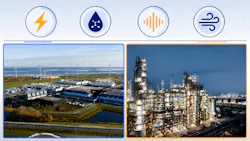
A data center does not spring up in a vacuum. It draws power, water and community attention in the same neighborhoods that have hosted heavy industry for generations, and the chemical industry is one of the oldest and most instructive points of comparison. Chemical plants have spent over a century learning, sometimes the hard way, how to manage power demand, water chemistry, noise and air emissions while operating next door to homes and schools. This article compares data centers and chemical plants across four areas, in order: power demand and usage, water usage and chemistry problems, noise problems and air pollution problems.
There is a real difference between the two industries that is worth keeping in mind throughout. A chemical plant converts raw materials into a physical product, and much of the energy and water it uses ends up embodied in that product or is recovered as process steam. A data center converts electricity into computation, and essentially all of that electricity ends up as waste heat that must be rejected to the environment. That single difference explains much of why the two industries look similar on paper yet differ in the details.
Power Demand and Usage
Data Centers
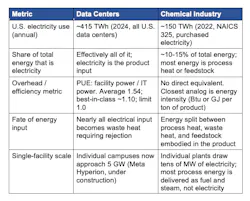
AI's growth is driving massive demand for chips and the power to run data centers. Data centers used 415 TWh in 2024 — 1.5% of global electricity — with the International Energy Agency (IEA) projecting 945 TWh by 2030 and 1,200 by 2035. Forecasters expect further growth, and the chemical industry may soon compete for scarce power.
Individual projects illustrate the scale. Meta is developing a data center campus in Richland Parish, Louisiana, with up to 5 GW of capacity. Microsoft is restarting Three Mile Island Unit 1, having signed a 20-year power purchase agreement with Constellation Energy in September 2024 to buy the plant's entire 835 MW output once it returns to service, expected around 2028.
The energy consumption of a data center is measured with a metric called Power Usage Effectiveness (PUE): the ratio of total facility power demand to the energy used by the computing equipment itself. The Uptime Institute reports an average PUE of about 1.54. Some hyperscale data centers have achieved a PUE of 1.10 or less. The theoretical limit is 1.0. For example, a 200 MW data center (IT load) with a PUE of 1.54 has a total facility power demand of about 308 MW, with the extra 108 MW spent on cooling, pumping, air conditioning, controls and lighting.
Chemical Industry
The U.S. chemical sector (NAICS 325) consumed about 3.98 quadrillion Btu of fuel in 2022, according to the U.S. Energy Information Administration's Manufacturing Energy Consumption Survey (MECS). Of that total, about 512 trillion Btu, or roughly 13 percent, was purchased electricity, which converts to about 150 TWh a year. The American Chemistry Council notes that the chemical industry is the second-largest manufacturing user of energy in the country, and that fuel and power consumed per unit of output today is about half of what it was in 1974, reflecting decades of efficiency investment.
The chemical industry's energy diet looks very different from that of a data center. Most of a chemical plant's energy goes into process heat (cracking, distillation, drying) and into feedstocks such as natural gas liquids that become part of the finished product rather than being rejected as waste heat. Electricity is a comparatively small slice, roughly 10 to 15 percent of total energy use industry-wide, because so much of the work is thermal rather than electrical.
There is no direct chemical-industry equivalent to PUE, because a chemical plant has nothing analogous to an “IT load” that represents the useful output. The closest parallel is energy intensity, expressed as energy consumed per ton (or tonne) of product, such as gigajoules per tonne of ethylene. Chemical producers track and continuously reduce this figure the same way data center operators track PUE, but the two metrics measure different things: PUE measures overhead relative to compute, while energy intensity measures total energy relative to physical output, feedstock included.
A single number puts the two industries in perspective. Meta's planned Hyperion campus, at up to 5 GW, would consume about 43.8 TWh a year if it ran continuously at full capacity. That is nearly 30 percent of the entire U.S. chemical manufacturing sector's annual electricity purchases of about 150 TWh, drawn from one campus rather than the thousands of plants that make up the chemical industry nationwide. In practice, no facility runs at 100 percent capacity factor around the clock, so the real figure would be lower, but the comparison shows how quickly a handful of hyperscale campuses can approach the electrical footprint of an entire heavy industry.
Water Usage and Chemistry Problems
Data Centers
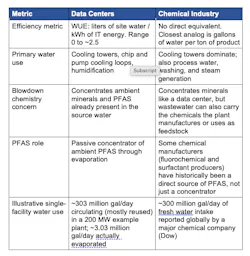
Many data center operators plan to use groundwater or surface water to support cooling. Water Use Effectiveness (WUE) is measured as the annual site water usage (liters) divided by the annual IT equipment energy usage (kWh). Chips must be kept below a manufacturer-recommended maximum temperature, often cited as under 85°F, and water has a heat capacity roughly 3,200 times greater than air for a given volume (4.18 J/cm³ for water versus 0.0013 J/cm³ for air), which is why evaporative cooling is so effective and so widely used.
The EPA has published WaterSense at Work, a guide to best management practices for commercial and institutional facilities to put a metric on their water use. Unfortunately, no such guide exists for the chemical processing industry (CPI), partly because of the extreme diversity of its many different products. However, Dow Chemical’s Water and Nature Strategy is focusing on cutting freshwater intensity, scaling industrial water reuse and implementing site-specific stewardship plans to address regional water stress issues. According to Dow, the program has achieved some significant water reductions from their operations.
Pure water is a good insulator, but dissolved ions can turn it into a conductor, risking short circuits, so glycols or other nonconductive fluids are typically used to cool the chips directly, with heat ultimately rejected to a water-based cooling tower. Evaporative cooling systems achieve lower energy use but higher water consumption, while air cooling eliminates water use but increases energy demand. Water Use Effectiveness (WUE) ratings range from 0 (air-cooled) to about 2.5, though the metric overlooks water embedded in power generation and does not distinguish potable from reclaimed sources.
Groundwater contains dissolved minerals that concentrate as cooling tower water evaporates, forming scale that reduces heat-transfer efficiency. Cooling towers typically recirculate water four to six times before the concentrated “blowdown” is sent to a wastewater plant, and even the minerals in a slightly “hard” water can be concentrated to a point where they shorten the operational life of heat exchangers, requiring them to be cleaned or retubed. For a theoretical 200 MW data center with a PUE of 1.54, cooling tower water flow runs about 210,300 gallons per minute, with evaporation losses of roughly 3.03 million gallons per day and blowdown around 701 gallons per minute.
There is also growing concern about PFAS (per- and polyfluoroalkyl substances) in cooling water. PFAS does not evaporate; it concentrates in cooling tower water as a conservative pollutant, and an evaporative system can multiply groundwater PFAS concentrations by a factor of four to six in the blowdown. In some states, the elevated PFAS concentration can render tower blowdown a potentially hazardous waste.
Chemical Industry
Cooling is also the single largest water use in the chemical industry. Recent USGS and EPA figures put total U.S. industrial self-supplied water withdrawal, across chemicals and all other manufacturing sectors combined, at roughly 14,800 to 18,200 million gallons per day, with EPA noting that cooling operations account for more than half of combined industrial and commercial water demand. At the company level, Dow has reported using about 300 million gallons of fresh water per day globally across its sites, a figure that happens to fall in the same order of magnitude as the roughly 303 million gallons per day of water circulating through the cooling loop of the theoretical 200 MW data center described above, even though one number describes fresh intake and the other describes a mostly recirculated internal loop.
Chemical producers have no direct counterpart to WUE, since the metric is defined around IT equipment energy, but they track an analogous water intensity figure, gallons of water per ton of product, and have driven it down over time much as data centers aim to drive down WUE. The chemical industry's cooling towers face the same scaling and blowdown chemistry as a data center's: hardness minerals concentrate with each cycle, and the concentrated blowdown must be treated or discharged under a permit.
Where the two industries diverge sharply is in the chemistry of the water leaving the site. A data center's cooling tower blowdown mainly concentrates whatever was already in the groundwater it drew from, including any ambient PFAS. A chemical plant's wastewater can contain the actual substances the plant manufactures or uses as feedstocks and solvents: organics, in some sectors heavy metals, elevated BOD/COD and process-specific compounds, discharged under the EPA's Organic Chemicals, Plastics, and Synthetic Fibers effluent guidelines (40 CFR Part 414) or a comparable category. Notably, some fluorochemical and surfactant manufacturers are not merely concentrating ambient PFAS the way a data center's cooling tower does; they have historically been a direct source of PFAS entering the environment, which is why PFAS discharge limits and monitoring requirements for chemical manufacturers tend to be more extensive than for a facility that is only using water for cooling.
Noise Problems
Data Centers
There are two types of vibration to consider at a data center. Mechanical equipment — chillers, pumps and generator sets — creates ground vibration in its base, which does not travel far and can be minimized with vibration-isolation mounts. The second type is airborne sound from transformers, fans, compressors and similar equipment, which accounts for most neighborhood noise complaints.
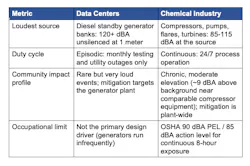
An unsilenced standby generator can produce 120 dBA or more. In a large N+1 configuration of 161 generator sets used for backup power and sized for a 200 MW example data center, estimated sound levels run about 123 dBA at 1 meter, and reaching a 45 dBA nighttime residential limit could require roughly 8 kilometers (about 5 miles) of unmitigated distance. With comprehensive vibration and sound treatment — acoustic louvers, inertia bases, variable-speed fans and earthen berms — airborne noise can potentially be reduced to 45 to 50 dBA for residential neighbors at under 1,000 feet. The key point is that data center noise is largely episodic: the loudest sources, the diesel generator banks, run only during monthly testing and actual utility outages, not continuously. However, there is still the noise from fans, compressors and pumps needed to operate the data center. These can be significant contributors to the overall noise level from the data center.
Chemical Industry
Chemical manufacturing plants run their noisiest equipment continuously rather than episodically. Published measurements of process equipment in chemical manufacturing — compressors, pumps, control valves, flare stacks, induced-draft fans and turbine generators — show noise levels ranging from 85 to 115 dBA at the source, exceeding the 85 dBA occupational noise limit used in the United States, the United Kingdom and South Africa. OSHA sets a permissible exposure limit of 90 dBA for an 8-hour workday and an 85 dBA action level that triggers a hearing conservation program, both measured at the worker's ear rather than at the property line.
Community-facing measurements tell a somewhat different story than the worker-exposure numbers. A peer-reviewed study of homes near natural gas compressor stations, a source with noise characteristics similar to chemical plant compression equipment, found outdoor noise levels at homes within 300 meters averaged about 60.3 dBA, roughly 9 dBA higher than control homes farther away. That is a meaningful, chronic elevation, but it is far below the 120-plus dBA an unsilenced data center generator bank can produce at close range.
Air Pollution Problems
Data Centers
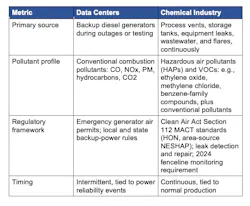
A diesel generator bank startup constitutes an emergency condition for a data center. A single diesel generator produces particulate and vapor emissions in addition to carbon dioxide, including CO, NOx and hydrocarbons. Because these pollutants are released close to ground level, and because data centers are often relatively close to neighboring communities, a power failure that triggers generator startup could create a hazardous air emission condition for adjacent neighborhoods, particularly if it happens repeatedly or during an extended outage. According to the U.S. EPA's AP-42 emission factors, diesel combustion produces about 22,300 lb of CO2 per 1,000 gallons burned, along with roughly 20 to 24 lb of NOx and 3.3 lb of particulate matter per 1,000 gallons. Data center air pollution is therefore concentrated into rare, intense episodes tied directly to power outages.
Chemical Industry
Chemical plant air emissions are, by contrast, a routine and continuous feature of operation rather than an emergency backup condition. The EPA regulates hazardous air pollutants (HAPs) from chemical manufacturing under the Clean Air Act's Hazardous Organic NESHAP (HON), which sets maximum achievable control technology (MACT) standards for process vents, storage vessels, transfer racks, wastewater, equipment leaks and heat exchange systems at plants that are major sources of HAPs. Emissions of concern from these facilities include toluene, ethylene oxide, methanol, xylene, hydrogen chloride and methylene chloride, chosen because of documented effects ranging from lung and eye irritation to central nervous system effects and, for some compounds, cancer risk.
Historically, fugitive emissions — leaks from pump seals, valve packing, compressor seals and flange gaskets rather than a stack or vent — have made up a substantial share of a chemical plant's total air toxics releases; one widely cited Toxics Release Inventory analysis found that nearly one-third of reported air toxics releases from all reporting facilities were fugitive rather than stack emissions. EPA's 2024 update to the HON rule added new fenceline monitoring requirements specifically to give regulators and communities a more accurate, real-time picture of what is actually leaving a chemical plant's boundary, rather than relying solely on calculated estimates. Chemical plants also operate flares, which are used both for routine combustion control and for emergency pressure relief, and EPA has separately tightened flare operating and monitoring requirements after finding that flares were not always achieving their required destruction efficiency.
What Should You Do?
Here's what to watch for when a hyperscale data center is considering your community as a site.
First, hyperscalers need land with access to power and water. One hyperscaler bought a golf course as a proposed site. Easy access to the existing electrical grid is a prime consideration, and the facilities generally require large amounts of water, which can be hard to secure.
Power demand can significantly affect plans for use and expansion. Megawatt- and gigawatt-scale data centers can consume the entire output of a generating station, leaving CPI customers powerless, and can drive steep increases in power bills. If your community is in an air quality attainment area, rising energy demand in neighboring communities can degrade your community's air quality, triggering additional air pollution offset requirements.
Data centers use large amounts of water for cooling because it's cheaper than installing large, complex air-cooled units. That water use shows up as evaporation — contributing fine particulates to the air from big cooling towers — or as thermal discharge to a local treatment plant or river. This matters most where strict water quality standards apply: Even a few degrees of temperature rise can alter a stream's oxygen balance and force upgrades to wastewater discharge requirements.
If a planned data center proposes using groundwater for cooling, expect geothermal and geotechnical challenges to local aquifers. Even small data centers can use millions of gallons a day, depleting or altering the aquifer your community relies on.
Data centers also need backup power on top of their heavy grid demand, typically fueled by natural gas or diesel. A single megawatt-hour of energy can require up to 3.412 thousand cubic feet of natural gas or 24.84 gallons of diesel fuel. When a data center's output reaches multiple hundreds of megawatt-hours, that demand can strain the existing gas grid and diesel fuel supply system, raising concerns about air emissions, storage requirements and fuel delivery during an extended outage.
Finally, data centers generate significant noise, both from normal operations and from standby systems. One analysis of a hyperscale data center recommended a buffer zone of 0.25 to 1 mile, even with the best sound-control practices available — particularly when the site relies on diesel backup generators.
Data center operators have much to learn from the CPI about environmental impact and community relations. If a data center moves into your neighborhood, you may need to distinguish yourself from it in the eyes of the surrounding community, or risk being blamed for the noise pollution — including persistent low-frequency noise — it generates. The CPI has learned its lessons about being a good neighbor. Hyperscale data centers still have many lessons ahead of them.
It may be prudent for the CPI to strengthen relationships with regulators (air quality, water quality, wastewater treatment), the real estate community and local utilities. That way, when data centers scout new sites, the CPI can help ensure they comply with community standards and become good neighbors.
About the Author
 David L. Russell
David L. Russell
David is president of Global Environmental Operations, Inc. He is an experienced environmental/chemical engineer and has written on various subjects, including remediation, water and wastewater treatment, sampling and sustainability. He lectures and works in various parts of the world.