Climbing the Operations Training Pyramid with Bloom's Taxonomy
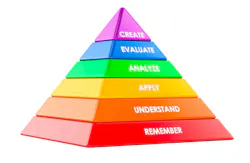

If Bloom's Taxonomy is good enough for Yale and Harvard, why not apply it to operator training? A tech company specializing in augmented reality solutions has developed a training program based on this cognitive hierarchy.
The company, Index AR Solutions, was among the exhibitors and presenters at the 2026 eChem Expo in Kingsport, Tennessee, April 8-9. The session, entitled From Classroom to Jobsite: Bloom’s Taxonomy for Industrial Workforces, focused on the six steps of the training process, which begins with remembering the information that the student or trainee learned.
Most organizations stop teaching midway through the learning pyramid at the “apply” stage of Bloom’s Taxonomy. These companies are missing opportunities to further develop employee skills, said Sam Elkins, senior manager of app production at Index AR Solutions.
"If we have the opportunity to take it to that next level of analyze, evaluate and create, we want to do that because we feel like that is going to create a more well-rounded training experience," Elkins said.
For about 60% of organizations, worker education ends after employees learn to apply the information in new work situations, according to Index AR research. That may seem like the goal for many companies, but Bloom’s Taxonomy calls for a more comprehensive learning experience.
Moving Beyond the ‘Apply’ Stage
A team of educational psychologists led by Benjamin Bloom developed Bloom’s Taxonomy in 1956. It was revised in the early 2000s into the version used today. The process has been adopted by Harvard University’s Derek Bok Center Teaching and Learning for developing learning objectives and Yale University’s Poorvu Center for Teaching and Learning to guide curriculum design.
The six steps from beginning to end include remember, understand, apply, analyze, evaluate and create. The last three steps of analyze, evaluate and create are essential for building a workforce that can support larger projects. When workers master these last three levels, they can deliver more value to the company.
For instance, at the analyze stage, workers learn to draw connections among ideas, including the ability to differentiate, organize, question and test their understanding of the subject. Elkins demonstrated this in a training model of a gas furnace. In this troubleshooting scenario, trainees are asked to select components that are intentionally missing from the furnace.
“The user is instructed to track down and locate and get a sense of what is missing here, and I can use the knowledge that I have to identify what is missing and what is needed,” Elkins explained.
At the evaluating stage, workers can judge the effectiveness of processes or methods and prioritize actions based on risk, safety or efficiency. They also can defend their decisions using evidence and criteria.
“I think a good example of this is someone who has been in the field for many years can use the scenarios that they have gone through themselves and now make effective decisions and additionally meeting scenarios that come up,” Elkins said.
When someone reaches the “create” level, they can design solutions for new or open-ended problems. At this stage, they can also develop original plans, configurations or workflows and adapt knowledge to unfamiliar scenarios. Workers at this level demonstrate the ability to work more independently.
Walk Before You Run
In some cases, managers may need to work back down the pyramid to provide additional training on a certain level. One session attendee, who said he was from Eastman Chemical, told Elkins he has done that in the past during training on 3D models.
“I've actually taken some of the trainings that I do down the pyramid because I was trying to push people too far in one instance,” he said. “And if they don't use it— if you teach someone how to analyze a situation and they don't use it for six months — they're not going to know how to apply it.”
Elkins agreed that in some instances, managers may need to revisit certain areas of training before advancing up the Bloom’s Taxonomy pyramid. He shared an example of elementary school teachers who “test the waters” with a student’s knowledge and then work backward to help them relearn a concept that’s slowing their progress. But he stressed the opportunity that lies ahead if organizations can achieve higher levels of proficiency.
"If we have the opportunity to take it to that next level of analyze, evaluate and create, we want to do that because we feel like that is going to create a more well-rounded training experience," Elkins said.
About the Author
 Jonathan Katz
Jonathan Katz
Executive Editor
Jonathan Katz, executive editor, brings nearly two decades of experience as a B2B journalist to Chemical Processing magazine. He has expertise on a wide range of industrial topics. Jon previously served as the managing editor for IndustryWeek magazine and, most recently, as a freelance writer specializing in content marketing for the manufacturing sector.
His knowledge areas include industrial safety, environmental compliance/sustainability, lean manufacturing/continuous improvement, Industry 4.0/automation and many other topics of interest to the Chemical Processing audience.
When he’s not working, Jon enjoys fishing, hiking and music, including a small but growing vinyl collection.
Jon resides in the Cleveland, Ohio, area.