Are Your Storage Tanks Optimized for Overpressure and Vacuum Conditions?
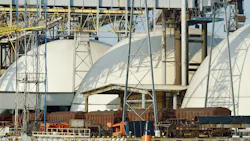

Now in its seventh edition since first drafted in 1952, the American Petroleum Institute’s API Standard 2000 - Venting Atmospheric and Low-pressure Storage Tanks was created to help guide the design and operation of storage tanks that often encounter widely varying weather conditions.
At this month’s eChemExpo, held April 8-9 in Kingsport, Tenessee, Michael Davies, CEO of Protego, a solutions provider and services firm that conducts research and development, application-specific engineering, overall protection system design and safety awareness training for the oil and gas, chemical, pharmaceutical and bio-energy industries, discussed the ins and outs of using API 2000 to guide the optimal design of storage tanks that perform to spec without being over-engineered — read: more expensive — than they need to be.
“Overpressure in an outdoor storage tank may occur due to increases in ambient temperature or solar radiation, while vacuum conditions can result from decreases in ambient temperature or intense rainfall events,” Davies explained. Further amplifying these effects are volatile compounds that condense and vaporize, thereby magnifying the pressure changes induced by temperature variations.
The effects of extreme weather on tank headspace volume and local phase equilibrium are frequently neglected in risk analyses, Davies added. “This oversight can lead to inadequate venting system design and, in severe cases, tank implosion.” In parallel, efforts to reduce emissions in support of climate change mitigation have driven the increased use of vapor recovery systems and common vent headers in tank farms.
Phase Changes and Valve Chatter
In particular, the behavior of stored methanol is under examination, as its use as a relatively low-carbon fuel is on the rise. “For example, one well-known cruise line is converting its ships from diesel to methanol in order to reduce their carbon footprint,” Davies said. “But this creates an explosive atmosphere that's there all the time. So, we need to protect these vessels differently.”
Another issue that can arise with venting systems is the types of valves when used together. For instance, Davies showed a video of a spring-loaded valve and a jet valve or flame arrestor. When used in sequence, these valves interacted, slipping into a chattering mode rather than staying open. “So that is not a safe system anymore,” Davies said. “But by using a different type of valve that doesn’t dynamically interact with the jet valve, it pops open, and it relieves. So, there are solutions out there, you just have to understand the impact of built-up back pressure and dynamics to have a safe design.”
Davies next cited a series of three actual storage tanks in Germany that had volumes of 32, 60 and 100 cubic meters and for which API 2000 was used to size each tank’s inbreathing capacity. Despite explicit recommendations in API 2000 to not use the standard’s simplified equations when condensation is involved, the largest of the three imploded upon severe cooling conditions, while the smaller two were spared. “If you're at a very low liquid level and have severe weather conditions with strong cooling, then you're going to run into potential issues,” Davies said.
Similarly, Davies cited recent research that appears to explain several ethanol tanks in Brazil that apparently had the opposite problem. “The tank is heating up in the sun, so the vapor will expand. Further, resultant convection will increase the rate of heat transfer,” Davies explained. “On the other hand, if we have this hot tank sitting there and we get a heavy rainstorm, we've got film cooling from the rain, which has an even greater cooling and vacuum inbreathing effect than we had outbreathing due to the sun’s heat.”
Editor’s Note: While we’ve addressed many of the factors that come into play when it comes to designing optimal storage-tank venting systems in this article, a full understanding involves data correlations and differential equations—both of which Davies covered in his complete presentation, at the other end of this link (no registration required): API 2000 Venting Design Limits Under Extreme Weather and Vapor Recovery Integration
About the Author
 Keith Larson
Keith Larson
Keith Larson has more than three decades of experience covering industrial automation and other aspects of operational technology and its convergence with the IT space. He currently serves as content director for Endeavor Business Media’s brands in the industrial automation, engineering design and process industry sectors. He holds a BS degree in chemical engineering from the University of Illinois at Urbana-Champaign and worked as a research engineer for Amoco Chemicals (now BP) before joining the ranks of the business media in 1989 as senior editor for the then-fledgling process control and instrumentation start-up Control. He holds several U.S. and international patents for his research work in industry, and among other journalistic achievements, has been honored with a Jesse H. Neal award for editorial excellence from the American Business Press, now part of the Specialized Information Industries Association.