eChem Expo Dispatch: Tailwaters, Fly Fishing and Eastman Kingsport

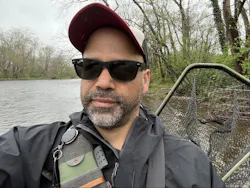
My road trip to Tennessee began with a visit to the banks of the Watauga River in Elizabethton. I rented a cabin for a few days of fly fishing before the eChem Conference and Expo, about 40 miles away in Kingsport.
I had hoped for a few prized brown trout, but the only fish this Ohioan hooked wiggled off before they reached the landing net. Fly fishing in the Appalachians requires a level of technical skill lacking in many Great Lakes fly fishers like me. The biodiversity of these cold tailwaters requires knowledge of insect lifecycles and hatches to trick a hungry trout into biting. My guide for the day, CP editorial board member and Kingsport resident Ellen Turner, fared much better.
And it’s even more daunting on the rocky Watauga, which was too swift to wade after a scheduled dam release (not to mention the slimy, invasive “rock snot” on the boulders, making the wading conditions even more treacherous). The river has two dams built by the Tennessee Valley Authority, or TVA. President Franklin D. Roosevelt signed the TVA Act in 1933 as part of his New Deal program. The goal was to bring hydroelectric power and reduce flooding in rural Tennessee.
The signs of a region trying to balance nature’s splendor with industrialization is pervasive. That sense carried through to a perimeter tour of the Eastman Chemical plant in Kingsport April 7. Attendees loaded into vans for a guided drive-by view of this immense complex. The facility spans 900 acres along the South Fork of the Holston River. While the river is known as a fly-fishing mecca, the plant’s presence reminded me more of an industrial waterway like the Cuyahoga River in my hometown of Cleveland.
The complex is an ecosystem of sorts with miles of railroads bringing materials to and from the site and cooling water that’s drawn from the river, treated and then released back into the waterway. The Kingsport operation consumes coal and natural gas to power its own electricity through multiple on-campus powerhouses, and it breaks down plastic waste into their molecular building blocks for reuse in new materials.
As our docents explained, in the early 1920s, George Eastman, founder of the Eastman Kodak Co., was seeking sources of photographic raw materials after World War I disrupted his traditional supply lines. He selected Kingsport because of the abundant Appalachian timber needed to distill methanol. Eastman also eyed Kingsport as a production site to tap the Holston River for cooling water in addition to abundant rail access.
In its early years, the Kingsport site produced various materials, including cellulose acetate for filmmaking. Today, the hulking complex is home to about 7,000 workers and 600 operational buildings.
“There's probably 42 miles of rail tracks inside the main fence, 250 rail switches and five locomotives operating inside the plant,” said Savana Corbin, who works in the corporate analytical lab.
The complex is a city within a city with its own fire department and doctor’s office. Most of the products processed here are raw materials for other goods.
Eastman generates its own electricity through multiple powerhouses on campus. The Kingsport site has largely converted to natural gas, but a full transition away from coal is unlikely, the tour leaders said. One of the powerhouses once housed five pulverized coal boilers capable of producing 1,500 psi steam. The plant converted the boilers to natural gas in 2018. This particular powerhouse also operates as a cogeneration plant, using steam to turn turbines for electricity and then capturing the exhaust to heat processes around the site.
Even more impressive, though, was learning that the Kingsport site manufactures all its equipment.
“Machinery for process upgrades, everything is made in-house here at our big shop,” said Corbin, while driving by a building early in the tour.
Looking astonished, one tour participant said, “Oh, that’s crazy.”
I later asked another tour leader, David Arnold, who works in the innovation division, why the company manufactured its own equipment. He explained that some of Eastman’s processes are so unique that it’s easier for the company to produce its own equipment rather than relying on suppliers.
As our van passed one of the powerhouses, Corbin pointed out a cooling tower. It’s part of the system the company uses for cooling its manufacturing processes. She explained how the water moves through the plant before being discharged back into the river. The tour guides were careful to note that the water returns to the river in a cleaner state than when they extracted it.
We soon rode past the acetate manufacturing area, and Corbin called attention to collection points along the Holston River. That’s where the company tests the water quality to ensure it’s clean, she said.
“If anyone has their Tennessee fishing license, we highly recommend fishing on this river,” Arnold chimed in. “It’s really good, especially where the water comes back into the river from the plant. Since it’s very clean, you have a lot of fish that gather in that area.”
I’ll have to take Arnold at his word, here (I’ve fished near sewer overflows before so why not a chemical plant?).
About a half hour into the tour, Corbin said, “And this right here, this little guy, is the pilot plant for methanolysis.”
I took particular interest in this segment of the tour, having previously reported on the company’s chemical recycling efforts.
Eastman built the pilot plant in 2020 to test the process before committing to a full-scale facility. It is roughly 500 times smaller than the commercial plant the company has since built on the other side of the campus. Methanolysis is a process that breaks down hard-to-recycle plastics into their molecular building blocks so they can be reused in other products.
The commercial-scale methanolysis facility produced its first recycled monomer product in March 2024. The Kingsport plant receives plastic waste, such as PET bottles, at a collection point in “monstrous bins” that are transferred to a crushing area and turned into plastic dust.
Like many other chemical producers, Eastman’s foray into plastics recycling is part of its overall sustainability ambitions. The industry is trying to reposition itself as a leader in solving the plastics waste crisis through circular solutions. However, many environmental groups have pushed back against chemical recycling, calling it a CO2-intensive process that puts more pollutants in the air.
Tears in the Holston River
Eastman's Kingsport operations are intertwined with the community and the natural resources that surround the plant. The tour guides spoke with pride about the company’s efforts to return the water it draws from the river in the cleanest possible state. But there’s still work to be done.
A month before the eChem Expo, Eastman confirmed that roughly 150 gallons of a chemical intermediate had been accidentally discharged into the river through the company's industrial sewer system, leaving a visible white sheen on the water's surface. And, according to at least one report, toxic releases into the South Fork of the Holston River have been a problem in the past for the site.
Eastman is like a lot of storied industrial plants throughout America. The environmental challenges the company faces are not unique. It’s producing essential materials and trying to reinvent itself as a sustainability leader while continuing to innovate.
The workforce itself is changing, as well. Toward the end of the tour, I asked Arnold whether the company faces any challenges producing its equipment in house. Finding skilled workers to build the specialized equipment, such as towers, is difficult, he told me. To address that, the company partners with many universities in the region, such as Virginia Tech, UT Knoxville and the University of Southern Mississippi, to bring talent to the plant. That pipeline has also brought something less tangible, in the form of diversity. Arnold, who is white, said being raised in Northeast Tennessee he didn't experience much diversity and explained how the experience has been valuable for him personally.
The day before the event, eChem Expo conference Director Damon Shackelford told me that nearly everyone in the Kingsport community has some relation to the plant, whether working there directly or through family members. Shackelford has lived in Kingsport most of his life and worked at Eastman for more than 29 years before joining EndeavorB2B, the parent company of Chemical Processing.
Similar to the way ecosystems change over time, Eastman and the town of Kingsport adapt together with the pressures facing industrial communities.
About the Author
 Jonathan Katz
Jonathan Katz
Executive Editor
Jonathan Katz, executive editor, brings nearly two decades of experience as a B2B journalist to Chemical Processing magazine. He has expertise on a wide range of industrial topics. Jon previously served as the managing editor for IndustryWeek magazine and, most recently, as a freelance writer specializing in content marketing for the manufacturing sector.
His knowledge areas include industrial safety, environmental compliance/sustainability, lean manufacturing/continuous improvement, Industry 4.0/automation and many other topics of interest to the Chemical Processing audience.
When he’s not working, Jon enjoys fishing, hiking and music, including a small but growing vinyl collection.
Jon resides in the Cleveland, Ohio, area.