Technology Selection: Centrifuge or Nutsche — What’s right?
When a Midwest specialty chemical contract development and manufacturing organization (CDMO) began evaluating a brownfield expansion, the equipment decision looked, on paper, like a straightforward calculation: a peeler centrifuge and vacuum paddle dryer combination priced about $1 million, versus a single agitated Nutsche filter-dryer (ANFD) priced at nearly double. The lower-cost option also used less energy. And yet the CDMO chose the more expensive ANFD — a decision that ultimately had less to do with capital cost than with crystal breakage, containment, footprint and the kind of batch-to-batch reliability that doesn't show up on a capex spreadsheet until it costs you a failed campaign.
That decision, examined in full in Part 2 of this article next month, illustrates why solid-liquid separation technology selection in a pharmaceutical or agro/specialty chemical process train is seldom as simple as comparing sticker prices. Separating crystallized solid particles from mother liquor — and then washing and drying that solid to specification — is one of the most consequential unit operations in a pharmaceutical-chemical (“pharma-chem,” or bulk pharmaceutical chemical/BPC and active pharmaceutical ingredient/API) process train. Two families of equipment dominate batch operation in this space: the batch filtering centrifuge (in vertical basket, horizontal peeler and inverting filter centrifuge configurations) and the Agitated Nutsche Filter-Dryer (ANFD). This two-part article defines both technology families and lays out the practical decision criteria — flux rate, cake thickness, wash chemistry, containment, drying and discharge requirements. Part 1 covers the batch filtering centrifuge: its main configurations and the process parameters that govern its filtration performance. Part 2 turns to the ANFD, works through the full case study behind the numbers above and sets out when each technology comes out ahead.
Batch Filtering Centrifuges — Definition and Types
A batch-filtering centrifuge separates solids from a slurry by feeding it into a rotating perforated basket lined with a filter medium (usually polypropylene or felt). Centrifugal force drives the mother liquor through the accumulating solids bed and the perforated basket wall, while solids build up as a cake on the inside of the filter media lining the basket. A typical batch cycle is: feed → cake formation/filtration or ‘deliquoring’ → wash (usually with water in one or more stages) → spin/dewatering → cake discharge → heel removal or basket wash-down (optional). Relative to gravity or vacuum filtration alone, centrifugal g-force substantially accelerates both liquid removal and residual-moisture reduction. The filter medium in these high-speed centrifugal separators is almost never metal cloth — it is typically a woven synthetic “cloth” on a backing drainage screen, most commonly polypropylene, with PTFE (Teflon) used where a sticky or crystal-adherent cake needs better release or felt where the crystals are needle-shaped.
Vertical Basket Centrifuge
This design has a vertical axis, with slurry loaded from the top into a perforated basket that sits on (or is suspended from) the drive shaft. Discharge is typically by a full- or partial-blade metal scraper/plow operating at reduced basket speed. The drive can be positioned either above the basket (top-driven, as in the classic Mark III design) or below it (bottom-driven, as in Tolhurst and many other designs — generally the preferred arrangement because it is more stable, keeps the drive and seals clear of the product zone and simplifies top-loading). Vertical baskets are mechanically simple and rugged, handle a wide range of particle sizes and can be fully enclosed for containment. Their main drawbacks are a slower, more discharge-limited cycle with uneven cake formation due to gravity and/or manner of slurry feedpipe arrangement, and therefore wash efficiencies are lower with a greater tendency for vibration as compared to horizontal peeler machines.
Regional footprint: vertical basket centrifuges historically dominated North America, which is why they are conventionally sized in inches — common basket diameters include 32 inches, 36 inches and the workhorse 48-by-30-inch basket (about 16 cubic feet of cake capacity at a 7-inch cake depth), up to the largest common size, a 60-by-30-inch basket (about 32 cubic feet of cake capacity, with some ‘gypsum centrifuge’ baskets getting to 70”x50” or approx. 65 cubic feet capacity with a 10” cake).
Horizontal Peeler Centrifuge
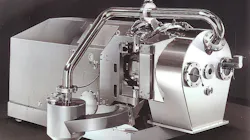
This design has a perforated basket mounted on a horizontal axis; a peeler knife shaves the cake off the filter media lining the basket wall while the basket is still spinning at reduced speed, enabling fast, largely automated discharge. This gives the shortest cycle times and highest throughput of the three centrifuge types, making it a workhorse for large-volume API or bulk chemical production. The trade-off is mechanical shearing of the crystals from the peeling action, which can cause particle attrition or fines generation of fragile or friable crystals— not ideal in certain applications. Horizontal peelers historically originated and dominated in Europe, which is why they are conventionally sized in millimeters — common basket diameters include 630 mm, 800 mm, 1,000 mm, 1,250 mm and 1,600 mm (with some suppliers offering baskets up to 2,000 mm). Mechanically, horizontal machines run smoother than vertical baskets — much like a front-load home washing machine versus a top-load unit — because the rotating mass (wet cake) are better distributed and balanced along a horizontal axis, which also tends to provide better wash efficiencies.
Inverting Filter Centrifuge (IFC)
In an IFC, the filter cloth (mounted as a bag inside the basket) inverts inside-out at high speed to roll the cake off the basket without a mechanical blade contacting the product. This is much gentler than peeling — better suited to fragile crystals, sticky cakes or shear-/attrition-sensitive crystal habits and polymorphs — while retaining the speed advantage of centrifugal filtration. Usually, each batch in an IFC is smaller and faster than a peeler or vertical basket centrifuge. Because the IFC basket is a closed, pressure-tight vessel, it also enables full containment through discharge, which matters for potent or genotoxic compounds, and allows an optional ‘pressure-added’ feature (see next para). The IFC was pioneered by Heinkel, a German precision tool company founded in 1884 under a different name, that pivoted into filtering-centrifuge design and engineering in the 1960s and introduced the inverting filter technology in 1971, with the first generation hydraulically driven IFC in 1978 that found its use primarily in manufacturing explosives and then in the 1980s in pharmaceuticals manufacturing with the second generation VFD driven IFC.
Pressure-Aided Centrifugation (PAC)
PAC — Pressure Added (or Aided) Centrifugation — is a feature unique to the IFC, originating with Heinkel. Because the IFC basket is a sealed, pressure-tight vessel, an additional step can be applied after filtration and wash are complete: a gas overpressure is applied above the cake surface, driving residual liquid through the cake and filter medium in addition to centrifugal force. In certain API chemistries, PAC can push residual cake moisture, measured as loss on drying (LOD), below 1% — approaching or matching what an ANFD drying step would achieve (using the more expensive vacuum/pressure/thermal technology) — without leaving the sealed IFC vessel. This is one of the more compelling reasons an IFC-with-PAC is evaluated directly against an ANFD in process design, rather than only against a plain peeler or basket centrifuge.
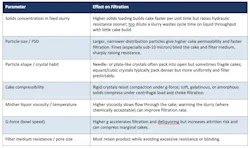
Perhaps the single most important sizing parameter for comparing these technologies is flux rate — filtrate throughput expressed as gallons per minute per square foot of filtration area (GPM/ft²). As a rule of thumb (not a hard boundary), a batch filtering centrifuge would be suitable for slurries with a flux rate of roughly 3-5 GPM/ft², and because flux rate drops off as cake thickness increases, centrifuges are typically operated with a cake depth under 6-7 inches (150-175 mm). An ANFD, by contrast, generally requires a better-filtering slurry — a flux rate of 5 GPM/ft² or more — and the ability to build a cake of 6 inches or more to justify its cost. This is the crux of the technology-selection decision detailed in the case study in Part 2. As with any process chemistry, and especially for cake filtration applications, the numbers are not set in stone and can and do change on a case-by-case basis.
Cake Stratification
One filtration-related consideration in a centrifuge that doesn't arise in an ANFD is the possibility of cake stratification: in some applications — not all — particles segregate by size during centrifugal cake formation and settle into distinct layers, much like the layers in a baked cake. This tends to happen when slurry residence time in the spinning basket runs longer rather than shorter, giving particles more time to classify by settling velocity and size as the cake builds. Stratification, where it occurs, can slow filtration (fine layers blind faster) and reduce wash efficiency, since wash liquor preferentially channels through coarser layers and bypasses fines-rich zones. Where it's a concern, feeding the slurry more slowly, or feeding it into the spinning basket in slugs — a short burst of feed, a pause, then another burst, repeated through the fill — shortens the effective residence time per increment and helps limit segregation. Stratification is not an issue in an ANFD because filtration can be carried out with the agitator in slow motion, which keeps particles suspended and prevents them from segregating by size as the cake forms. Cake channeling in the thick ANFD cake can become an issue, especially during washing, but that is usually handled by reverse rotation of the agitator and light pressing of the cake to smooth out the channels.
Static vs. Dynamic Washing
Wash method is another point of differentiation. An ANFD can provide both a static wash (also known as “plug-flow” or displacement wash, where wash liquid is added and allowed to displace through a stationary cake, exactly as in a centrifuge) and a dynamic wash (the agitator reslurries/resuspends the cake in wash liquid before refiltering) — and can alternate between the two as many times as the chemistry requires. A conventional batch filtering centrifuge can only provide a static, displacement-style wash. One exception exists: a horizontal design called a siphon peeler centrifuge can perform a dynamic-style wash, but it is a specialized, lesser-known machine that most end users neither know about nor want to be bothered with in routine operation. This wash flexibility — the ability to fully reslurry a cake to reach deep into agglomerates or break up channeled/stratified layers — is a distinct advantage for the ANFD in API chemistries where impurity or residual-solvent specs are tight.
Filter Media Selection and Nominal Retention
A common misconception is that filter media must be rated finer than the smallest particle in the slurry. In practice, the medium itself doesn't do the heavy lifting in cake filtration — the initial layers of solids deposited onto it do. Once a thin bed of the coarser particles has formed, that bed becomes the effective filtering medium, and it's the bed that goes on to catch progressively finer particles as the cake builds. Practically, this means a slurry with a PSD in the 10- to 50-micron range generally doesn't need a sub-10-micron-rated medium; a coarser medium — say, 20-micron nominal retention — is usually the better choice for increasing filtration rates. Some fine solids will initially “bleed through” a coarser medium before the cake bed is fully established, which is why a polishing filter downstream is commonly used to catch that early bleed-through. The residual cake heel left behind from a prior batch plays a similarly useful role: it gives the next batch an already-established filtering bed from the start of the cycle — until, over repeated batches of the metal plow or peeler rubbing on the same heel and creating heat, the heel “glazes over” and begins to impede flux rate rather than help it.
Typical Performance Outcomes for Centrifuges
- Cake thickness — up to roughly 6 to 8 inches (150 to 200 mm), depending on basket size, type and flux rate. Vertical baskets and peelers tend toward the thicker end; IFCs run somewhat thinner, in the 4-inch range, since the whole cake must invert cleanly off the bag and the basket spins faster, which means smaller but faster batches.
- Wash efficiency — static/displacement washing, typically three to four cake volumes of wash liquor per stage (application-specific), provides good mother-liquor displacement provided the cake stays crack-free; efficiency drops if the cake channels or is stratified.
- Cake moisture — after spin, the wet cake isn't a simple liquid “heel” sitting on top of the solids — it's liquid held by the solids themselves, both as surface moisture and as harder-to-remove bound moisture within and between particles. This typically runs 10% to 20% w/w of the wet cake from a centrifuge (the exact figure is application specific and depends heavily on the specific gravity of the solid relative to the liquid), and closer to 20% for the wet cake in an ANFD at the end of wash, before vacuum drying begins. Either way, this is well above the LOD of less than 1% to 2% usually required for a finished, dry API or intermediate — which is exactly why a drying step (a separate dryer after a centrifuge, PAC in an IFC or the ANFD's own vacuum-drying stage) is typically still required.
Coming in Part 2
Every centrifuge route described above still ends with a wet cake that has to be dried — in a separate dryer downstream, or by PAC in an IFC. Part 2 looks at the technology built to filter, wash and dry in a single vessel: the Agitated Nutsche Filter-Dryer. It walks through how an ANFD operates step by step, returns to the Midwest CDMO’s brownfield decision to show how flux rate, cake depth, crystal breakage, containment and flexibility tipped the choice toward the more expensive vessel, and closes with a side-by-side guide to when each technology wins.
About the Author
 Tom Patnaik
Vice President, Sales & Service
Tom Patnaik is a mechanical engineer with a bachelor's degree from National Institute of Technology (NIT), India, and a master's degree from Texas A&M University. He has over 25 years of experience in the chemical process equipment industry, focusing on micronization, reaction, filtration and vacuum drying. Currently, he serves as vice president of sales & service, Thaletec USA, responsible for raising awareness and acceptance of the company's glass-lined reactors, heat exchangers and columns, among others.