When The Cheaper Equipment Isn't the Right Equipment

Part 1 opened with a Midwest specialty chemical contract development and manufacturing organization (CDMO) weighing two options: a peeler centrifuge and vacuum paddle dryer train priced at about $1 million, or a single agitated Nutsche filter-dryer (ANFD) priced at nearly double. The CDMO chose the more expensive vessel. Part 2 explains why.
Part 1 also covered the three types of batch filtering centrifuge — vertical basket, horizontal peeler and inverting filter centrifuge (IFC), including the IFC's pressure-aided centrifugation (PAC) option — and the process parameters that govern their filtration performance. Four of those parameters carry through everything that follows.
- Flux rate: Filtrate throughput, measured in gallons per minute per square foot (GPM/ft²). As a rule of thumb, a batch filtering centrifuge handles slurries of roughly 3-5 GPM/ft², while an ANFD generally needs a faster-filtering slurry of 5 GPM/ft² or more.
- Cake thickness: Centrifuges typically operate with a cake depth under 6 inches (150 mm); an ANFD needs to build a cake of 6 inches or more to justify its cost.
- Washing: A conventional centrifuge can perform only a static (displacement) wash. An ANFD can also reslurry the cake in a dynamic wash and alternate between the two as often as the chemistry requires.
- Drying: Wet cake from a centrifuge typically holds 10% to 20% w/w liquid, well above the 1% to 2% maximum loss on drying (LOD) usually required for a finished active pharmaceutical ingredient (API) or intermediate. A separate dryer (or PAC in an IFC) is still needed.
Why the ANFD is the Natural "Technology Twin" for Comparison
A filtering centrifuge and an ANFD answer the same fundamental question in a pharma-chem process train: How do you separate solids from mother liquor, wash out impurities or residual solvent and hand off a well-defined dry solid for further processing or packaging? Both can be fully enclosed for containment, and both handle the batch crystallizations typical of API and intermediate manufacturing. They are routinely evaluated head-to-head at the process-design and tech-transfer stage because they cover overlapping duties with very different strengths: One is optimized for filtration speed, the other for combining filtration and drying in a single vessel. Because the choice affects equipment count, cycle time, containment strategy and product-quality risk all at once, it is one of the more consequential unit-operation decisions in solids process design.
ANFD Definition and Operation
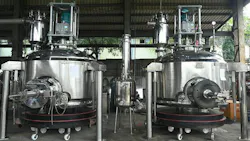
An ANFD is a single, jacketed, closed vessel with a porous filter plate (or a filter cloth or sintered metal mesh on a plate) at the bottom and a top-mounted agitator that both rotates and reciprocates. The agitator is usually a two-blade S-anchor or a three-blade design, sometimes fitted with wall and bottom-scraper blades. The ANFD performs the entire filtration, wash and drying sequence in one vessel, without transferring the wet cake elsewhere:
- Inert purge: Before charging, the vessel headspace is purged with nitrogen to prevent ignition, since combustible solvent vapor and fine particulate can create a flammable atmosphere.
- Slurry charge: The slurry is charged into the vessel.
- Filtration: Filtration is driven either by pressure applied above the slurry or by vacuum pulled from below, on the filtrate discharge side of the filter plate. The vacuum configuration is thought to be the origin of the term "pressure nutsche." Filtration continues until the mother liquor has passed through, leaving a wet cake on the filter media.
- Wash: The cake is washed statically (plug flow), dynamically (reslurry) or by alternating between the two as needed, as described in Section 3.3 of Part 1. During a static wash, the cake can crack and form channels that let wash liquid shoot straight through without washing the cake. When that happens, running the agitator in reverse smooths the cake and closes the channels. Dynamic washing is usually preferred, but static washing has its own advantage: Because the wash liquid flows through the interstitial channels of an undisturbed cake, stripping away surface impurities without resuspending the solids, it can reduce the volume of wash liquid required in certain applications. Wash liquid volume typically runs three to four times the cake volume, though this varies by application. So 2,000 liters of wet cake, as in the Section 6 case study, could require roughly 1,000 liters of wash liquid — all of which must then be properly handled and disposed of, adding directly to operating cost.
- Vacuum drying: The vacuum system pulls the vessel down to as low as roughly 10 mm Hg, and heat is applied through the jacketed sidewalls (and, optionally, the agitator) while the agitator tumbles the wet cake against the heated walls. The tumbling cake typically contacts only about a quarter of the way up the vessel wall, which is why the process is sometimes called "contact drying." Telescoping lump breakers can break up large lumps that would otherwise trap moisture, reducing them to granules that improve heat transfer and drive off solvent to the target LOD. Drying is usually the longest stage and the bottleneck of the entire process. The heated agitator adds only about 5% to the total heated surface area, but its constant, intimate contact with the tumbling solids gives it an outsize effect: In practice, a heated agitator can cut drying time by up to 25% compared with jacket-only heating. Because the effect is highly application-specific, it is best confirmed in a test center, where the agitator's heating fluid can be switched on and off to compare drying times directly.
- Discharge: Once dry, the solids — no longer called "cake," a term that implies moisture — are discharged by agitator rotation. Because the agitator cannot scrape the filter media directly, roughly a quarter-inch of solids typically remains on the media as a "heel." A nonmetallic blade attachment on the agitator or a high-pressure air knife can sweep off some of the heel, though both have limited effect.
ANFDs are often built of corrosion-resistant alloys such as Hastelloy C-22 when the mother liquor contains corrosive chlorides such as hydrochloric acid. That metallurgy, combined with the vessel's pressure/vacuum rating, large welded flanges, agitator (which may have a rotary joint and be cored for heating fluid), filter-media subassembly and integral half-pipe jacket, makes the ANFD an expensive piece of equipment: A unit with 1 m² of filtration area and 1,000 liters of slurry volume can run into seven figures.
Case Study: A Brownfield Expansion Decision
A specialty chemical CDMO in the Midwest, a longtime user of 1960s-era vertical basket centrifuges followed by tray dryers, set out to add production capacity as part of a broader process-train upgrade. Its priorities went beyond the immediate unit operation: minimizing manual handling, shrinking the equipment footprint and reducing operator exposure. All three have become significant pressures in specialty chemical manufacturing as skilled labor grows scarce, the cost of adding production space climbs and toxic-chemical exposure has become a front-burner environmental, health and safety (EHS) issue in a way it wasn't six decades ago.
The new process called for a 2,000-gallon glass-lined reactor discharging a crystalline slurry of 20% solids with a well-defined particle size distribution; the goal was to preserve a mean particle size of about 100 microns. Two downstream configurations were evaluated side by side:
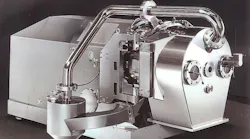
- Option A — Centrifuge and dryer train: The reactor would discharge in multiple drops into a 1,250-mm horizontal pharma peeler centrifuge with C-22 wetted parts. The centrifuge would then transfer the washed solids, at roughly 20% moisture, in four drops through a fully contained chute into a 5,000-liter vacuum paddle dryer to produce roughly 2,000 kg of dry powder.
- Option B — Single-vessel ANFD: The reactor would discharge the entire 6,000-liter batch directly into a 5-m² ANFD of C-22 construction, which would handle filtration, washing and drying in one vessel.
Beyond footprint, labor and containment, the CDMO weighed crystal breakage and economics. Capital cost mattered but was secondary to process and product-quality risk.
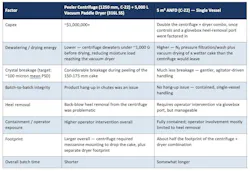
The centrifuge-and-dryer train was priced lower, at just over $1 million, and used less energy overall: centrifugal dewatering at roughly 1,000 G left less residual moisture for the vacuum dryer to remove. But it carried real operational costs: considerable crystal breakage while peeling the 150-175 mm cake; product hang-up in the transfer chutes, which undermined batch-to-batch integrity; a persistent heel-removal problem in which the centrifuge's back-blow cleared the heel only partially; and a larger footprint that required mounting the centrifuge on a mezzanine. Another drawback of multiple drops from the reactor was the potential for crystal growth during the approximately two-plus hours it took to centrifuge the entire 6,000 liters of slurry. Larger PSD (particle size distribution) of the solids was seen to adversely impact the yield in the next stage of the process train.
The ANFD priced out at nearly double the centrifuge-and-dryer train once controls and a glovebox-equipped heel-removal port were included. Batch time ran somewhat longer, and energy consumption was higher, because nitrogen pressure drove filtration of both the mother liquor and the wash liquid, and the vessel then had to vacuum-dry a considerably wetter cake than the centrifuge would have left. In exchange, crystal breakage was far lower, the process was fully contained, operator intervention was minimal (limited mainly to heel removal through the glovebox) and the footprint was roughly half that of the centrifuge-and-dryer train.
After running the full numbers, the CDMO chose the ANFD, putting crystal integrity, containment and footprint ahead of the alternative's lower sticker price and better energy economics.
When ANFD Competes With or Beats a Centrifuge / IFC-with-PAC
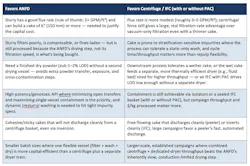
The key trade-off: An ANFD's drying step is usually its bottleneck. Heat transfer relies on conduction from the jacket (and, to a lesser but meaningful degree, the heated agitator) through an agitated powder bed. That is slow, especially for thick cakes or large batches, and can stretch a batch to many hours or even days. A centrifuge, especially a peeler, filters and deliquors much faster but leaves a wetter cake that still needs a separate dryer to reach pharma-grade LOD, unless PAC in an IFC closes that gap. Whether the trade is worth it depends on filterability (flux rate), potency and containment requirements, and campaign scale. That is why, as the case study shows, this comparison is made slurry by slurry rather than by defaulting to one technology across a whole process train, and it’s recommended to partner with an OE manufacturer to run trials in their test center.
Leading Equipment Suppliers and Brands (Western Hemisphere)
Many of the historic nameplates below have since been absorbed into larger process-equipment groups, notably Andritz and De Dietrich Process Systems, but the names remain in common industry use to identify machine type and heritage.

Conclusion
Batch filtering centrifuges and ANFDs are close technology twins: Both filter and wash API or intermediate solids and separate them from mother liquor. But as the CDMO's decision shows, they are optimized for different points on the filterability spectrum. Centrifuges win where flux rate is moderate, cake depth stays at or below about 6 inches (150 mm), and a separate dryer (or an IFC with PAC) can economically finish any drying required. ANFDs win where the slurry filters well enough to build a thick, high-flux cake, where dynamic reslurry washing is needed to meet impurity specs, and where a single-vessel, fully contained process that delivers finished dry powder outweighs the ANFD's higher capital cost and slower, conduction-limited drying. The right answer is almost always slurry-specific. That is why side-by-side testing of flux rate, cake thickness and LOD on the actual process stream — not a spreadsheet comparison alone — remains the deciding factor in technology selection.
About the Author
 Tom Patnaik
President, AUM Enterprise LLC
Tom Patnaik is president of AUM Enterprise LLC, a pharma-chemical asset knowledge provider serving manufacturers, sellers and users of pharma-chemical process equipment across North America. He holds BS and MS degrees in Mechanical Engineering and an MBA and brings over 30 years of process engineering and business development expertise across filtration, mixing, drying, reactor, size reduction, classifying, packaging and control valve equipment.