Podcast: Chemical Leaders Put AI to Work, BASF Eyes Evonik
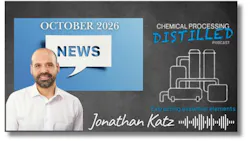




Welcome to Distilled News for October 2026. I'm Jonathan Katz with the top stories trending on ChemicalProcessing.com.
Our first story is a look back at the CIEX Chemical R&D Innovation Summit, which took place in Indianapolis Sept. 9-10.
About 130 people, mostly C-level executives and VPs working across technology, R&D and innovation, attended the event organized by the Merlien Institute. The conference took place at the headquarters and R&D center of the Heritage Group, which owns more than 50 companies across various industries, including highway construction and materials and chemicals refining.
Several speakers addressed the role that artificial intelligence is having at the product-development level in the chemical sector.
We heard from Venki Chandrashekar, CEO of polystyrene and styrene monomer producer Americas Styrenics, more commonly known as AmSty.
He discussed the need for large commodity producers, like AmSty, to differentiate themselves through operational excellence. Chandrashekar said in the past, when growth was strong, the company would invest in new production plants. But with commodity markets slowing, the company needed to adopt a new strategy. Instead, AmSty is focusing on creating value through its existing assets, including a focus on reliability and equipment availability and developing customer-centric products.
“If your operations don’t work well and you’re fighting fires, there’s no way you’re going to focus on innovation,” he said.
Meanwhile, Hexion is using AI to transform its entire business ecosystem, according to company CEO Michael Lefenfeld. The company faced increasing economic challenges, including more regulations and worker turnover, with 20% of its exempt workforce expected to retire by 2032.
The 170-year-old producer of formaldehyde-based glues decided to link AI to customer data to formulate products based on their partners’ needs, Lefenfeld said.
Lefenfeld explained that Hexion shifted to a “chemistry-as-a-service model,” starting with its wood-products customers. The goal was to make transformational changes in the structure of products. As Lefenfeld said, the company “took a grenade to every process” with the goal of designing Hexion for modern technology.
The company installed sensors at every unit operation at various customer sites so it could get that info and then create models. To get that data, Hexion built AI systems on models linked through secure channels into a central data lake.
Lefenfeld highlighted several wins from the AI project, including a $30 million in annual savings for wood-products customers.
CIEX attendees also heard from Jayshree Seth, a corporate scientist at 3M, who spoke about the use of generative AI in existing workflows.
3M uses various AI models, including an enterprise system developed in 2024, to accomplish these tasks internally.
While AI is helping researchers perform tasks more efficiently, Seth prefers to use the term “artificial diligence” over intelligence because the company still relies on people to interpret the data.
“It's a word generator. We all know that,” Seth told the CIEX attendees. “It is not intelligent. It's diligent, though. If you don't want to read 200 patents, it will. It'll even read a thousand, 10,000. But we need to call it like it is. It can compute consistently without any conscious contemplation.”
I sat down with Seth after her session to ask her about the role of AI in the chemical industry.
She said AI can create an “illusion of wisdom,” emphasizing that AI-generated content must be verified with evidence and facts.
“It requires us to be even more critical thinkers,” Seth told me. “And the scientist community is poised for that because by nature and virtue of what we do, we're critical thinkers, so this is really the era where critical thinking and questioning and checking and looking for facts and evidence and data becomes even more important. And we have to keep that in the forefront.”
We now turn to company news with a proposed megamerger and a few plant closures.
Evonik confirmed Sept. 25 that BASF made a non-binding offer to acquire the Essen-based company.
Tribune News Service reported that a German chemical industry union voiced skepticism over the possible takeover.
The takeover of one successful company by another does not automatically mean a brighter future for its sites and employees simply because the resulting company would be larger, said Michael Vassiliadis, head of Germany’s IGBCE union.
BASF also later confirmed exploratory contacts with Evonik and its largest shareholder, the RAG Foundation, over a potential acquisition.
"The course and outcome of the exploratory talks are currently open," the Ludwigshafen-based chemicals giant said.
Evonik said BASF's non-binding approach concerned a possible voluntary public takeover offer for all of the company's shares. But no talks are currently taking place, it added.
The RAG Foundation holds around 43.8% of Evonik, meaning its position would be crucial to any potential deal. It also noted that it currently has three outstanding bonds carrying rights to be exchanged for Evonik shares.
Tribune News Service reported Oct. 5 that Goodyear Tire & Rubber Co. is exiting the chemical business and will close its remaining plants in Niagara Falls, New York, and Pasadena, Texas.
The company will cease production at its Niagara Falls chemical plant by the end of the month after 80 years of production. The plant, which employs about 70 workers, has faced scrutiny over its emissions of a cancer-causing chemical.
Westlake Corp. will it will close its polyvinyl chloride (PVC) plant in Cologne, Germany. In a Sept. 29 statement, the company cited weak demand, elevated energy costs and increased import pressure from Asia as key reasons for the closure.
The plant has annual PVC production capacity of approximately 165,000 metric tons. Westlake expects the facility to cease operations in the first quarter of 2027 and plans to continue supplying customers from its other German PVC facilities, including the recently acquired Wilhelmshaven site.
Westlake said the Cologne plant's smaller scale and higher logistical costs make it more expensive to operate than its other European PVC facilities.
And finally, Sumitomo Chemical said Oct. 6 it has achieved production-scale manufacturing of liquid crystal polymer, or LCP.
LCP is a high-performance engineering plastic used in electronic devices, automotive components and office automation equipment. The material combines heat resistance and flame retardancy with high fluidity, which enables its use in applications requiring complex molded components.
Sumitomo Chemical established technology to mass-produce the bio-based LCP in June 2025. The company said production-scale manufacturing has now demonstrated that LCP containing biomass-derived monomers can be produced while maintaining the material's key performance characteristics. The company is preparing a mass-production system for the material and plans to begin supplying customers with samples produced at production scale.
That wraps up this month's top stories from ChemicalProcessing.com. Stay informed on the stories that matter most to the chemical processing industry. I'm Jonathan Katz, and this has been Distilled News.
About the Author
 Jonathan Katz
Executive Editor
Jonathan Katz, executive editor, brings nearly two decades of experience as a B2B journalist to Chemical Processing magazine. He has expertise on a wide range of industrial topics. Jon previously served as the managing editor for IndustryWeek magazine and, most recently, as a freelance writer specializing in content marketing for the manufacturing sector.
His knowledge areas include industrial safety, environmental compliance/sustainability, lean manufacturing/continuous improvement, Industry 4.0/automation and many other topics of interest to the Chemical Processing audience.
When he’s not working, Jon enjoys fishing, hiking and music, including a small but growing vinyl collection.
Jon resides in the Cleveland, Ohio, area.