Computational Model Could Speed Organic Semiconductor Material Design
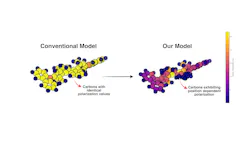
A new computational modeling framework could help chemical engineers more quickly identify and optimize organic semiconductor materials for applications including organic light-emitting diodes (OLEDs) and flexible electronics. Researchers at the University of California, Davis and Germany’s Max Planck Institute for Polymer Research developed a model that more accurately captures how molecular structure and electronic behavior affect charge transport in these materials.
The framework accounts for the local environment around individual atoms and how molecular polarization changes as atoms interact with their surroundings. Researchers report that it is more accurate than conventional approaches that assign the same electronic properties to broad classes of atoms.
The model also can simulate molecules in neutral, charged and excited states, allowing researchers to examine conditions relevant to operating electronic devices. Combined with machine learning, the approach could predict properties of new molecules before they are synthesized, potentially reducing the number of materials that need to be produced and tested experimentally.
Toulik Maitra, a chemical engineering Ph.D. student at UC Davis, developed the framework during a six-month appointment at the Max Planck Institute for Polymer Research. He is now applying the modeling techniques to research on organic semiconductor materials for OLEDs, including thermally activated delayed fluorescence (TADF) emitters and high-mobility molecules.
The work could help researchers investigate organic alternatives to OLED materials that rely on rare metals such as iridium and platinum. TADF materials can produce comparable performance using organic molecules, according to the release.
An early version of the research is available on arXiv as the international team prepares the work for peer review. The researchers' next steps include continuing to apply the modeling approach to organic semiconductor research and expanding its use to areas such as device-performance and vibration analysis.