Heat Pumps: What’s All the Steam About?
Saving energy in a chemical plant goes hand in hand with optimizing and integrating heat. An assessment sponsored by the U.S. Department of Energy (DOE) puts industrial waste heat at 20%-50% of energy input, with roughly 60% of the unrecovered heat it analyzed below 232°C.
A heat pump can upgrade it using electricity, but the economics hinge on the temperature lift, the gap between the waste-heat source and the reboiler’s required temperature.
Fuel for steam generation can account for up to 80% of energy use in the most steam-intensive sectors, and DOE lists chemicals as a segment with one of the greatest boiler fuel demands (BCS, Incorporated, 2008). Almost a third of industrial processes demand heat between 100° and 200°C, which is the temperature regime industrial heat pumps now target (Hamid et al., 2023).
One European study found that heat pumps could technically cover a third of industrial heat demand, while other estimates with complementary but more detailed temperature and lift cutoffs estimate the achievable energy savings to be less than 5% of industrial energy use (Rehfeldt et al., 2018; Marina et al., 2021). The real potential is likely underestimated because the studies used supply temperatures, which exceeded process requirements (Bever et al., 2024).
The technology is straightforward. A mechanical heat pump takes up waste heat by evaporating a working fluid, then compresses the vapor so it condenses at a higher temperature against the stream that needs heat. The coefficient of performance (COP), which measures the heat out over work in, is capped by the Carnot value of sink temperature divided by lift.
Real machines reach roughly 55%-75% of it (Bever et al., 2024; Hamid et al., 2023; DOE, 2003). Open-cycle mechanical vapor recompression (MVR) uses the process vapor as working fluid, which is suitable for close-boiling splitters and evaporators (DOE, 2003; Ipieca & IOGP, 2023).
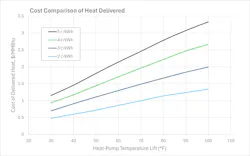
COP depends strongly on source and sink temperatures (Sadjjadi et al., 2023), so make sure you have a strong understanding of your temperature requirements and dynamics before talking to vendors. The process must also keep running if the heat pump trips, which means retaining backup steam is often in the cards (DOE, 2003). DOE's thresholds provide a useful rule of thumb when considering energy cost: an electricity-to-fuel price ratio below 3 favors a heat pump, and above 6 argues against it (DOE, 2003).
You must also consider your boiler efficiency, so a COP of about 4.4 breaks even when electricity costs about 5.5 times boiler fuel per unit of energy at 80% boiler efficiency. DOE historically reports simple paybacks of 2-5 years.
Recent analysis has shown a ~500 kW unit, condensing at 145°C from a 71°C source, paid back in 3.9 years (Hamid et al., 2023). Plants, however, tend to fund heat recovery only when paybacks run well under three years, so your mileage may vary.
Plant and policy
If you are in the EU, carbon prices may enter the conversation when considering heat pumps. For example, if we take €90/t carbon, the boiler's direct emissions may be worth considering. Taking 210 grams of CO2 per kWh as the emissions factor, running the 500 kW heat pump for 2,000 hours, 4,000 hours, or 24/7 could avoid €18,000 or €37,800 or €82,800 per year, respectively.
However, you need to consider regulatory standards when selecting your technology, specifically the fluid. The F-gas revision tightens market access for fluorinated refrigerants, and a proposed The per- and polyfluoroalkyl substances, or PFAS, restriction under the EU’s REACH regulation would cover most of them, HFOs and HCFOs included (Bever et al., 2024).
Other things to consider for your site should begin with cogeneration. When lower steam demand backs down on-site power generation, the extra power purchase may reduce your savings. Small streams that cool quickly force the heat pump to raise its lift. This also can have a negative impact on savings over time. Heat fluctuation and uncertain long-term reliability should be among key decision drivers for your investment.
Another point to consider is that a heat pump adds rotating equipment, so first run a pinch analysis to confirm that you haven’t overlooked a simpler recovery project.
Flexibility
A recent mapping of published reports on energy-flexible heat pumps found no studies of units above 100 kW that combine industrial heat supply with price-driven operation or grid services (Sadjjadi et al., 2023). Because grid-responsive technologies and facilities are nascent, today’s approach keeps the need for industrial processes to have constant temperatures and firm supply, and storage above 100°C requires pressurized water or vapor. But as electricity demand continues to rise across all sectors and more technology for flexible operations emerges, heat pumps, namely variable speed ones, can be part of the shift in operations and energy savings.
References
- BCS, Incorporated. (2008). Waste heat recovery: Technology and opportunities in U.S. industry. U.S. Department of Energy, Industrial Technologies Program. https://doi.org/10.2172/1218716
- Bever, P. M., Bless, F., Arpagaus, C., & Bertsch, S. S. (2024). High‐Temperature Heat Pumps for Industrial Use. Chemie Ingenieur Technik, 96(8), 1071-1084. https://doi.org/10.1002/cite.202300241
- Hamid, K., Sajjad, U., Ahrens, M. U., Ren, S., Ganesan, P., Tolstorebrov, I., Arshad, A., Said, Z., Hafner, A., Wang, C.-C., Wang, R., & Eikevik, T. M. (2023). Potential evaluation of integrated high temperature heat pumps: A review of recent advances. Applied Thermal Engineering, 230, Article 120720. https://doi.org/10.1016/j.applthermaleng.2023.120720
- Ipieca & IOGP. (2023). Heat pumps: Energy efficiency compendium. Ipieca.
- Marina, A., Spoelstra, S., Zondag, H. A., & Wemmers, A. K. (2021). An estimation of the European industrial heat pump market potential. Renewable and Sustainable Energy Reviews, 139, 110545. https://doi.org/10.1016/j.rser.2020.110545
- Pahle, M., Quemin, S., Osorio, S., Günther, C., & Pietzcker, R. (2025). The emerging endgame: The EU ETS on the road towards climate neutrality. Resource and Energy Economics, 81, 101476. https://doi.org/10.1016/j.reseneeco.2024.101476
- Rehfeldt, M., Fleiter, T., & Toro, F. (2018). A bottom-up estimation of the heating and cooling demand in European industry. Energy Efficiency, 11(5), 1057-1082. https://doi.org/10.1007/s12053-017-9571-y
- Sadjjadi, B. S., Gerdes, J.-N., & Sauer, A. (2023). Energy flexible heat pumps in industrial energy systems: A review. Energy Reports, 9, 386–394. https://doi.org/10.1016/j.egyr.2022.12.110
- U.S. Department of Energy. (2003). Industrial heat pumps for steam and fuel savings: A Best Practices steam technical brief (DOE/GO-102003-1735). Office of Energy Efficiency and Renewable Energy, Industrial Technologies Program.
About the Author
 Thomas Kwan
Thomas Kwan
Global Vice President, Strategic Innovation and Industrial Ecosystems
Thomas Alan Kwan is an energy transition expert at Schneider Electric's Sustainability Research Institute. With a Ph.D. in chemical and environmental engineering, he brings a blend of academic rigor and industrial experience to the field of sustainable manufacturing and green engineering.
At Schneider Electric, he leads initiatives focused on new and emerging industrial systems, with a particular emphasis on the chemical processing sector. His work involves developing innovative solutions and practices to drive energy, environmental and economic benefits.
Previously, he was a key member of Unilever's product engineering team, where he integrated green chemistry and engineering principles for product and process development. His contributions earned him a lifetime honorary membership on the team. Kwan also has experience in environmental regulation, having worked with the U.S. EPA on Clean Water Act programs.
Through his research and collaborations, Kwan continues to explore innovative ways to reduce energy consumption, minimize waste, maximize value and improve overall process efficiency in chemical manufacturing operations.