Energy Saver: Heat Pumps Slash Waste in Distillation Operations
Key Highlights
- Heat pumps can achieve 50%-80% energy savings in distillation, evaporation and concentration processes by recovering waste heat and boosting it to useful temperatures.
- Operational advantages include reduced maintenance, improved product quality and increased grid flexibility.
- Successful implementation involves targeting processes with favorable temperature differences.
- Early adoption is crucial as costs decline and decarbonization policies strengthen.
We operate at the intersection of thermodynamic efficiency and economic reality throughout our facilities. I've spent the better part of my career optimizing energy systems, and I can tell you that heat pumps used to be one of those technologies everyone talked about but was rarely deployed. The economics just didn't work. But something's changed in the last few years, and we're now seeing installations that would have been laughed out of the capital appropriation meeting five years ago.
If you run distillation columns, evaporators or any concentration equipment, you know steam bills are expensive. What’s frustrating is watching all that energy we pump into reboilers pass straight through the overhead condenser into the cooling tower. It's not just wasteful; it's thermodynamically offensive! Heat pumps give us a way to grab that waste heat and boost it back to useful temperatures. Instead of losing it, we're putting it to work.
When you integrate heat pumps into distillation operations, you're looking at 50%-80% energy reduction compared to conventional steam reboilers. That's not theoretical. The range depends on how well you've optimized the thermal integration, but even conservative implementations can hit 50%.
For evaporation and concentration work, mechanical vapor recompression systems, which are really specialized heat pumps, routinely deliver north of 50% energy savings. Masaru Nakaiwa and his team documented this back in 1997, and we've only gotten better at it since then. Carbon emissions are falling along with energy consumption, an important consideration as carbon pricing becomes more common in the business environment.
A midsized chemical facility recently ran the numbers on a heat pump deployment. The plant is projecting over 5,500 MWh/year in annual savings (Orozco et al., 2024). Those are savings that get senior management's attention.
Understanding Real-World Performance
The payback depends on the coefficient of performance, or COP, which is basically how many units of heat you get out for every unit of electricity you put in. Well-designed industrial systems typically run between 3 and 8. So if your COP is 4, you're getting four times as much heating value as the electricity cost, which sounds great until you factor in that electricity usually costs more per unit energy than natural gas.
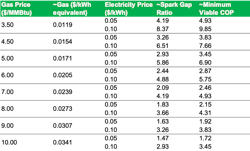
The table below shows where different systems sit in terms of efficiency and temperature capability. Notice that traditional gas boilers can hit higher temperatures but waste a lot of energy, while heat pumps are more efficient but can be temperature limited. This is why application matching matters so much.
But COP tells only part of the story. For distillation work specifically, heat-integrated distillation columns, or HIDiC systems, can cut total energy requirements by around 60% compared to conventional designs using mechanical vapor recompression (Nakaiwa et al., 1997). These work by recovering the condenser duty that normally gets dumped as waste heat, compressing it and feeding it back to the reboiler. The key advantage is that the temperature lift is modest, typically just 20°-40°C, which keeps the compression energy manageable and the COP high.
Process-Specific Applications
Not every process is a good candidate. Different operations have different thermal signatures, and you need to match the technology to the application. Here's what we've learned works well:
Distillation columns are the obvious first target. You've got overhead vapor sitting at maybe 40°-50°C that you're just condensing and throwing away. Compress it up to 140°-160°C, and you can supply the reboiler duty directly. In petrochemical gas fractionation, absorption heat pump integration into a standard 50,000-metric-ton-per-year depropanizing column can achieve 50%-60% reductions in both steam consumption and carbon emissions (IPIECA, 2023).
The payback period makes sense even without carbon credits.
Evaporation and concentration processes are equally promising. A recent example is a gypsum board manufacturing facility that deployed heat pumps for its final drying step. The plant achieved 52% energy cost reduction and reached zero carbon emissions for its particular process. When full electrification doesn't make sense, hybrid approaches combining heat pumps and natural gas have shown 30% cost savings with 50% emission cuts (Skyven Technologies, 2025). That's a pragmatic middle ground that still delivers meaningful progress.
Wastewater heat recovery is starting to get traction. This is especially true in food and beverage and chemical processing where warm wastewater streams are present. There's a lot of embedded energy there. The EU did an assessment suggesting waste heat could theoretically cover 73% of process heating needs below 150°C (Butler & Denis-Ryan, 2024). Now, that's a high-level number, and your actual potential depends entirely on your specific processes and site layout, but it points to the scale of opportunity if we get serious about waste heat recovery.
Integration Economics
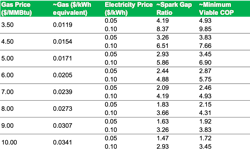
Energy savings translate to operating-cost reduction, and perhaps that's obvious. But whether you actually save money depends significantly on the ratio of your electricity price to your natural gas price. Let me give you an example: Take a 10 MW process heat load, natural gas at $3.50-10/MMBtu, industrial electricity at $0.05-0.10/kWh. Depending on how well you optimize the thermal integration and energy costs, your annual savings range can be substantial, but it's not automatic.
In the U.S., where electricity costs significantly more per-unit energy than natural gas, even a heat pump with a COP of 3.5 can struggle to break even on operating costs alone (Center for Energy and Environment, 2025). This is what we call the “spark gap, “customarily defined as the ratio of electricity price to fuel price. You need to know your local spark gap and the minimum viable COP to make the economics work.
European facilities have an advantage here because carbon pricing mechanisms approaching €90/ton CO₂ add roughly €18-27/MWh to natural gas costs, which substantially improves heat pump competitiveness. Without that carbon price signal, you're relying purely on the energy arbitrage, and in many U.S. markets that's still challenging. The table below shows an approximation of what you need in terms of minimum COP to break even across different gas prices and electricity rates, assuming an 85% efficient boiler baseline.
Operational Benefits Beyond Energy
Direct energy savings are just part of the value proposition. We've seen several operational advantages that often matter as much or more:
Maintenance actually goes down. Mechanical vapor recompression systems eliminate the complex reboiler/condenser heat exchanger networks in conventional distillation. Simpler thermal architecture means less fouling, less scaling, fewer cleaning cycles. These problems compound over time in mature installations and often erode energy efficiency more than the original design inefficiencies (GEA Group, 2023; Chivas Brothers & Piller Blowers & Compressors, 2018).
Product quality typically improves. Heat pumps give you much tighter temperature control compared to steam-heated reboilers. For heat-sensitive specialty chemicals where traditional methods create nasty thermal gradients, this precision cuts product loss and boosts yield. In several projects, this benefit exceeded the direct energy savings in the economic evaluation (Arpagaus et al., 2023).
Grid flexibility opens new revenue streams. Industrial heat pumps represent controllable electrical loads. Grid operators increasingly value this flexibility for managing renewable electricity variability. As more solar and wind comes online, being able to shift when you run your heat pumps becomes worth real money in demand-response programs.
Scaling Implementation
BASF is currently constructing a 50-MW industrial heat pump system for steam generation, powered by renewable electricity, targeting 500,000 metric tons annually of net-zero steam (Vögele, 2025). That's not a pilot project; that's full-scale production deployment. The mechanical engineering challenges at multi-megawatt scale are solved problems using standard compressor technologies and industrial design practices.
For facilities considering deployment, match your implementation strategy to your thermal opportunities. Start with distillation columns where the overhead-to-reboiler temperature difference is favorable. Roughly anything under 80°C is generally worth evaluating. Evaporation and concentration operations with available waste-heat sources make good secondary targets to consider. Deploy sequentially across process units, so you can demonstrate value and build organizational confidence before committing serious capital to facility-wide systems.
The fundamental economics remain compelling: 50%-80% energy reduction in distillation and similar benefits in evaporation and drying applications. As electricity grids continue to decarbonize and equipment costs keep declining, the business case only strengthens. If you're serious about operational efficiency and carbon reduction, start your process mapping exercises this year. Figure out where heat pumps make sense for your specific operations, run the economics with your actual energy pricing, and get at least one pilot system installed so you can learn what works in your environment.
The window to be an early adopter is closing. This will soon be standard practice, and you'll have missed the chance to learn while the technology was still novel enough to generate interest from your technical staff and management team.
References
Arpagaus, C., Bertsch, S., Bless, F., Brendel, L., Paranjape, S., & Uhlmann, M. (2023). Industrial heat pumps: Technology readiness, economic conditions, and sustainable refrigerants. Presented at ACEEE Industrial Heat Pump Workshop, Industrial Summer Study, Detroit, MI. American Council for an Energy-Efficient Economy.
Butler, C., & Denis-Ryan, A. (2024). Industrial heat pumps key to addressing excess gas demand. Institute for Energy Economics and Financial Analysis (IEEFA).
Center for Energy and Environment. (2025). Industrial electrification through heat pump adoption for process loads. Minnesota Department of Commerce.
Chivas Brothers & Piller Blowers & Compressors. (2018). MVR heat pumps & thermal efficiency at Chivas Brothers Distillery [Case study]. Renewable Thermal Collaborative.
GEA Group. (2023). Efficiency and reliability—The strongest advantages: Mechanical vapor recompression technology [Technical documentation].
IPIECA. (2023). Heat pumps [Energy efficiency solutions brief].
Nakaiwa, M., Huang, K., Owa, M., Akiya, T., Nakane, T., Sato, M., & Takamatsu, T. (1997). Energy savings in heat-integrated distillation columns. Energy, 22(6), 621-625.
Orozco, R., Martin, S., Kenton, K., & Heredos, D. (2024). Industrial heat pump market study. Bonneville Power Administration.
Skyven Technologies. (2025, February 12). The role of industrial heat pumps in improving energy efficiency.
U.S. Department of Energy. (2014). Industrial heat pumps for steam and fuel savings. Advanced Manufacturing Office.
Vögele, T. (2025, September 26). BASF begins building 50 MW industrial heat pump. PV Magazine.
About the Author
 Thomas Kwan
Thomas Kwan
Global Vice President, Strategic Innovation and Industrial Ecosystems
Thomas Alan Kwan is an energy transition expert at Schneider Electric's Sustainability Research Institute. With a Ph.D. in chemical and environmental engineering, he brings a blend of academic rigor and industrial experience to the field of sustainable manufacturing and green engineering.
At Schneider Electric, he leads initiatives focused on new and emerging industrial systems, with a particular emphasis on the chemical processing sector. His work involves developing innovative solutions and practices to drive energy, environmental and economic benefits.
Previously, he was a key member of Unilever's product engineering team, where he integrated green chemistry and engineering principles for product and process development. His contributions earned him a lifetime honorary membership on the team. Kwan also has experience in environmental regulation, having worked with the U.S. EPA on Clean Water Act programs.
Through his research and collaborations, Kwan continues to explore innovative ways to reduce energy consumption, minimize waste, maximize value and improve overall process efficiency in chemical manufacturing operations.