Chemical Engineers Develop Mesh to Capture Varying-Size Microplastics
Related Reading
- Illinois Tightens Plastic Pellet Spill Rules for Chemical Manufacturers
- EPA, HHS Move Microplastics from Fringe Concern to Federal Priority
- The Microplastics Regulatory Clock Is Ticking
- Plastics Industry Faces Rising Tide of Litigation, Regulation and Reputational Risk
- EPA Designates Microplastics, Pharmaceuticals as Priority Contaminants
- Study: Industrial Chemicals Found Deep in Ocean Waters
- Microplastics Regulation Revs Up in 2025, More Action Expected in 2026
- Chemical Industry Advances PFAS Destruction and Removal Technologies
- Compliance: Microplastics Regulation Surges
Chemical engineers at North Carolina State University (NC State) have developed a biopolymer mesh that can capture microplastics across a broad range of particle sizes, potentially offering a single material for removing larger microparticles and much smaller particles from water. The material works in both freshwater and saltwater and is made from alginate and chitosan, biopolymers derived from seaweed and crustacean shells.
The research was led by Orlin Velev, a chemical and biomolecular engineering professor at NC State. The researchers drew inspiration from floating seaweed mats and spherical "Neptune balls," which can naturally collect microplastics.
"Our goal here was to develop a multiscale structure that allows us to capture the full range of plastic microparticles," Velev said in a statement.
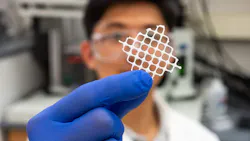
The resulting "cleaners" consist of a porous mesh of biopolymer fibers coated with soft dendritic chitosan colloids. The larger mesh can capture plastic microparticles around a millimeter or larger, while the fine fibers provide adhesive surfaces for much smaller particles.
"What you end up with looks like a fluffy net," Velev explained. "The 'net' part of the structure is a mesh capable of capturing the larger plastic microparticles — a millimeter or larger in size." The fine fibers coating the mesh can capture particles down to tens of nanometers through adhesion.
In proof-of-concept testing, the researchers found the mesh could capture laboratory-produced nanoparticles and real-world microplastics across a wide range of sizes in both freshwater and saltwater.
"We've demonstrated that this design works," Velev noted. He added that the materials are naturally derived and relatively inexpensive, but that large-scale deployment would depend on investment in scaling the cleanup approach.
The research was published in Science Advances in the paper, “Artificial Neptune balls: Superadhesive biomimetic networks for broad size microplastics capture and removal.”