Plastics Industry Faces Rising Tide of Litigation, Regulation and Reputational Risk
Key Highlights
- You can lose even when you win. Plaintiffs in plastics litigation often can't prove their case — but that doesn't protect defendants from crippling legal costs, media coverage and reputational damage.
- The recycling label on your product may already be illegal — somewhere. A patchwork of conflicting state laws means the same recyclability claim that's required in one state could expose you to a lawsuit in another.
- Microplastics litigation is coming — the science just hasn't caught up yet. Courts have so far struggled to establish causation between microplastics and human harm, but that window is closing fast as federal research priorities and a wave of new legislation accelerate the science.
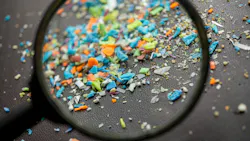
Stakeholders in the plastics industry are facing unique challenges as new laws, policies and public scrutiny reshape the regulatory landscape for plastic products, labeling and waste streams. Litigation can create resource burdens on defendants and impose economic hardship via litigation costs or declines in consumer trust stemming from the litigation — regardless of the outcome. Common claims in such suits include violations of environmental protection standards, public nuisance due to pollution and state consumer protection statute grounds alleging misleading or untruthful claims about the impacts of plastic products, false advertising about the chemical composition of plastic products and contamination of waterways. New claims are emerging seemingly every day.
Scientific Advancement and Heightened Interest in Plastics Research
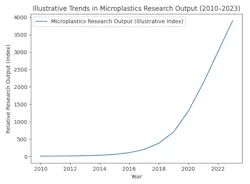
Litigation and regulatory interest in plastics and microplastics have not increased in a vacuum. Legal interests and actions involving the plastics industry and plastic products coincide with an increase in scientific research on plastics and microplastics. There is a sharp increase in interest in plastic pollution/exposure risk coming from the scientific community, as demonstrated by bibliometric data on the subject.
Figure 1 reflects the growth in microplastics-related scientific publications based on multiple peer-reviewed bibliometric studies. The figure is intended to illustrate relative growth over time rather than exact annual publication counts and does not correspond to a single database query or dataset.
Academic and scientific journals are not the only venues seeing increased interest in researching plastics. The current administration has made the study and understanding of plastics and microplastics a priority. The U.S. Environmental Protection Agency and the U.S. National Oceanic and Atmospheric Administration are both engaged in research to understand the impacts of microplastics in water and to marine life. The U.S. Department of Health and Human Services, in the Make America Healthy Again report, notes microplastics as a key area of research and seeks to understand the health impacts of plastics across discrete areas such as chronic illness, cancer and reproductive health.
Trends in Law and Regulation
Within the last two decades, regulating plastics and microplastics has become a focus of international and federal regulation.
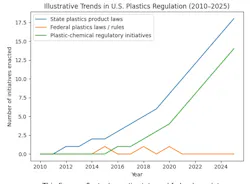
Figure 2 reflects domestic state and federal regulatory actions affecting plastics and plastic-associated chemicals. “State plastics product laws” include statewide enactments addressing plastic products or packaging (e.g., bag bans, expanded polystyrene restrictions, packaging Extended Producer Responsibility). “Federal plastics laws” include enacted federal statutes and final rules that explicitly address plastics. “Plastic-chemical regulatory initiatives” include major federal and state actions targeting chemicals commonly used in plastic materials (e.g., per- and polyfluoroalkyl substances (PFAS), phthalates, flame retardants). Actions are aggregated by year to illustrate relative trends in regulatory activity and are not intended to represent an exhaustive inventory.
As shown in Figure 2, U.S. regulation of plastics has expanded over the past decade. State governments have enacted an increasing number of product-focused plastic restrictions, while federal statutory activity has occurred more sporadically. More recently, regulators at both the state and federal levels have targeted chemicals used in plastic materials, including additives and processing aids.
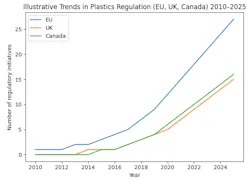
Figure 3 reflects major plastics-related regulatory initiatives adopted by the European Union (EU), the United Kingdom and Canada between 2010 and 2025. Initiatives include enacted laws, directives, regulations and major implementing measures that materially affect plastics or plastic packaging. Counts are aggregated annually to illustrate trends rather than intended to provide an exhaustive inventory.
Internationally, plastics regulation has accelerated markedly over the past decade, particularly in the EU. As illustrated in Figure 3, the EU began adopting plastics-focused regulatory initiatives earlier than other jurisdictions and has continued to expand and refine its regulatory framework through successive legislative packages. The United Kingdom and Canada followed later but show clear acceleration in regulatory activity beginning in the late 2010s and early 2020s, reflecting a broader international shift toward comprehensive plastics regulation.
Trends in Plastics Litigation
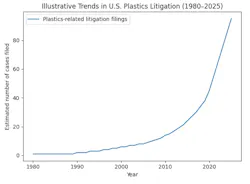
Plastics-related litigation has increased significantly over the past decades, as illustrated in Figure 4. Our analysis of litigation trends highlights an increase in legal action targeting stakeholders in the plastics value stream.
Figure 4 illustrates plastics-related litigation trends based on publicly available litigation trackers and case surveys. The figure aggregates multiple categories of plastics litigation and is intended to illustrate relative growth over time rather than to provide an exhaustive or precise count of annual filings.
The body of case law making up plastics and microplastics litigation falls into several key areas. Federal statutory causes of action against plastics manufacturers relate to the Clean Water Act (CWA), the Resource Conservation and Recovery Act, and the Microbead-Free Waters Act of 2015. Typically, these statutes contain provisions allowing plaintiffs a direct route to challenge alleged harmful or unlawful actions taken by entities such as manufacturers and processors. These statutes also allow plaintiffs to petition the implementing agency to enforce provisions of regulations that may lead to enforcement actions, penalties or other non-litigation costs to manufacturers. Similarly, state environmental statutes provide a means to bring claims against plastics manufacturers, often for issues related to water quality or other environmental contamination. State claims include public nuisance and other common-law claims, as well as claims arising from state consumer protection statutes.
Discussion
As litigation and regulation surrounding plastics evolve and expand, the legal risks of doing business along the plastics value chain will evolve as well. Litigation that once focused on “black and white” issues, like dumping chemicals into the environment during processing, now shifts to “gray area” issues, such as the “trueness” of recyclability labeling.
Many theories of legal action against plastics companies often lack the scientific evidentiary support to sustain legal scrutiny and the award of damages. At present, a plaintiff generally cannot establish causal links between plastics and microplastics and allegations of actual harm to human health or the environment because science is evolving. Establishing this link between the presence of plastics and/or microplastics from a company’s products and actual alleged harm has proven difficult given the ubiquity of microplastics and the fundamental compositional complexity of plastics and establishing a causal link to specific health endpoints.
Although general allegations are unlikely to succeed on the merits under existing legal and scientific frameworks, businesses often incur significant costs even where a plaintiff’s legal argument is lacking and ultimately found deficient. The time and resources needed to defend such litigation are huge, and media coverage and reputational damage are often even more costly.
Newer theories of action, including those targeting microplastics, greenwashing and recycling, may pose a greater concern to stakeholders. These laws are evolving in real time, which can make strategizing for compliance challenging.
Emerging Issues in Plastics Litigation
Microplastics Litigation
Microplastics, or plastic particles measuring less than 5 mm, are currently in the regulatory, public and academic spotlight. Congress has introduced bills in recent years (the Microplastics Safety Act and the Plastic Health Research Act, for example, were both introduced in 2025) aimed at researching microplastics with the intention of using that information to limit or mitigate the release of these contaminants into the environment. Many states have implemented or are seeking to implement research bills, product bans, and other regulations targeting microplastics, as well. For a more detailed review of recent microplastics regulatory developments, see Bergeson & Campbell, P.C.’s recent memorandum.
In a litigation context, the outcome of the “microplastics craze,” largely, is actions brought from a consumer protection angle. Companies marketing plastic products as “pure,” “natural” or “safe” are vulnerable to allegations that the products contain undisclosed microplastics, exposing consumers to unknown or emerging health risks. This provides a basis for litigation where environmental standards for microplastics have not been established.
In Becerra v. Coca-Cola Co., for example, plaintiffs alleged that plastic bottles that were marketed as “pure” contained microplastics. The legal argument asserted that this information would inform certain consumer purchasing decisions, and that marketing the products as “pure” was an omission of material information.
Lack of scientific evidence, coupled with misleading information, has created a widespread fear about the presence and effects of microplastics. An increased focus on studying, understanding and reacting to plastics and microplastics likely means that a more complex legal and regulatory framework awaits plastics manufacturers within the next couple of decades. This also means that lawmakers will be armed with data to help make informed and reasonable decisions, rather than reacting to fearmongering, as may be the case at present. Regardless of the regulatory framework that will emerge, litigation involving microplastics will become more common as more information is developed.
Recycling and Greenwashing Litigation
Recycling and greenwashing litigation is rooted in allegations that companies misrepresented plastics as recyclable, sustainable, compostable or environmentally beneficial, despite knowing that the real-world recycling infrastructure could not process those materials at the requisite scale. These claims are generally based on state law. California, Pennsylvania and New York, for example, have statutory frameworks that allow plaintiffs to sue companies on these grounds.
In People v. Exxon Mobil Corp., the California Attorney General alleged that Exxon Mobil violated the state’s Unfair Competition Law and False Advertising Law by promoting plastics as recyclable while allegedly knowing that most plastics are not recycled in practice. The complaint did not hinge on the recyclability of any single product; instead, it alleged that Exxon misled consumers and policymakers about the overall recyclability of plastics as a class. This approach signals a litigation strategy that treats corporate speech and marketing about sustainability itself as actionable conduct, even where individual products may technically meet narrow recyclability definitions.
Another good example of a case that illustrates ways that plaintiffs can use claims laws to bring a plastics lawsuit is City of Philadelphia v. Bimbo Bakeries. In this case, the city alleged that manufacturers and distributors of plastic film products misrepresented recyclability in violation of Pennsylvania’s Unfair Trade Practices and Consumer Protection Law. Philadelphia asserted that misleading recyclability claims increased consumer reliance on plastic bags that could not be processed by municipal recycling systems, thereby externalizing waste management costs onto the city. The case is significant because it illustrates how municipal plaintiffs are invoking consumer protection statutes, traditionally used in private consumer actions, to recover public costs. The complaint frames misleading recyclability claims as a driver of municipal expenditures, effectively linking consumer deception to public financial harm.
Recycling litigation against state regulatory programs, in addition to stakeholders along the value stream, is also evolving. California’s Attorney General was recently sued by 18 industry groups over the state’s Truth in Labeling law (S.B. 343). The law prohibits the use of recycling language or symbology on products that are not actually or practically recycled in the state. For plastics, this limits producers to a very small number of resin types that can be labeled as recyclable (high-density polyethylene, for example, can be labeled recyclable, while non-rigid plastics cannot). This law directly conflicts with laws in other states that require a range of plastic products to include recycling language and symbology. The complaint in the case (California League of Food Producers v. Bonta) raises First Amendment issues, as well as claims that the law is too vague or ambiguous with which to comply. As more states seek to regulate labeling and recycling, jurisdictional conflicts between states will spark more litigation as producers navigate an increasingly difficult compliance and commercial framework.
Conclusion
Litigation targeting plastics manufacturers, production and products is a growing area wearing many hats. Stakeholders in the plastics industry should prepare for a dynamic environment, where laws, regulations and public perception of processes and products are in flux and subject to change. As these changes evolve, stakeholders should remain apprised of trends in law, science and public perception to position themselves proactively against litigation and associated business risks. In a fluid framework of uncertainty, diligence and informed decision-making are some of the best tools entities can utilize to minimize business harm.
Figure References
Figure 1 See Snehamayee, N., Somya, S., Kumar, S. C., Niranjan, M., Ranjan, S. B., & Kumar, M. N. (2026). Microplastics and Human Health: A Comprehensive Review on Exposure Pathways, Toxicity, and Emerging Risks. Microplastics, 5(1), 8. https://doi.org/10.3390/microplastics5010008; see also Nyadjro, E., Webster, J., Boyer, T., Cebrian, J., Collazo, L., Kaltenberger, G., Larsen, K., Lau, Y., Mickle, P., Toft, T., Wang, Z. (2023). The NOAA NCEI marine microplastics database. Scientific Data. 10. 10.1038/s41597-023-02632-y; see also World Health Organization, Microplastics in Drinking Water (2019).
About the Author
 Catherina D. Narigon
Catherina D. Narigon
Catherina D. Narigon is an Associate with Bergeson & Campbell, P.C., assisting clients with matters under the Toxic Substances Control Act (TSCA), the Safe Drinking Water Act, the CWA, and other state and federal regulatory statutes.
 L. Claire Hansen
 L. Claire Hansen
L. Claire Hansen is an Associate with Bergeson & Campbell, P.C., assisting B&C professionals with TSCA, Federal Insecticide, Fungicide, and Rodenticide Act, and other federal and state regulatory and policy matters.