Solution Spotlight: Closing Measurement Gaps Without Shutting Down the Plant





Transcript (edited for clarity)
Traci: Welcome to the Solution Spotlight edition of our Chemical Processing Distilled podcast. Solution Spotlight delves deeper into a topic from an industry perspective. I'm Traci Purdum, editor-in-chief of Chemical Processing. Please subscribe to this free podcast on your favorite platform.
In today's episode, we're discussing how chemical manufacturers can use non-intrusive measurement instrumentation to gain better process and asset health insight without adding unnecessary disruption. Chemical plants are under pressure to improve safety, reliability, productivity and sustainability, but many still face measurement gaps in hazardous, hard-to-access or high-maintenance areas.
Joining us is Michael Machuca, global chemical industry director for the measurement instrumentation portfolio at Emerson, to discuss how non-intrusive measurement technologies can help plants close those gaps and make better operational decisions. Thanks for joining me, Michael.
Michael: Thanks for having me.
Traci: Can you tell me a little more about your background?
Michael: Yeah, of course, Traci. I'm in charge of our chemical industry business for the measurement instrumentation portfolio at Emerson. I've been with Emerson for about 21 years in various roles, mostly supporting our instrumentation portfolio, which includes pressure, temperature, level and flow devices, as well as our analytical platform for analyzing both liquids and gases.
I started off in oil and gas, supporting that industry, and for the past few years, I've been supporting the chemical industry. I'm excited to be here and share some best practices around how we can leverage measurement improvements to help our customers achieve their goals of operating their plants more efficiently, more sustainably and more profitably.
What is the Importance of Measurement Instrumentation?
Traci: Well, you sound very well-suited to all my questions today. I'm looking forward to getting into it. My first question is about the importance of measurement instrumentation right now. We've already established that many facilities are under pressure to improve safety, reliability, productivity and sustainability, but they're often doing this with limited maintenance windows and aging infrastructure. Why is measurement so important to addressing those challenges?
Michael: The simple answer is that you can't improve something if you're not measuring it, or if you don't have insight into how your assets are performing in a reasonable time frame. If you're operating blind, you can't improve your processes and you can't baseline where you currently stand in order to develop a plan for improvement. The only way to make those improvements is to have the right measurements in place. Otherwise, you're essentially operating blind.
A lot of the plants we work with have measurement gaps. They may have been designed a long time ago, when energy costs weren't as much of a concern and prices were a lot less expensive, and there wasn't as much focus on sustainability goals. Most of the chemical manufacturers we work with now have net-zero targets and sustainability goals they want to achieve to reduce carbon emissions, and that wasn't as much of a concern before. As a result, in some cases, a lot of things weren't being measured. When the plant or facility was built, designers might have been looking only at capital costs during the design phase, trying to reduce initial capex rather than considering whether that would create inefficiency down the road once the plant was operating.
With this increased focus on efficiency and sustainability, we're uncovering a lot of needs for better measurement to give operators better insight, and to help maintenance teams ensure things are operating reliably so they can catch issues that look suspect.
It's also really important from a safety standpoint. If you don't have the information you need, there's the potential for a process excursion to go undetected because there's no measurement in place. This helps operators make better, faster decisions with improved insight. The nice thing is that we now have a lot more ability to add measurement points with newer technologies. The key one we're talking about here is non-intrusive — the ability to easily add a measurement point without a lot of process disruption. Another key enabler we're leveraging is wireless technology, which gets that information back to the people who need it to make fast decisions. So we've got a lot of new, exciting advancements in measurement technology that are making it easier and more cost-effective to add measurement points that might have been missing or overlooked.
Traci: You can't manage what you don't measure. That's a mantra for a reason, right?
Michael: Right, exactly.
What is Non-Intrusive Measurement?
Traci: Now, explain what non-intrusive instrumentation means. Let's break that down a bit.
Michael: In its simplest terms, a non-intrusive measurement doesn't have to physically touch the process. It doesn't require penetrating the pipe or vessel, so there's no contact with the process fluid. That makes it much easier to add a measurement point, especially after a facility has been built.
It's also helpful with process fluids that are very corrosive or involve high temperatures or high pressures. An in-line instrument in those conditions might need a very expensive, thick-walled design, or it might have to be made from an exotic material to be compatible with the process fluid. Strong acids, for example, will eat away at typical lower-cost materials of construction, so you may have to use something a lot more expensive.
Sometimes customers go non-intrusive because they're worried about something physically touching the process due to cleanliness requirements — they don't want to contaminate it. We see that a lot with semiconductor chemicals, which require super-clean fluids. Non-intrusive technologies help with that.
So basically, you're getting a measurement without physically touching the process, which reduces installation complexity. A traditional measurement method might be too disruptive or too expensive because of process compatibility needs. We typically see this with flow, temperature, corrosion and acoustic monitoring — for example, monitoring pressure relief events. These can all be measured non-intrusively, so you don't have to shut down the process to install the devices.
Traci: Is there a calibration process that needs to happen more frequently because of non-intrusive instrumentation?
Michael: No, not really. Each device is slightly different, but typically no additional calibration process is required. With a temperature measurement, for example, you do have to add insulation around it, since you're measuring on the outside. For ultrasonic flow meters, the technology we'd use for flow, the transducers are calibrated at the factory. So there's really no additional step — in most cases, it's actually an easier instrument to install.
Why Do Measurement Gaps Still Exist?
Traci: Let's move to the reasoning behind measurement gaps. Why do they still exist? What are some common reasons?
Michael: I touched on this a bit in the first question, but to go into more detail: In a lot of cases, it comes down to the complexity and cost of adding a measurement point after the fact. In many cases, the plant wasn't designed with that measurement point in mind, or it was simply missed. Adding a new measurement point usually requires shutting down the process, and the cost of a shutdown is very high — you're no longer making product. You may also have to cut the pipe, add wiring, or deal with a location that doesn't have power nearby.
The plant may have been built in a way that makes accommodating a new measurement point difficult and cost-prohibitive. Operators often know it would be great to have an additional measurement point, and they have a wish list of devices they'd like to add, but they have to wait for the next plant shutdown or major capital project. So the addition of these points often gets delayed for a long time. Non-intrusive instrumentation gives you another option: You can install an additional measurement point without shutting down, which helps you get better data to improve the safety, reliability and energy efficiency of the facility.
Reducing Safety Risks
Traci: That leads into my next question, about safety risk. There are many benefits, but you've mentioned cutting into piping and shutting down a process. We know that bringing the process back up is where the danger often lies. Can we talk about how non-intrusive instrumentation helps reduce safety risk?
Michael: Exactly. Just not having to access the process and cut into the pipe during installation can be especially dangerous if what's in that pipe is toxic, corrosive or flammable. You never know — there are procedures to purge the pipeline and make sure nothing's in there, but there's always risk when you cut into something you can't see inside of. Non-intrusive instrumentation helps there from a safety standpoint.
Also, with non-intrusive instrumentation, you no longer have leak points — no flanges on either end — which is two fewer leak points, especially important if the process is corrosive. In a lot of cases, plants use manual gauges, so someone periodically has to go check the temperature in a vessel or pipeline. Non-intrusive instrumentation can eliminate those manual rounds, which also improves insight into what's happening in the process. If you're only getting periodic checks, you don't have real-time information. You could have a process upset that creates an overpressure or over-temperature condition, or a leak going undetected because there's no flow indication. With the improved visibility of additional measurement points, you're no longer operating blindly, which has a definite impact on the safety of any process.
Another way we see people using non-intrusive instrumentation is as a check meter. Say you have a critical measurement and an in-line device doing its job — you can add a non-intrusive device, like a clamp-on ultrasonic flow meter, on a temporary basis to validate that the in-line measurement is reading correctly. It can be temporary or permanent, just to ensure everything is running as it should. All of this has a strong impact on safety.
Benefits to Uptime and Availability
Traci: You've touched on safety, and you're also touching on uptime, maintenance and availability. Can we get into that a bit? How does non-intrusive instrumentation affect uptime and plant availability?
Michael: If you have a non-intrusive device, you can get it up and running a lot faster since you don't have to wait for a shutdown. For a critical measurement point, some customers install redundancy — an additional meter they can put into a bypass — and you can do that with a non-intrusive measurement point too. That helps ensure you avoid a shutdown.
If you have issues like fouling, plugging, corrosion or erosion, those can cause in-line technologies to stop measuring properly. This is another area where having something outside the pipe — unaffected by plugging, erosion or fouling — helps keep the plant up and available, because it's essentially immune to those difficult process conditions.
Relevant Technologies
Traci: You've mentioned clamp-on flow meters and a few other things. What are some of the most relevant technologies?
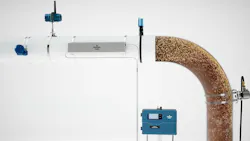
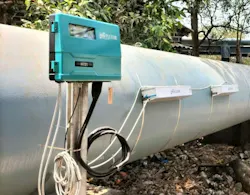
Michael: Probably the most relevant is the clamp-on ultrasonic flow meter, which can be used for liquids, gases and steam. It's the most common, most widely used non-intrusive device. It has a lot of advantages in corrosive, high-temperature or high-pressure applications, where an in-line device can be difficult because of material compatibility issues and the physical capacity needed to contain those pressures.
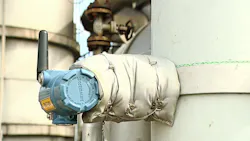
We also see opportunities around temperature measurement. In some cases, it's difficult to add a thermowell for an additional temperature monitoring point. With this technology, you simply clamp the temperature sensor onto the outside of the pipe, and it reads the surface temperature and calculates the process temperature through a special algorithm. Thermowells can be difficult in high-pressure, high-temperature applications — you have to do wake frequency calculations to make sure vibrations don't cause the thermowell to fail — so not having something intrusive into the pipe is an advantage where thermowells aren't suitable.
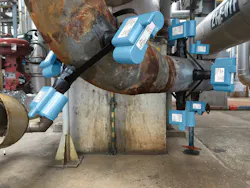
Corrosion and erosion monitoring is another non-intrusive application, and we're seeing a lot more installations of it. These devices are strapped around the outside of the pipe and ultrasonically measure wall thickness to detect corrosion. That's actually a critical safety application I should have mentioned earlier — if you have a corrosive process that weakens wall thickness, you could have a loss of containment. Real-time corrosion monitoring can help you adjust the chemical inhibitors being injected to prevent corrosion. It's a much better approach than manually checking thickness once a year or relying on corrosion coupons that are periodically pulled and inspected for metal loss.
The last one we're seeing a lot of is acoustic monitoring, largely driven by regulatory requirements. Acoustic monitors are placed on pressure relief valves and listen for pressure relief events. If there's an overpressure situation, or certain chemicals are released to the atmosphere, the EPA now requires that those events be monitored, logged and corrected. That's another critical safety application.
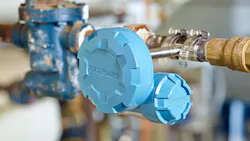
The same device is also used to monitor leaking steam traps, which is more of an energy-efficiency solution. In a typical facility, 30% of steam traps might be leaking at any given time, wasting energy by venting steam. The acoustic monitor can detect a stuck trap so you can send someone to repair it and reduce that energy loss. So those are the main ones: flow, temperature, corrosion and erosion monitoring, and acoustic monitoring.
Traci: Non-intrusive, but also non-visible. Corrosion is the hidden danger — it's so catastrophic when it happens, and you don't realize it's occurring without these types of measurements.
Michael: Absolutely.
Application Opportunities
Traci: You've been at this for more than 20 years, several of them in the chemical industry. Where do you see the strongest application opportunities?
Michael: Usually, it's where you have limited insight today, which is somewhat obvious. We see a lot of examples around utilities applications. Utilities are critical — air, gas and steam are used to run a lot of plant processes. But since they weren't technically part of the process or process control, a lot of investments weren't made in instrumentation for them when the plant was originally designed. A lot of energy is used on boilers to generate steam, and a lot of plant air is used to run pneumatic valves and devices — those compressors use a lot of energy — and often those flows aren't being measured. So utilities is one area.
Another is heat exchangers. In a lot of cases, their efficiency isn't being monitored. A non-intrusive temperature measurement on the inlet and outlet can indicate whether efficiency is starting to degrade.
Interplant transfer lines — moving water or other fluids between unit operations for allocation purposes — are another good opportunity for non-intrusive measurement points. We've talked about corrosion monitoring; any corrosive service is a good non-intrusive opportunity there. And anything involving high temperature, high pressure or corrosion, especially if there's a new regulation requiring additional monitoring points that weren't designed into the plant.
Water management is another area. We're seeing a lot of people trying to reduce water usage and consumption, for sustainability or cost reasons. Adding a non-intrusive clamp-on flow measurement to track where water is going within the facility can help detect leaks you weren't aware of.
Gas consumption — nitrogen, for example, which is often used in tank blanketing and purchased from a third party — is another good non-intrusive application, helping detect leaks and monitor usage to reduce consumption. And as I mentioned, pressure relief monitoring is a regulatory requirement now — the EPA's HON and MON mandates require monitoring of pressure relief events. It's an easy way to comply, because the devices are wireless and battery-powered. You just put the acoustic monitor on and you're up and running.
Traci: Compliance is important, not only for altruistic reasons but for the bottom line — if you get fined, you're going to be paying.
Michael: Absolutely right.
Supporting Digital Transformation
Traci: Let's move into digital transformation and how this all helps support that.
Michael: The key thing about digital transformation is that it requires more measurement points. We're seeing a lot of momentum around AI and leveraging advanced technologies to operate more efficiently, along with really nice new analytics packages. But the foundation of all of that is good data coming into those systems. Additional measurement points — what we call the intelligent field — are a key enabler for digital transformation. Without good data coming in, those systems aren't going to be as effective, and non-intrusive wireless devices are a good way to add new data sources where critical information might be missing.
We're actually launching a new platform at Emerson called Synchros: low-cost, non-intrusive wireless sensors. We're starting with our temperature sensor, to make it easier to add additional monitoring points at a lower cost and help enable the digital transformation people have been looking to implement across their facilities.
Where To Start?
Traci: A lot of this can be overwhelming. How do plants know where to start?
Michael: What we traditionally recommend is to start with an operational problem you might have, not necessarily the technology. Ask yourself: Where am I lacking visibility? Where is my team spending too much time on manual checks and manual rounds? Are there recurring maintenance issues? If you had access to better data, how could that reduce energy usage, downtime or uncertainty?
Try to identify a few high-value measurement gaps and consult with a measurement expert to find a solution — whether that's a wireless device, a non-intrusive device, or, in some cases, the only option is an in-line measurement. There are also ways to install even intrusive devices, such as between flanges, so there's not a lot of modification required.
I'd also say involve your operations teams, maintenance teams, reliability people and, especially, the safety side of the business. Leveraging measurement experts — whether from the company I represent or elsewhere — can really help find the best solution to close those measurement gaps. We're certainly willing to come in and help. One thing we do, and a lot of companies do, is plant walkdowns and audits to identify where measurements might be missing and determine the best way to install a new measurement point, whether that's upgrading older technology or adding non-intrusive options in a much easier fashion.
Key Takeaways
Traci: A fresh eye is important — having someone with your experience, who's been through many plants, come in and bring that perspective to a facility. You've answered so many questions for me. I'll give you the last one: What are your key takeaways from everything we've discussed?
Michael: I think the key takeaway is that buzz phrase we already mentioned: You can't improve what you can't measure. And there are options — don't assume something will be too disruptive or too expensive to install. There may be options you haven't considered, like non-intrusive flow or temperature measurement. Don't give up just because you're worried it will require a shutdown. Consult with measurement experts who can help find a solution you haven't thought of — one that can really improve your measurement and insight into the process.
These solutions can have great returns on investment if they help you avoid a shutdown through improved insight, or, in the most extreme case, prevent a safety incident. That's a critical thing to consider. There are a lot of technologies out there to help, and I'd encourage people to think about the non-intrusive ways they might be able to add these additional measurement points.
Traci: Thank you for your thoughtful answers, Michael, and for participating in this Solution Spotlight edition of Chemical Processing Distilled. My takeaway is that non-intrusive measurement instrumentation gives chemical plants a practical path to improve visibility without creating unnecessary process disruption, and that's very important.
For listeners, the next step is to look across your facilities and identify where better measurement could reduce safety risk, improve availability, lower maintenance burden, or support better energy and process decisions, just as Michael told us. For more information on non-intrusive measurement instrumentation, visit Emerson.com/non-intrusive-measurement. You can also visit ChemicalProcessing.com for more tools and resources aimed at helping you achieve success. On behalf of Michael and Emerson, thanks for tuning in. Thanks again, Michael.
Michael: Thank you.