
This month, Chemical Processing covered a lot of ground, literally. Our executive editor went fly fishing in Tennessee and came back with a dispatch from one of America's most storied chemical complexes. Our writers mapped the legal minefield awaiting plastics producers, followed the renewable energy investments reshaping decarbonization strategy, examined the hidden hierarchies that keep workers from being heard and traced the long road from autonomous control pilot to full production deployment. It was, in short, a month about systems: what holds them together, what pushes them forward and what quietly undermines them.
Chemical Makers Plug in to Renewable Energy
Jennifer Markarian's deep dive into renewable energy adoption found chemical manufacturers moving well past aspiration. Companies like BASF and Lanxess are executing concrete, multi-year strategies — power purchase agreements, renewable energy certificates, on-site generation, process electrification — driven by a convergence of regulatory pressure, customer demand and geopolitical risk. BASF's Marcos Gomez described the company's "make and buy" model: direct investments in offshore wind and solar for supply security, paired with purchased green electricity for flexibility. The result has been meaningful progress, with renewable electricity growing from 26% to 36% of BASF's global consumption in a single year. Sustainability consultant Cristina Pellegrino perhaps put it most plainly: this environment is reinforcing the business case for "no regret" initiatives that reduce exposure to geopolitical shocks while supporting decarbonization goals. For the chemical sector, the question is no longer whether to plug in. It's how fast.
eChem Expo Dispatch: Tailwaters, Fly Fishing and Eastman Kingsport
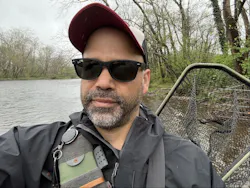
Executive Editor Jonathan Katz mixed business with pleasure during a recent visit to Kingsport, Tennessee — home of the Eastman Chemical plant. The facility spans 900 acres along the South Fork of the Holston River, employs roughly 7,000 people, contains 42 miles of internal rail track, manufactures most of its own specialized equipment, and operates its own fire department and doctor's office. A century after George Eastman selected Kingsport for its Appalachian timber and river access, the site has reinvented itself as a chemical recycling pioneer, running a commercial-scale methanolysis operation that breaks down plastic waste into molecular building blocks for reuse. But Katz didn't let the tour narrative go unchallenged. A chemical discharge into the Holston River a month before his visit, along with documented historical releases, served as reminders that the tension between industrial ambition and environmental stewardship is never fully resolved — only managed, imperfectly, over time.
Plastics Industry Faces Rising Tide of Litigation, Regulation and Reputational Risk
Attorneys Catherina D. Narigon and L. Claire Hansen of Bergeson & Campbell delivered a bracing legal analysis that should be required reading for anyone operating anywhere in the plastics value chain. They pointed out that scientific research on microplastics has grown exponentially since 2018; regulatory activity at the state, federal and international levels has accelerated in parallel; and plastics-related litigation has followed, with estimated filings approaching 95 cases annually by 2025. The piece's most memorable observation may be its most counterintuitive one — that companies can lose even when they win. A plaintiff who cannot prove causation still imposes crippling legal costs, sustained media coverage and lasting reputational damage on the defendant. Meanwhile, newer theories of liability — greenwashing, misleading recyclability claims, microplastics exposure — are evolving faster than the legal and scientific frameworks needed to contain them. A patchwork of conflicting state recycling laws means the same label that's required in one state could expose a producer to a lawsuit in another. Narigon and Hansen's prescription is simple: diligence and informed decision-making are among the best tools available in an environment this fluid.

You've Told Your Team to Speak Up. But Are You Actually Listening?
Lauren Neal, founder of the Valued at Work consultancy, returned this month with a column that operates at the uncomfortable intersection of organizational culture and process safety. Her argument is simple: every site has two hierarchies. The formal one lives on the org chart. The informal one — built on familiarity, shared communication styles and social permission — is the one that actually governs who gets heard in real time. Some people can interrupt and be seen as decisive. Others do the same thing and get labeled disruptive. Some can question decisions directly. Others learn, over time, to soften their language or stay quiet. In chemical and industrial environments, Neal argued, this is not a matter of fairness alone. When workers hesitate to escalate concerns because of how they expect to be received, the organization is already operating with an incomplete picture of reality. Her challenge to leaders: who have you made it easiest to listen to? The answers to that question, she suggested, may matter more than any formal speak-up policy ever written.

What Does It Take to Deploy Autonomous Control in a Chemical Plant?
Josh Cable's feature on autonomous surveyed a technology landscape that is genuinely advancing: digital twins, advanced process control, reinforcement learning algorithms and edge computing are all converging to make autonomous operations feasible in ways they weren't even five years ago. Yokogawa's field test at an ENEOS facility in Japan, where an AI algorithm autonomously managed a butadiene distillation column for 35 consecutive days, stands as one of the clearest proof points available. But Cable was equally rigorous about the barriers. High upfront costs topped the list, with nearly 60% of U.S. executives in a Schneider Electric survey identifying investment as their leading concern. Legacy system integration ranked close behind. And then there's the barrier that doesn't show up on technology roadmaps: organizational resistance. As Evonik's Henrik Hahn put it, integration is as much organizational as it is technical. The companies moving fastest, Cable found, aren't the ones attempting enterprise-wide transformations — they're the ones running structured pilots in standardized plant types and hardening their playbooks before scaling. Autonomy, in other words, is not a destination. It's a direction.
Taken together, May's best stories trace a single underlying tension: the chemical industry is operating in an era of genuine possibility — cleaner energy, smarter plants, circular materials — while navigating a thicket of legal exposure, cultural inertia and the stubborn difficulty of changing how large, complex systems actually behave. The ambition is real. So are the obstacles.
About the Author
 Traci Purdum
Traci Purdum
Editor-in-Chief
Traci Purdum, an award-winning business journalist with extensive experience covering manufacturing and management issues, is a graduate of the Kent State University School of Journalism and Mass Communication, Kent, Ohio, and an alumnus of the Wharton Seminar for Business Journalists, Wharton School of Business, University of Pennsylvania, Philadelphia.
Recent Awards:
2025 Eddie Award for her column "Lax Regulations Burn Rivers"
2024 Jesse H. Neal Award for best podcast Process Safety with Trish & Traci