Is Your PRV Monitoring Strategy Defensible Under HON?

Chemical facilities today operate in an environment where emissions performance, regulatory compliance and operational reliability are increasingly interconnected. While large process units often dominate sustainability discussions, smaller and less visible components can have a disproportionate impact on emissions outcomes. Among these are pressure relief valves (PRVs), which, despite being critical safety devices, have historically operated with limited real‑time visibility.
PRVs protect equipment and personnel during overpressure conditions. Under normal operation, they remain closed and inactive, often for long periods of time. When relief events do occur, information to understand exactly when a valve opened, how it behaved and how long it remained lifted has traditionally been supplied based on indirect indicators or periodic inspections. As regulatory expectations evolve, this lack of continuous insight has become more difficult to justify.
This challenge is especially evident under the updated Hazardous Organic NESHAP (HON) requirements, which went into compliance July 15, 2026. HON places increased emphasis on accurate emissions determination, defensible reporting and greater transparency, particularly for hazardous air pollutants. For chemical facilities handling ethylene oxide, for example, even short‑duration or intermittent releases require careful attention due to their potential environmental and public health impacts.
PRV Monitoring Options
To meet these expectations, facilities are increasingly adopting monitoring technologies that provide real‑time visibility into PRV behavior. Three widely applied approaches are detection using a limit switch and acoustic monitoring, direct spring valve position monitoring or pilot-operated valve monitoring via a differential pressure (DP) transmitter solution.
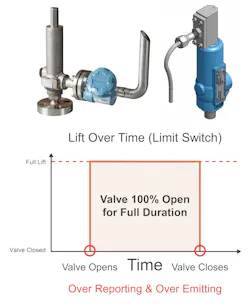
While all approaches improve awareness of relief activity, they differ meaningfully in how emissions information is interpreted and used for reporting, and they can be thought of as a good–better–best continuum. A limit switch and an acoustic transmitter provide a basic, cost-effective detection signal (Figure 1, Good approach).
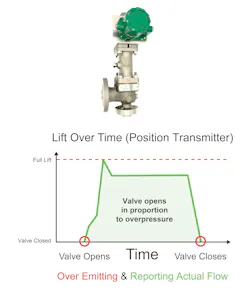
Direct valve position monitoring captures lift over time continuously for more accurate emissions quantification (Figure 2, Better approach).
A pilot‑operated valve solution with a DP transmitter provides the highest‑fidelity measurement, making it best suited for higher‑capacity or critical service valves. By continuously capturing valve travel throughout the release event—and modulating it with system pressure—this solution provides the data to create a lift‑over‑time profile that reflects real dynamic behavior, including partial openings and throttling. This enables more accurate determination of actual flow and emissions, aligning reported values closely with true process conditions, rather than assumed full‑lift scenarios (Figure 3, Best approach).
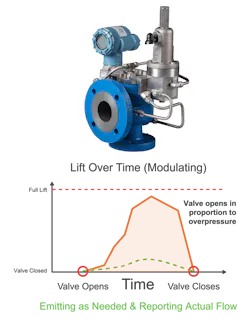
Because pilot-operated valves inherently modulate in response to system pressure, the resulting lift-over-time profile reflects how the valve dynamically adjusts during relief, including partial openings and throttling behavior. This continuous modulation enables a more precise determination of actual flow throughout the event, allowing emissions to be quantified based on real valve response rather than assumed full-lift conditions. As a result, reported emissions more accurately reflect true process conditions and are aligned closely with actual release volumes.
Together, these visualizations highlight the distinction between detecting that a relief event occurred and understanding how the valve physically responded during that event, an increasingly important consideration for HON and other regulatory compliance.
PRV Monitoring in Action
This distinction became central for a large chemical manufacturing facility preparing for HON compliance of its ethylene oxide unit (Figure 4). The site needed to improve PRV monitoring to meet upcoming regulatory requirements, but it initially did not have clarity on which approach would best support accurate and defensible emissions reporting.

Historically, the facility relied on periodic inspections and inferred indicators to assess PRV activity. As HON requirements came into focus, it became clear that this approach alone would introduce uncertainty into emissions documentation and potentially lead to conservative reporting assumptions. To address this issue, the site began evaluating monitoring options with a focus on improving accuracy, transparency and long‑term regulatory confidence.
Both limit switch and direct valve position monitoring were considered as part of this assessment, particularly given that most of the installed base consisted of direct spring PRVs. Through technical review and demonstration of valve behavior under simulated relief conditions, the facility gained a clearer understanding of how each method characterized emissions events. Seeing valve lift represented over time, rather than inferred from event duration alone, helped clarify how the monitoring strategy directly influenced reported emissions.
Below is an example representative of the facility’s evaluation, comparing how the limit switch and direct valve position monitors characterize emissions from PRVs in this ethylene oxide application.
For illustrative purposes, one can consider a 3L4 direct‑spring PRV set at 150 psig and 100 °F, installed in an ethylene oxide service. Under these conditions, the valve has a rated relieving capacity of 6822 SCFM. Assuming a one‑minute relief event, the total mass released can be estimated based on this capacity.
Using this same release scenario, Figure 5 below shows how emissions would be characterized by the two monitoring approaches. A limit switch solution indicates the on-off valve position and event duration, typically treating the release as a single continuous event. In contrast, a direct valve position monitor measures actual valve lift over time, capturing partial openings, modulating behavior and the brief reseating that occurred during the relief.
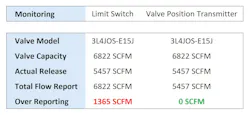
This comparison highlights how the choice of monitoring technology can materially affect reported ethylene oxide emissions for PRVs, even when the underlying process conditions and release duration are identical.
Ultimately, the facility selected direct valve position monitoring for its relief valves within the ethylene oxide unit. The decision was driven by the ability to more accurately quantify valve lift and duration, which supported more precise emissions reporting. From the site’s perspective, this accuracy was viewed as a clear advantage—not only for regulatory defensibility under HON, but also for avoiding over‑reporting of emissions. More accurate reporting reduced uncertainty around compliance metrics, and it helped mitigate the risk of unnecessary fees or penalties associated with conservative emissions estimates.
With continuous monitoring in place, PRVs evolved from largely passive safety devices into measurable elements of the facility’s emissions management strategy. Direct, time‑stamped data created from data supplied by the device reduced reliance on assumptions and improved confidence during internal reviews and external audits.
An additional benefit of real-time monitoring of relief events is the ability to correlate process conditions leading up to the event. This allows operators to identify and troubleshoot the root cause rather than simply reacting afterward. In most cases, PRVs are performing as designed, protecting personnel and equipment from uncontrolled overpressure conditions. But by making these events visible and actionable, operations can shift from a reactive response model to a proactive, prevention-focused approach for those cases where a PRV is not acting as expected.
Operationally, real‑time visibility helped align environmental, reliability and instrumentation teams around a shared understanding of PRV performance. Reduced dependence on routine manual inspections lowered personnel exposure and helped minimize the environmental footprint associated with maintenance activities. Over time, emissions monitoring became a natural extension of daily operations, rather than a periodic or reactive compliance task.
This experience reflects a broader transformation underway across the chemical industry. As regulations such as HON continue to evolve, real‑time visibility into PRV performance is becoming essential. Whether through acoustic detection, direct position measurement or a combination of approaches, understanding how relief valves behave in service is a key enabler of accurate reporting, regulatory confidence and sustainable chemical operations.
About the Author
 Lucas Franco
 Lucas Franco
Lucas Franco is a Global Product Manager with Emerson’s pressure management business, where he specializes in digital and instrumentation solutions for industrial applications. He leads product strategy across pressure relief valves, transmitters and monitoring technologies, bridging technical engineering depth with commercial execution. Franco works closely with global sales, service and engineering teams to deliver high‑value solutions focused on reliability, safety and lifecycle performance. His experience spans portfolio management, value proposition development and executive‑level strategy across complex industrial markets. Franco holds a Bachelor of Engineering, Electrical and Electronics Engineering degree from Centro Universitário Facens and an MBA from USP/Esalq, both in São Paulo.
 Unqua Jilani
 Unqua Jilani
Unqua Jilani is an Associate Product Manager for the digital monitoring product line within Emerson’s pressure management business. She helps drive the growth and advancement of Emerson's digital monitoring portfolio and leverages her engineering expertise to support operations, customers and product strategy. Jilana joined Emerson in 2022 as an application engineer before transitioning to product operations engineering, where she supported low-pressure pilot valves. She holds a Bachelor of Science degree in Mechanical Engineering from the University of Houston.