Four Alarms in Three Weeks: A Safety Professional's Hotel Wake-Up Call
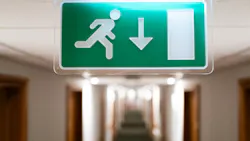
After more than 24 hours in transit and a 15-hour time zone shift, I was desperate for sleep. I finally got to bed that first night, only to wake at 3 a.m. — but I was determined to squeeze in a few more hours. Then the loudspeaker crackled: there would be a test of the evacuation alarm. Fine, I thought. Quick test, then back to sleep. The announcement blared for 30 minutes as staff knocked on every door to confirm the alarm was audible. I can guarantee you, it was.
As I moved to answer the knock, I glanced at the fire escape sign on the back of the door. It didn't make sense. Half-asleep, I was trying to figure out where I was — and then I realized: the sign had the wrong room marked.
You might be wondering why a safety professional didn't catch that at check-in.
I have a strict ritual when I check into a hotel:
- Put my bags in the room.
- Check the smoke detector — make sure it isn't covered.
- Grab my key and physically walk to the nearest emergency stairwell.
I've entered rooms where the smoke detector was covered to keep it from triggering. I won't stay in a room until the detector is fixed.
I walk my exit because I want the muscle memory of having done it at least once. Fire alarms go off in hotels in the middle of the night more often than you'd think. When that happens, I don't want to be studying a map on the back of the door — I want to know my turns before I need them.
That was my second evacuation test in two weeks. I'd hoped for a break.
The following week, I was resting in my hotel room in Toronto. My room had a small kitchen, and I'd been careful: window open while cooking, extractor fan running. I'd just finished dinner when the fire alarm went off. My first thought: "But I'd been so careful." Turns out, it wasn't me.
I grabbed my phone and room key, headed to the fire escape and down the stairs. In the lobby, one guest was explaining to the front desk how they'd left something in the microwave too long, as the rest of us trudged out into the cold. I hadn't thought to grab a jacket or warmer shoes. Standing outside staring up at my window, I realized I'd also left my passport behind, and really hoped there wasn't a fire.
The fire trucks came. About 30 minutes later, the scene was declared safe and we returned to our rooms.
Three alarms in three weeks. That seemed like a lot. It wasn't over.
A few days later, I was in an office building mid-presentation when the fire alarm started screeching. "Not again," I thought. We filed calmly to the fire escape and the muster point. After about 40 minutes, the scene was cleared. A small refrigerant leak in the air conditioning system had triggered the alarm.
Four alarms in three weeks. I was starting to wonder if I was the common denominator.
What struck me, reflecting on each incident, was how differently people responded depending on context. Both workplace alarms prompted a quick, calm exit — everyone out and chatting at the muster point while we were accounted for. The hotel evacuations were a different story. It astounded me how long some guests took to leave, especially when the alarm sounded around dinnertime, not in the middle of the night when a slower response might be understandable. I'd been outside 10 to 15 minutes, and people were still trickling out. There was simply no urgency.
That's exactly why we practice fire drills. But we also need to remember that risk doesn't stay at the office. The next time you check into a hotel, walk to your fire exit, check the smoke detector, and if something isn't right, report it. Your life could depend on it.
About the Author
 Trish Kerin, Stay Safe columnist
Trish Kerin, Stay Safe columnist
Director, Lead Like Kerin
Trish Kerin is an award-winning international expert and keynote speaker in process safety. She is the director of Lead Like Kerin Pty Ltd, and uses her unique story-telling skills to advance process safety practices at chemical facilities. Trish leverages her years of engineering and varied leadership experience to help organizations improve their process safety outcomes.
She has represented industry to many government bodies and has sat on the board of the Australian National Offshore Petroleum Safety and Environmental Management Authority. She is a Chartered Engineer, registered Professional Process Safety Engineer, Fellow of IChemE and Engineers Australia. Trish also holds a diploma in OHS, a master of leadership and is a graduate of the Australian Institute of Company Directors. Her recent book "The Platypus Philosophy" helps operators identify weak signals.
Her expertise has been recognized with the John A Brodie Medal (2015), the Trevor Kletz Merit Award (2018), Women in Safety Network’s Inaugural Leader of the Year (2022) and has been named a Superstar of STEM for 2023-2024 by Science and Technology Australia.