New Mexico Clarifies PFAS Labeling Rule: Industrial Products Are Off the Hook

By this date, you are aware of the fast-approaching requirements that apply under the New Mexico Environment Department (NMED) final rule issued on May 5, 2026, regarding per- and polyfluoroalkyl substances (PFAS) in consumer products. (See Bergeson & Campbell, P.C.’s May 4, 2026, memorandum on the final rule.) The most controversial and burdensome part of the rule concerns labeling products containing intentionally added PFAS manufactured after Jan. 1, 2027. NMED recently clarified that “[i]t is NMED’s position that the scope is limited to consumer products as that term is defined in the PFAS Protection Act, which means industrial products are not subject to reporting requirements or labeling requirements.” I will explain why this is welcome news and why clarification was needed.
Background
Many states are regulating PFAS intentionally added to products and doing so in very different ways. This places enormous pressure on commercial stakeholders to be aware of disparate state regulatory requirements and to understand what is in scope, what is not, and when certain requirements take effect. Under the New Mexico final rule, products manufactured after Jan. 1, 2027, must be labeled to communicate to purchasers that the product contains PFAS. Certain products are exempt from the labeling requirement. These include used products offered for sale or resale; products for which labeling requirements are preempted pursuant to the Federal Insecticide, Fungicide, and Rodenticide Act (FIFRA) or for which labeling requirements currently exist; veterinary products, including veterinary parasiticides and veterinary biologics, and the packaging of veterinary products regulated by the U.S. Food and Drug Administration (FDA), U.S. Department of Agriculture (USDA), or the U.S. Environmental Protection Agency (EPA); and medical devices, drugs and the packaging of medical devices and drugs regulated by FDA.
Prior to the sale of a product that contains intentionally added PFAS, a label that meets certain requirements must be affixed. The label must be an outline of an Erlenmeyer flask with the word “PFAS” inside the flask. The label must be clearly visible and legible prior to sale. Other requirements apply.
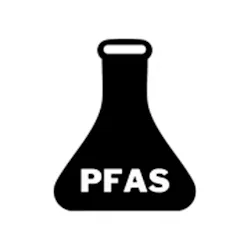
If the product is sold in consumer packaging that obscures the product label, the consumer packaging must also be labeled. If, prior to sale, a retailer repackages the labeled product, then the retailer shall label the new consumer packaging in accordance with this section. Where the consumer is unable to view the labels on the product or consumer packaging at the time of purchase or receipt, such as in catalog or online sales transactions that occur over the Internet or telephone, the manufacturer or retailer shall, prior to sale or distribution, clearly include information to the prospective consumer prior to purchase that the product contains intentionally added PFAS by providing a label or disclosure.
Waiver opportunities exist. Labeling waiver requests are due Oct. 31, 2026. According to the final rule, waiver requests will be considered approved pending review, and NMED will issue a final determination of whether to approve or deny the request by June 1, 2027. If NMED denies the waiver request, a manufacturer must label a product for sale or distribution within 90 days of the denial of the label waiver; products already manufactured as of the date of denial may be sold without a label. Approved label waiver requests will expire three years after approval.
Need for Clarity
The PFAS Protection Act defines “consumer product” as “a tangible personal property that is distributed in commerce and normally used for personal, family or household use, including product categories that are normally used in households but designed for or sold to businesses, such as commercial carpet or floor waxes.” The lack of clarity arose from this definition. Specifically, the question it left unanswered is whether “industry” is a consumer. NMED’s clarification that “[i]t is NMED’s position that the scope is limited to consumer products as that term is defined in the PFAS Protection Act, which means industrial products are not subject to reporting requirements or labeling requirements” emphatically resolved the ambiguity. NMED recently posted guidance documents and responses to frequently asked questions (FAQ) for manufacturers.
Discussion
It cannot be overstated that readers must stay on top of the wave of state PFAS laws, regulations, guidance documents and FAQs that are engulfing stakeholders. Manufacturers can be expected to continue adding PFAS to their products in the near term because replacement chemicals are not commercially available in all cases. In the interim, state-specific restrictions, reporting requirements and labeling provisions apply and will continue to evolve. Failure to observe them can, and will, invite unpleasant and costly consequences.
About the Author
 Lynn L. Bergeson, Compliance Advisor columnist
Lynn L. Bergeson, Compliance Advisor columnist
LYNN L. BERGESON is managing director of Bergeson & Campbell, P.C., a Washington, D.C.-based law firm that concentrates on conventional, biobased, and nanoscale chemical industry issues. She served as chair of the American Bar Association Section of Environment, Energy, and Resources (2005-2006). The views expressed herein are solely those of the author. This column is not intended to provide, nor should be construed as, legal advice.