What New Mexico's Proposed PFAS Labeling Rule Means for Manufacturers

2026 will be a consequential year for per- and polyfluoroalkyl substances (PFAS) regulation. Safer States released an analysis in February reporting on 2026 state chemical initiatives. According to the analysis, at least 15 major state laws and regulations are expected to take shape, including broad restrictions on PFAS. This column focuses on New Mexico's proposed rule implementing the Per- and Polyfluoroalkyl Substances (PFAS) Protection Act. What makes the New Mexico proposal so interesting is the consumer-facing label requirements for products that contain intentionally added PFAS.
Background
A detailed overview of the proposed rule is available in Bergeson & Campbell, P.C.'s Oct. 15, 2025, memorandum. Similar to other state PFAS restrictions, the proposed rule would include provisions phasing out and prohibiting the sale of consumer products containing intentionally added PFAS and imposing reporting and labeling requirements starting in January 2027. Under the October 2025 proposed rule, after Jan. 1, 2027, a manufacturer would not be allowed to sell, offer for sale, distribute, or distribute for sale a product containing intentionally added PFAS unless the manufacturer does one of the following:
- Labels the product in accordance with the standards set forth in the proposed rule; or
- Documents that the product is labeled in a manner consistent with corresponding labeling requirements enacted by another state.
Used products would be exempt from the labeling requirement.
Prior to the sale of a product that contains intentionally added PFAS, the manufacturer would be required to affix, or cause to be affixed, a label that conforms to the following requirements:
- The label must clearly inform the consumer, using words and symbols approved by the New Mexico Environment Department (NMED), that the product contains intentionally added PFAS in both English and Spanish. Text must be no smaller than the largest font used for other consumer information on the product.
- Labels must be affixed using materials and methods that are sufficiently durable to remain legible for the useful life of the product.
If the product is sold in consumer packaging that obscures the label on the product, the consumer packaging must be labeled. In addition, consumer packaging must also include the web address for https://www.env.nm.gov/pfas/, a web page hosted by NMED that provides information about PFAS in products. If, prior to sale, a retailer repackages the labeled product, the retailer must label the new consumer packaging.
Where the consumer is unable to view the labels on the product or consumer packaging at the time of purchase or receipt, the manufacturer or retailer would be required to provide, prior to sale or distribution, information to the prospective consumer that the product contains intentionally added PFAS. Disclosure and NMED's website address would be required to be included on sales literature, web pages, product specification sheets and marketing materials, as applicable.
Additional requirements would apply to the sale of a complex durable good that contains intentionally added PFAS, or of a component that contains intentionally added PFAS.
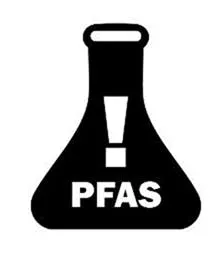
Before the New Mexico Environmental Improvement Board's (NMEIB) February 2026 hearing on the proposed rule, NMED submitted revised proposed rules to the hearing docket. The January 2026 revision would exempt certain products from the labeling requirement, including products for which labeling requirements are preempted pursuant to the Federal Insecticide, Fungicide, and Rodenticide Act and medical devices, drugs, and packaging regulated by the U.S. Food and Drug Administration. Acceptable labeling would include "This product is made with PFAS," "Made with PFAS," or "Contains PFAS," alongside the symbol of an Erlenmeyer flask with the word "PFAS" inside the flask. The February 2026 version of the proposed rule would require only the symbol of the flask with the word "PFAS" inside it.
Why We Care
The administrative process in New Mexico is extensive. NMEIB maintains a hearing docket that includes a great deal of PFAS information. Technical experts from both NMED and industry associations recently testified at a hearing that went into considerable detail on the pros and cons of the proposed rule and labeling requirements. The requirement is unlikely to be reconsidered.
Not all state PFAS restrictions include labeling provisions. New Mexico's approach could portend a new wave of such restrictions, putting even more pressure on manufacturers to cease intentionally adding PFAS to their products within the scope of the labeling requirement. If you think this sounds a bit like Proposition 65 (Prop 65), you are not alone. The conceptual approach is quite aligned with the label warning requirements under Prop 65.
Watch this space. January 2027 is fast approaching, and other states are expected to impose labeling requirements similar to New Mexico's proposal.
About the Author
 Lynn L. Bergeson, Compliance Advisor columnist
Lynn L. Bergeson, Compliance Advisor columnist
LYNN L. BERGESON is managing director of Bergeson & Campbell, P.C., a Washington, D.C.-based law firm that concentrates on conventional, biobased, and nanoscale chemical industry issues. She served as chair of the American Bar Association Section of Environment, Energy, and Resources (2005-2006). The views expressed herein are solely those of the author. This column is not intended to provide, nor should be construed as, legal advice.