Rice Process Eliminates PFAS, Generates Graphene
A new method for destroying per- and polyfluoroalkyl substances (PFAS) not only eliminates them from water systems but also generates high-value graphene.
Researchers at Rice University developed the zero net cost method, which relies on flash Joule heating (FJH) technology.
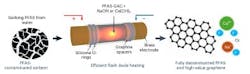
The researchers combined granular activated carbon (GAC) saturated with PFAS and mineralizing agents such as sodium or calcium salts and applied a voltage that took the mixture’s temperature to over 3000°C in under a second.
Under such extreme conditions, PFAS are converted into inert, non-toxic fluoride salts with >90% fluorine and >99% PFOA and PFOS – two of the most common PFAS pollutants - removal. Spent carbon is upcycled into flash graphene, offsetting treatment costs by $60–100/kg.
The sample is heated in a quartz tube with an inner diameter of 8 mm and a length of 9cm. The sample is fitted between two snug graphite electrodes, each 3mm long. 0.5g of copper wool is placed on each side of the graphite electrodes to enhance the electrical contact between the sample and external brass electrodes. The quartz tube, containing the sample, electrodes, and copper wool, is placed between two brass electrodes, each with two grooves fitted with O rings. This allows the sample and reaction area to be well sealed to minimize the volatilization of any reaction species as off-gas. This setup maximizes the formation of inorganic fluoride species by maximizing feedstock retention throughout the flash (Figure 1).
The method, described in a recent Nature Water is solvent- and catalyst-free, and a techno-economic assessment highlights its scalability and environmental benefits.
According to study lead James Tour, the T.T. and W.F. Chao Professor of Chemistry and professor of materials science and nanoengineering at Rice, it works with all PFAS compounds, including Teflon.
His group already has published over 30 papers in which the department’s FJH-based methods are used for everything from recovery of metals from ores and waste to making of carbon nanotubes, graphite and over 20 inorganics.
The biggest challenge to scaling up the process is access to enough electricity, Tour notes. However, he points out that Universal Matter, Burlington, ON., is currently using FJH technology to produce more than 1 t/d of graphene.
Mineral exploration and metal recovery technology specialist MTM Critical Metals Limited, West Perth, Australia, has acquired exclusive licensing rights to FJH technology.
About the Author
 Seán Ottewell
Seán Ottewell
Editor-at-Large
Seán Ottewell is a freelance editor based in Ireland. He has an impressive background in the chemical industry. After earning his degree in biochemistry at Warwick University, UK, he earned his master's in radiation biochemistry from the University of London. His first job out of school was with the UK Ministry of Agriculture, Fisheries and Food, London, where he served as scientific officer with the food science radiation unit.
From there he entered the world of publishing. In 1990, he was the assistant editor of The Chemical Engineer, later moving on to the chief editor's position. Since 1998, he has been a regular contributor to European Process Engineer, European Chemical Engineer, International Oil & Gas Engineer, European Food Scientist, EuroLAB, International Power Engineer, published by Setform Limited, London, UK.
Chemical Processing has been proud to call Ottewell Editor at Large since 2007.
He and his family run a holiday cottage in the small village of Bracklagh in East Mayo. He also fancies himself an alpaca farmer.