Chemical Looping Prevents Poisoned Catalyst

Researchers at the University of Minnesota Twin Cities have developed a new process that combusts acetylene with more than 99% selectivity for gas streams containing equimolar or dilute amounts of acetylene in ethylene.
It’s important because the industrial polymerization of ethylene to polyethylene can only proceed when acetylene concentration levels in the gas streams are below 2 ppm. Higher, and the catalysts are poisoned. An energy-intensive semi-hydrogenation reaction is currently used to deal with acetylene contamination.
At the heart of the new process is a bismuth oxide catalyst that provides its own oxygen during combustion rather than relying on an outside source. This process is known as chemical looping.
According to Matt Jacob, a University of Minnesota chemical engineering PhD candidate and first author of a paper in Science describing the work, chemical looping has two main advantages over other approaches.
First, mixtures of hydrocarbons and oxygen can be explosive, which limits the scalability of such processes.
Second, the identity of the active oxidant is not necessarily known when co-feeding oxygen over a metal oxide catalyst. Selective acetylene combustion in ethylene requires that all potential oxygen species be relatively inert for ethylene combustion.
“Chemical looping gives us an opportunity to control the concentration and reactivity of the oxidant, so we just need to ensure that the predominant and active oxygen species — lattice oxygen — is selective to acetylene combustion,” he explained.
The selective acetylene combustion process works even when up to 5% of the feed contains acetylene at atmospheric pressure and can reduce acetylene concentration below 2 ppm.
In this approach, lattice oxygen is removed from the catalyst during combustion, and when this hits 20–30% the catalyst can be regenerated with air.
The group now plans to extend the bismuth oxide strategy to other hydrocarbon mixtures and assess alternative catalysts that are more inert for ethylene combustion or more active for acetylene combustion.
In terms of scale up, Jacob says that one of the biggest challenges would be ensuring the catalyst does not become over-reduced, which may impact its ability to be reoxidized.
Another challenge is managing restructuring of the catalyst during successive reduction/oxidation cycles, which may pose difficulties in terms of solids handling, especially if the process was to be run in a fluidized bed.
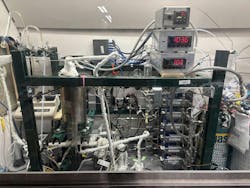
The lab work used a small-scale recirculating batch reactor (Figure 1) which helped maintain well-defined hydrodynamics and controlled reduction of the bismuth oxide catalyst.
About the Author
 Seán Ottewell
Seán Ottewell
Editor-at-Large
Seán Ottewell is a freelance editor based in Ireland. He has an impressive background in the chemical industry. After earning his degree in biochemistry at Warwick University, UK, he earned his master's in radiation biochemistry from the University of London. His first job out of school was with the UK Ministry of Agriculture, Fisheries and Food, London, where he served as scientific officer with the food science radiation unit.
From there he entered the world of publishing. In 1990, he was the assistant editor of The Chemical Engineer, later moving on to the chief editor's position. Since 1998, he has been a regular contributor to European Process Engineer, European Chemical Engineer, International Oil & Gas Engineer, European Food Scientist, EuroLAB, International Power Engineer, published by Setform Limited, London, UK.
Chemical Processing has been proud to call Ottewell Editor at Large since 2007.
He and his family run a holiday cottage in the small village of Bracklagh in East Mayo. He also fancies himself an alpaca farmer.