Nobel Chemistry Prize Honors Breakthrough in Molecular Chirality
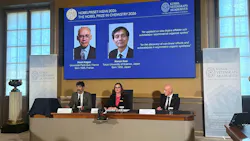
Stockholm — This year's Nobel Prize in Chemistry has been awarded to Henri Kagan of the former Paris-Sud University and Kenso Soai of Tokyo University of Science for "making chemistry choose a mirror image."
The Nobel Committee for Chemistry and the Royal Swedish Academy of Sciences in Stockholm announced on Wednesday that the duo were awarded for solving the puzzle of "homochirality," which refers to the two mirrored variants of many molecules including amino acids, only one of which is found in nature in the proteins of cells.
"How chemical asymmetry such as this could have emerged was long a mystery to chemists," the Royal Swedish Academy of Sciences said in a statement.
"Henri Kagan and Kenso Soai have provided a solution to a chemical mystery that is over a century old: how homochirality can emerge spontaneously. The chemical reactions they have developed are spectacular," said Heiner Linke, chair of the Nobel Committee for Chemistry.
"Thanks to Henri Kagan and Kenso Soai, we now know how homochirality can emerge. Their discoveries have been decisive for chemists who design reactions for the manufacture of pharmaceuticals," the Nobel citation read.
The principle of homochirality is of central importance in medicine: Many modern medicines are specifically developed as a single so-called enantiomer that produces the desired effect. The other variant, which may be ineffective or toxic, is therefore avoided.
For decades, however, it was impossible to prevent the formation of both variants during production. The most serious consequence of this phenomenon was arguably the thalidomide scandal of the 1960s, when the drug was prescribed as a sedative and sleeping pill, including for pregnant women. While one form of the active ingredient treated these symptoms, its mirror image caused birth defects in unborn children.
In the past, both enantiomers were always produced during the manufacture of medicines, explained chemist Matthias Breuning from the University of Bayreuth. "A scandal like the thalidomide one could have happened much earlier. People simply didn't know," he said. Today, care is taken during drug development and tests are carried out on both enantiomers.
Kagan, who was conducting research at the Paris-Sud University, later replaced by the Paris-Saclay University, discovered a way of manipulating chemical reactions in 1986, which enabled him to produce a greater excess of one of the two enantiomers.
Soai of the Tokyo University of Science later presented a chemical reaction in a 1995 publication that had the theoretical potential to produce homochiral molecules. In 2003, he then presented a reaction in which only one of the two enantiomers was actually formed.
"Other than life itself, no one had previously achieved this feat," the Swedish academy said.
Soai, 76, addressed the committee via video call following the announcement. "I am very excited to receive the very nice news," he said, adding that he was pleased to be sharing the prize with Kagan.
For Kagan, 95, the honour comes late in life. In 2013, the researcher admitted to the French magazine L'Actualité Chimique that he had been disappointed to be left empty-handed when the Nobel Prize was awarded for the same field of research in 2001 to William Knowles and Barry Sharpless from the United States, and Ryoji Noyori from Japan.
Soai and Kagan are set to share a prize of 12 million Swedish kronor ($1.2 million). The Nobel Foundation recently increased its award money as it celebrates the 125th anniversary of the prizes.
The awards ceremonies are scheduled to take place on December 10, the anniversary of the death of the prize's founder, Alfred Nobel.
©2026 dpa GmbH. Distributed by Tribune Content Agency, LLC.