Membrane-Free Design Lowers Projected Cost of Electrochemical CO₂ Capture
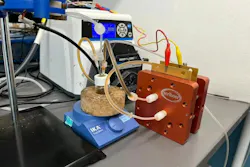
Researchers at Johns Hopkins University have developed a membrane-free electrochemical carbon-capture system that replaces the ion-exchange membrane used in conventional electrochemically mediated carbon capture with a solid sodium iron phosphate electrode. The change could reduce projected capture costs by eliminating membrane-related resistance, degradation and chemical crossover, according to the researchers.
The system pairs sodium iron phosphate, a material also used as a battery electrode, with 4,4'-azopyridine (AzPy). When an electric current is applied, the system captures CO₂, then releases it when the process is reversed.
Conventional electrochemical carbon-capture systems use polymer membranes to separate the CO₂-capturing chemicals from other parts of the electrochemical cell. The Johns Hopkins design instead uses sodium iron phosphate as a solid-state component, eliminating the membrane.
Researchers tested several solid materials before selecting sodium iron phosphate and found that sodium-ion movement through the material affected both the rate of operation and CO₂ capture capacity.
In tests using a gas stream containing 10% CO₂, the system operated for 75 capture-and-release cycles over 350 hours and captured an average of 89.8% of its potential CO₂ capacity. Under conditions representing ambient air, with 400 parts per million CO₂, the system completed 80 cycles over 210 hours and captured an average of 58.6% of its potential capacity.
The system also operated in simulated air containing 400 parts per million CO₂ and 20% oxygen, completing 40 cycles over 92 hours. The study and its findings were recently published in Nature Chemical Engineering.
An economic analysis by the research team estimated that a conventional membrane-based system costs approximately $207 per ton of CO₂ captured, with the membrane accounting for 28.9% of that cost. Eliminating the membrane and regenerating the sodium iron phosphate could reduce the estimated cost to about $148 per ton, according to the researchers. Further improvements to equipment, materials and electricity supply could reduce the projected cost to $58.20 per ton for concentrated CO₂ sources.
For direct air capture, the team estimated a cost of approximately $1,233 per ton for the conventional membrane-based system. Improvements to capture efficiency and equipment could reduce that estimate to about $284 per ton.
The researchers say the electrochemical system can be scaled by stacking multiple units. Further work will focus on improving the materials and equipment and operating the system at larger scale.
Why This Matters
For chemical engineers evaluating electrochemical carbon-capture systems, the work addresses a specific equipment limitation: the ion-exchange membrane. The researchers’ testing indicates that removing the membrane can reduce resistance and avoid membrane degradation and chemical crossover, while their economic analysis projects lower capture costs. The reported results remain laboratory-scale, however, and the projected costs depend on further improvements to materials, equipment and electricity supply.