CSB Finds Tank-Wall Thinning Preceded Fatal Washington Pulp Mill Failure
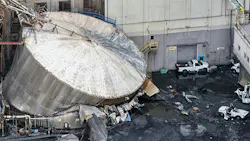
The U.S. Chemical Safety and Hazard Investigation Board (CSB) said it has identified significant tank-wall thinning as a key issue in its ongoing investigation into the May 26, 2026, catastrophic failure of a 1.2-million-gallon atmospheric storage tank at Nippon Dynawave Packaging’s pulp and paper mill in Longview, Washington.
The tank, identified as G Tank, released approximately 900,000 gallons of extremely hot, highly caustic white liquor, fatally injuring 11 employees and seriously injuring three others.
On the day of the incident, a process upset stopped the flow of white liquor from G Tank to the mill’s digestor, while white liquor continued entering the tank from the recausticizing process. The resulting increase in tank level preceded the catastrophic failure, according to the CSB.
In its update, the CSB reported that an external inspection of G Tank, conducted in July 2025, found that significant portions of its carbon-steel shell had thinned to below the calculated minimum safe thickness. The inspection contractor recommended an internal inspection and repairs, stating that the tank was not fit for continued service unless repaired, with a high likelihood of failure and significant consequences.
Nippon Dynawave conducted additional external inspections in October 2025 and February 2026. According to the CSB, both inspections found that substantial portions of the tank shell remained below the calculated minimum safe thickness. The tank nevertheless remained in service without an internal inspection or repairs, removal from service, or reduced operating conditions.
“Although the CSB’s investigation is still ongoing, we are greatly concerned that the tank was not promptly removed from service or properly repaired after the clear findings in the inspection report,” CSB Chairperson Steve Owens said in a statement.
CSB Investigator-in-Charge Drew Sahli said the minimum safe thickness represents the amount of material required for an atmospheric storage tank to safely contain its contents. He contends G Tank had areas with thicknesses below the minimum required for continued operation under its typical conditions.
The CSB is continuing to examine the circumstances surrounding the failure, including the tank’s condition, inspection and maintenance practices, operating conditions and emergency response procedures.
The update is the latest in a series of recent CSB activities. Last week, the agency released a safety video revisiting the January 2021 liquid nitrogen release at the Foundation Food Group poultry processing plant in Gainesville, Georgia. The incident killed six workers and seriously injured three others. According to the agency, the video highlights findings involving a single point of failure, atmospheric monitoring and alarms, emergency preparedness, process safety management and product stewardship.