Lubrizol, University of Pittsburgh Advance Continuous Chemical Manufacturing Process
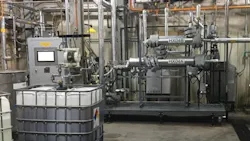
The University of Pittsburgh (Pitt) and Lubrizol developed a continuous manufacturing process for a chemical dispersant production line that was recognized in the 2025 Manufacturing USA Report to Congress as an example of industry-academic collaboration supporting domestic manufacturing innovation.
Through the U.S. Department of Energy-sponsored RAPID Manufacturing USA institute, researchers from Pitt’s Swanson School of Engineering and Lubrizol converted the process from large-batch production to a modular continuous system housed in a compact unit. According to the organizations, the approach reduced capital costs by 65% and operating costs by 60% while improving product quality.
The project was based on process-intensification research led by Götz Veser, professor of chemical engineering at Pitt, whose laboratory developed the prototype reactor technology used as the foundation for the continuous production modules.
“Process intensification enables us to do more with a far smaller physical, economic, and environmental footprint, and Lubrizol was willing to collaborate and put it into practice,” said Veser in a press statement.
According to Lubrizol, the collaboration with RAPID helped move the technology from research toward commercial-scale application and created a framework for applying similar approaches to specialty chemical manufacturing.
The project is part of a broader Pitt-Lubrizol research partnership focused on chemical engineering, sustainability and workforce development.
The collaboration follows recent efforts Lubrizol has undertaken to advance manufacturing technology at its CPVC resin production facility in Louisville, Kentucky, where the company installed LED reactor technology designed to improve resin stability, energy efficiency and production flexibility. According to Lubrizol, the upgrade is intended to support longer production runs and improved process performance.