Get Your Coriolis Tube Design Right — or Pay for It Later
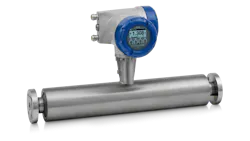





Selecting the right Coriolis flow meter tube design goes beyond pressure, temperature and flow rate specs — it can reduce how much a plant spends on pumps and energy for the life of a pipeline. In this Solution Spotlight episode of Chemical Processing Distilled, Al Dhanji, chemical industry manager for the Americas at KROHNE, breaks down straight tube versus bent tube designs and how each handles high-viscosity products, slurries and aggressive chemicals. Using honey and water as examples, Dhanji explains why forcing fluid to change direction creates pressure drop, driving up pump size and energy costs. He also covers how tube design affects performance under entrained gas conditions.
Transcript (edited for clarity):
Traci: Welcome to the Solution Spotlight edition of our Chemical Processing Distilled podcast. Solution Spotlight dives deeper into a topic from an industry perspective. I'm Traci Purdum, editor-in-chief of Chemical Processing. Please subscribe to this free podcast on your favorite platform.
In today's episode, we're discussing how to select the correct Coriolis flow meter tube design to maximize uptime and realize continued cost savings. Joining me today is Al Dhanji, chemical industry manager for the Americas at KROHNE. Al has been in the process instrumentation industry for more than 26 years. He started his career in service, transitioned to marketing, and now works in sales. He holds a bachelor's degree in electronics engineering technology and a master's degree in engineering management. Thanks for joining me, Al.
Al: Thank you, Traci. I appreciate the opportunity to share some knowledge on Coriolis flow meter tube designs.
Coriolis Meter Shapes, Configurations
Traci: We're always glad for more knowledge, especially me — I'm not as well-versed in Coriolis meters as I should be, so I'm excited to learn more today. Let's get started. What tube shapes or configurations do Coriolis meters typically come in, and how do they differ?
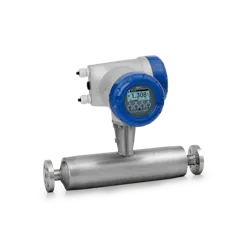
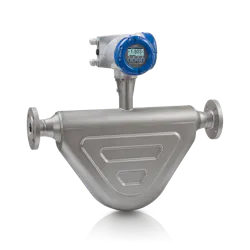
Al: Good question, Traci. Coriolis meters come in all kinds of shapes. Some are triangular, some look like a capital U, and some — when installed in a pipe — don't even look like a Coriolis meter because there's no bend in the measuring tube at all. That's called a straight tube design.
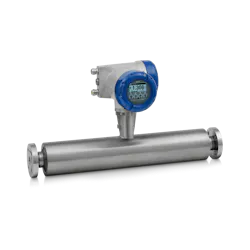
In the industry today, there are two main categories: straight tube design, where the measuring section is perfectly straight, and bent tube design, which covers everything else — a capital U, a V, tubes coming out the top and bottom, you name it. If it's not straight, it's a bent tube design.
Why Does Material Matter?
Traci: They come in different shapes, but do they also come in different materials of construction? And why does that matter for chemical processing applications?
Al: Good question. They absolutely come in different materials, and the main reason is compatibility with the media being measured. Take water, for example — a fairly docile liquid. A Coriolis meter with a stainless steel measuring tube would hold up perfectly and provide a good lifespan for that application.
But if the product is 50% sulfuric acid, stainless steel won't cut it — the tubes would decay within a short period. In that case, a measuring tube made of Hastelloy C would be more appropriate to ensure an adequate lifespan.
Other common materials include titanium, tantalum, duplex and super duplex stainless steel, among others. The goal with all of them is the same: making sure the tube is chemically compatible with the media it's measuring.
Traci: Do you find that folks sometimes pick the wrong material?
Al: Yes, that happens occasionally. And I gave a pretty simplistic example with the 50% sulfuric acid — temperature and other parameters come into play, too. But for the most part, customers specifying meters already know the requirements because they've done an in-depth analysis of the piping needed to transport the fluid from point A to point B. Most of the time, when customers specify a particular material, they're accurate and know what they need.
Shape Impacts Performance
Traci: Let's talk more about design — the U-shape, the triangle shape. How does tube shape affect performance and help maximize uptime?
Al: The best way to explain it: picture a vertical section of pipe with fluid flowing upward. I cut into that pipe and install a straight tube meter. The fluid enters the bottom, flows straight through without changing direction, and exits the top into the pipeline.
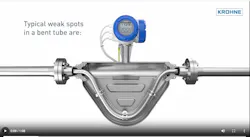
Now compare that to a bent tube meter. The flow still enters vertically at the bottom — there's a short straight section — but then the bent design forces the fluid away from its natural path. Say it's a triangular Coriolis meter: the flow changes direction to go down one leg of the triangle, changes direction again across the bottom, changes direction a third time to come back up the other leg, and then exits into the pipeline.
Every time you force fluid to change direction, you create a pressure drop. And a pressure drop introduces other challenges to the measurement and to the overall system.
Challenges
Traci: What are some of those challenges — pump sizing, energy costs, overall efficiency?
Al: Exactly, very good question. We already covered the pressure drop — forcing the fluid to change direction in a bent tube meter creates that drop. Say I've got a section of pipe where I want to install two Coriolis meters for redundancy. I can choose a straight tube design or a bent tube design.
Once the pipeline is designed, I need a pump to push the fluid through it, and pumps are typically rated in gallons per minute with a certain head pressure. Let's say my fluid engineers calculate that I need a 100-gallon-per-minute pump with 50 psi of head pressure to run the fluid efficiently. Now they ask which Coriolis meter I recommend.
If I run the numbers for a bent tube design versus a straight tube design, I might find that instead of a 100-gpm pump at 50 psi, I now need a 150-gpm pump at 75 psi. Two things happen: first, a bigger pump costs more upfront. Second, over the lifespan of the pipeline, running a 150-gpm pump at higher pressure consumes more energy, so I'm paying more over time, too.
That's why tube design matters from the very beginning — it can deliver savings both in the size of pump you buy and over the lifetime of the pipeline.
Traci: Interesting things to consider that might not be top of mind. What tube design factors matter most for challenging media — high viscosity, solids-laden, or aggressive chemical streams common in chemical processing facilities?
Al: Let's use two products people know well: honey and water. If I invert a bottle of honey to sweeten my tea, the honey may start to flow, but eventually I have to squeeze the bottle to force it out. That's because honey has a higher viscosity — it takes more energy to move. Compare that to a bottle of water, where I have to be careful not to tilt it too far, or I'll choke on how fast it comes out.
Now put both products into a pipeline. With honey, if I install a Coriolis meter — which measures volume flow, mass flow and density, making it a multi-parameter instrument — do I want to force that viscous product through a bent measurement section and back up again? Or is it easier to use a straight tube design, so I'm not forcing the honey to change direction, which requires additional energy?
We can go a step further: straight tube meters can be single-tube or multi-tube designs. For a highly viscous product, I'd use a single-tube design. With a multi-tube design, the honey is forced to split — say, into two smaller tubes in a twin-tube design — which takes even more energy, before the two tubes merge back into one on the way out. The more effective design is a single straight tube where the honey isn't forced to split at all, and the tube diameter stays close to the diameter of the connecting pipe. For a high-viscosity product, a single straight tube meter gives you the most efficient performance.
The same logic applies to solids-laden fluids, or slurries. With a bent tube meter, forcing the slurry to change direction creates a wear point — the tube walls thin out over time and can eventually develop a hole, both where the fluid enters and where it's forced to change direction again on the way out. A straight tube design minimizes that wear. And again, I'd use a single-tube design rather than a twin-tube design, so the slurry isn't split as it flows through.
For high-viscosity products and slurries, a single straight tube meter design gives you the best performance for your money.
Aggressive chemical streams are more of a toss-up — there, material of construction matters most. I need to make sure the tube material is compatible with the chemical. But based on everything we've covered about bent versus straight tube designs, my personal preference is still a straight tube design, paired with a material of construction that will hold up to the aggressive chemical.
Entrained Gas
Traci: Great visualizations — I appreciate that. Let's move on to entrained gas. How does it affect performance, and how can tube design or technology help maintain accurate readings under those conditions?
Al: Good question. Entrained gas conditions in a Coriolis meter are typically referred to as two-phase flow. A Coriolis meter performs very well in single-phase fluid — 100% liquid, or close to it, with little to no gas. Once gas gets entrained, it creates a challenge for the meter, and I'll explain why.
The flow shifts from single-phase to two-phase. For a simple example, picture the fluid with one large bubble or pocket of air entrained in it. Before the air, the fluid was 100% liquid flowing through the meter with a certain, predictable signal-processing requirement. Once that air pocket enters, two things happen.
First, the bubble decouples the fluid from the measurement tube wall, which dampens the signal going back to the Coriolis electronics. Second, you get a huge step change in density, since the density of a gas pocket is significantly lower compared to the same volume of liquid. That makes it a challenging measurement.
Some Coriolis meters on the market have entrained gas capabilities built in, either standard or as an option. These meters are designed to detect the signal damping and density changes and activate an algorithm to counteract the entrained gas, or two-phase, regime.
You will lose some accuracy when dealing with entrained gas — that's unavoidable. But a Coriolis meter with entrained gas capability will maintain repeatability. The benefit is that you're guaranteed to keep measuring. Without that capability, the meter can saturate and go into a restart mode, and you lose the measurement altogether. Some meters hold a value and wait for density to recover before resuming measurement — but during that time, you're still losing data. A true entrained-gas-capable meter continues measuring through the different flow regimes, sacrificing some accuracy but maintaining repeatability and providing you with a measurement of your process.
There's also a diagnostic benefit: an entrained-gas-capable meter can notify you when you're operating in an entrained gas regime. That's extremely valuable as a preventive diagnostic. If the process ran for days with no entrained gas and the algorithm suddenly kicks in, you know something upstream of the Coriolis meter — in the pipeline, , the mixing, or the process itself — has shifted out of normal operation.
Selecting The Correct Coriolis Meter
Traci: Very telling, and important. We've covered a lot — can you bring it all home with your recommendations for selecting the proper Coriolis meter?
Al: Great question, Traci, and I appreciate the chance to close on this note. When sizing a Coriolis meter, companies have traditionally focused only on application parameters — pressure, temperature, minimum, nominal and maximum flow rates, and ideally density and viscosity. Materials of construction is another parameter people are used to evaluating.
But the reason I wanted to do this podcast is to convey that there's a third important factor to evaluate: tube design itself. Does the application lend itself to a straight measurement tube design, or a bent tube design? That question deserves a place in the Coriolis meter selection process, too.
Traci: Al, thank you for sharing your deep knowledge of Coriolis tube design and helping our listeners understand it better. I appreciate your thoughtful answers and your time on this Solution Spotlight edition of Chemical Processing Distilled. Listeners, visit ChemicalProcessing.com for more tools and resources to help you succeed. On behalf of Al and KROHNE, thanks for tuning in. Thanks again, Al.
Al: Thank you, Traci. I appreciate the opportunity.
For more information, visit KROHNE's site. https://www.krohne.com/en-us/products/flow-measurement/flowmeters/coriolis-mass-flowmeters