Roundup: Chemical Industry Products to Watch - July 2026

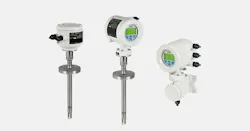
Thermal Mass Flowmeter Earns SIL 2 Certification
ABB introduced a SIL 2-certified version of its SensyMaster FMT400 thermal mass flowmeter for use in safety-critical process applications requiring integration into Safety Instrumented Systems (SIS).
Certified by TÜV SÜD to IEC 61508-2, the flowmeter enables thermal mass flow measurement in applications where functional safety compliance is required. The device performs direct mass flow measurement of natural and industrial gases by measuring how a heated sensor cools as gas flows past it. It also provides continuous self-diagnostics and fault detection to support process safety and equipment reliability, according to the company.
The flowmeter can be integrated into automated SIS architectures, allowing thermal mass flow measurement to be incorporated into safety loops. Built-in diagnostics provide real-time device health monitoring and predictive maintenance capabilities that reportedly reduce reliance on manual inspections and improve plant availability.

Inline Measurement System Monitors Monomer Condition in Real Time
SensoTech introduced the LiquiSonic inline measurement system, designed to continuously monitor polymerization-critical monomers during unloading, storage, transfer and production.
The inline measurement system continuously measures the condition of monomers such as methyl methacrylate, styrene, acrylates and methacrylates directly in pipelines or bypass installations. Using sound velocity and temperature measurements, the system creates an acoustic fingerprint of the process fluid to detect changes that may indicate the onset of polymerization or other product deviations, according to the company.
The measurement system operates without consumables and provides real-time process data that can be displayed locally, documented or transmitted to a plant control system. This enables operators to integrate monitoring, alarms and process logic into existing operating procedures.
The inline measurement system is designed for tank farms, chemical terminals and production facilities handling polymerization-critical monomers, providing continuous condition monitoring to support process safety, product quality and transfer operations.
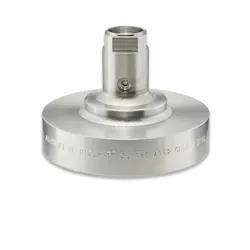
All-Welded Diaphragm Seals Protect Instruments in Harsh Processes
Ashcroft introduced the 502 and 503 all-welded flanged diaphragm seals, designed to isolate pressure instruments from hazardous and corrosive process media in demanding industrial applications.
The diaphragm seals feature a one-piece, all-welded construction that eliminates nonmetallic components within the seal assembly, reducing potential leak paths in applications where leak integrity and personnel safety are critical. The seals are designed for processes including sour gas separation, biogas and biodiesel production.
The diaphragm design supports a range of pressure ratings independent of pipe diameter and is available in process connection sizes from 1/2 to 1 1/2 NPS with ASME B16.5 Class 150 through 1500 flange configurations. Standard material traceability reports and positive material identification documentation are included for applications requiring material verification, including NACE-compliant environments.
The diaphragm seals are available with multiple wetted diaphragm and flange material options and offer a typical added tolerance of ±0.5%, according to the company.

Advanced Thermoplastic Y-Strainer Simplifies Maintenance
Hayward Flow Control introduced the YSH Series Y-Strainer, a thermoplastic y-strainer designed to improve flow performance while simplifying installation and maintenance.
The y-strainer features a one-piece injection-molded body with an increased barrel size and optimized barrel angle to improve flow capacity. A one-piece perforated thermoplastic screen with welded end caps and a snap-fit retainer is designed to increase strength, open area and straining capacity. The strainer is available in true union and integral socket or threaded-end configurations in sizes from 1/2 to 2 in.
Constructed from PVC, clear PVC or CPVC with EPDM or FPM O-rings, the strainer is pressure rated to 150 psi at 70°F under non-shock conditions. Standard features include permanent body markings, external buttress barrel threads, a piston seal and an 800-micron perforated screen. For sizes 1 in. and larger, drilled and tapped access points accommodate pressure gauges.
The strainer is designed for municipal water and wastewater treatment, chemical transfer and processing, mining and mineral processing, metal finishing and cooling system applications. Additional options include drain ports, stainless steel and alloy screens and alternative O-ring materials.
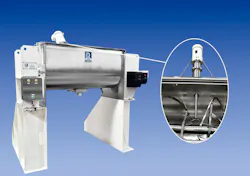
Ribbon Blender Improves Powder Mixing and Batch Consistency
Charles Ross & Son Company introduced the Model 42N-18 ribbon blender, an atmospheric mixer designed to provide uniform blending of powders, granules and dry bulk solids.
The ribbon blender has an 18-cu.-ft. working capacity and a 22-cu.-ft. total capacity. A double ribbon agitator, powered by a 7.5-hp motor, operates at speeds up to approximately 47 rpm with variable speed control to 5 rpm. A high-speed, four-blade chopper mounted on the mixing trough operates up to 1,800 rpm to improve dispersion of minor ingredients and reduce agglomerates, helping produce more consistent batches.
Constructed from Type 304 stainless steel with an 80-grit interior finish, the blender includes a hinged cover with an FDA-compliant silicone gasket, NEMA 12 safety interlock switches and a removable safety grate for cleaning and maintenance.
A pneumatically operated 4-in. dust-tight knife gate valve supports controlled product discharge, while an integrated load cell system provides batch weighing and process monitoring. Digital controls allow operators to monitor agitator speed and motor load and adjust operating parameters.