5 Quick Questions with Brad Buecker: On Water Treatment, Writer's Block and Why Safety Is Never Optional
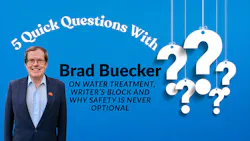
Brad Buecker, a frequent contributor to Chemical Processing, is a senior technical consultant at SAMCO Technologies and owner of Buecker & Associates, LLC. He has decades of experience in the power industry, specializing in steam generation chemistry, water treatment and air quality control, with prior roles at City Water Light & Power, Kansas City Power & Light, Burns & McDonnell and Kiewit. He holds a degree in chemistry from Iowa State University, has authored over 300 technical articles and three books on power plant chemistry and air pollution control, and is active in numerous professional organizations, including AMPP, ACS, AIChE and ASME.
I had him as a guest on a recent episode of CP's Distilled podcast, and I enjoyed our conversation so much that I wanted him to answer my five favorite questions.
Here's how he tackled my queries:
What's something you've learned recently that changed how you approach your work?
I continue to learn how the internet can be a valuable tool for researching technical information at a moment's notice. As I morphed from direct industry positions to technical consulting and writing for publications such as Chemical Processing, I relied (and still do to a great extent) on my hands-on experience. But technology always moves forward, and I use the internet to search for reliable references and technology updates. However, one must always evaluate information carefully and discard suspicious materials that come from unqualified individuals or groups. I see some of these same issues with LinkedIn posts, although many experts provide excellent information via this platform.
Also, although my direct experience is largely in the power and water treatment industries (with some valuable time at a chemical plant), I have made it a point to study general process details of the refining, steel and energy recovery industries, among others. I value obtaining practical knowledge about these industries and learning how plant processes can influence makeup water treatment, condensate and steam generation chemistry, cooling water system performance and wastewater treatment issues.
What part of your work energizes you most, and what drains you?
Most energizing is bringing valuable information to new industry personnel who are replacing the many retiring Baby Boomers. New employees can be overwhelmed when starting work at a large CPI or other industrial plant, where the learning curve is steep. I have always loved preparing good, practical articles for both new and experienced employees and presenting this information at important technical meetings, such as the International Water Conference, POWERGEN and the Electric Utility & Cogeneration Chemistry Workshop. Rewarding has been the positive feedback from industry colleagues over four decades who have been able to use the information immediately. My current employer, SAMCO, recognizes the value of this approach and strongly supports my efforts.
What drains me? Similar, perhaps, to an artist (but with drier material), periodic mental blocks. These are not terribly problematic regarding articles and presentations, but my three books presented tougher challenges in that regard.
If you could solve one problem in the chemical industry tomorrow, what would it be?
You and I recently discussed this thought in a CP podcast: the frequent tendency for CPI management and technical personnel to focus on process engineering and chemistry, somewhat to the neglect of makeup water, steam generation and cooling water treatment. I have observed this mindset both directly and via conversations with water treatment colleagues over the years. Then, when a boiler or cooling system fails (partial cooling tower collapse is not an unknown problem), the plant staff goes into a panic. Preventive rather than reactive operation and maintenance can pay off many times over.
What's a project or accomplishment you're proud of that others might not fully appreciate?
In the mid-1980s, a previously unknown problem, flow-accelerated corrosion (FAC), emerged in the power industry. The first observed incident caused a feedwater piping failure at a nuclear plant that killed four personnel. Subsequent failures have injured or killed plant personnel at other power plants, including a sister plant to the one where I worked. (That incident makes the issue extra personal.) FAC is a global phenomenon that top power industry research organizations, such as the Electric Power Research Institute, continue to address. I have had the good fortune to support these efforts and write about the topic a number of times in several publications. I am hopeful that the articles have alerted some plant personnel to the dangers of FAC, and that they in turn have initiated steps to investigate and correct any problems at their facilities.
How has your work influenced how you see the world outside of your job?
The importance of safety. Electronic information sharing now alerts us almost immediately to safety failures, as the recent fatal tank implosion in Washington and near-catastrophic tank failure in California illustrated. Companies simply can't take shortcuts regarding safety and employee training. One issue with many facets that has caused many horrible accidents is corrosion. Corrosion can occur anywhere on both the process and water side of plant equipment (or even underneath insulation), where leaks may release extremely hazardous or explosive compounds. Another issue that Chemical Processing has strongly emphasized is dust control. My coal-fired power plant experience taught me the criticality of dust control, but many other materials, in particulate form, can detonate explosively. It is often easy to overlook dust accumulations in remote areas.
About the Author
 Traci Purdum
Traci Purdum
Editor-in-Chief
Traci Purdum, an award-winning business journalist with extensive experience covering manufacturing and management issues, is a graduate of the Kent State University School of Journalism and Mass Communication, Kent, Ohio, and an alumnus of the Wharton Seminar for Business Journalists, Wharton School of Business, University of Pennsylvania, Philadelphia.
Recent Awards:
2025 Eddie Award for her column "Lax Regulations Burn Rivers"
2024 Jesse H. Neal Award for best podcast Process Safety with Trish & Traci