Bird’s-Eye View Prevents Process Safety Groundings
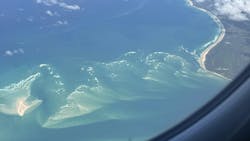
As I looked out the window on a recent flight, I could see the coastline and an amazing pattern of sandbars. It made me think about how perspective changes what we see. If I were in a boat on the water, I would not have been able to see the detail in the sand patterns. Because I was about 5,000 feet above sea level, I had a fantastic, bird‘s-eye view.
At sea level, I may have been at risk of running aground on the sandbars if I hadn’t had additional resources, such as a depth sounder, a GPS and even nautical charts. Our perspective determines what we see and what tools we need to use. Our ability to use these tools determines how successful we will be.
Several years ago, I went on a boating vacation. It was an area notorious for sandbars. So, all the rented boats had a very shallow draft. As we were cruising around on our first day, I was getting used to the depth sounder and GPS we had. It turned out I was not very skilled at using either! I ran us aground on a sandbar. The depth sounder was on the wrong screen, and I did not realize it. I also misjudged our position in relation to a known shallow area. I knew there was a shallow area to my port side; I also knew I needed to turn to port up ahead. I misjudged it all and turned too early. A simple phone call to the boat rental company, and they came and towed us out, no harm done, just a bit of embarrassment.
When we consider risk in our facilities, we face similar challenges. We focus on assessing the risks of specific activities or changes, but do we always make the effort to understand the bigger picture? Do we use the tools correctly? I was focused on the depth sounder, thinking I understood what I was looking at. I was standing at the helm, which was elevated, and had a good view of the area around the boat, but I was not focused on looking around. I failed to see what was in front of me. To be fair, the water was a little murky that day, and the sandbars weren’t easily visible from the helm.
As we prepare for risk assessments, we have several steps to undertake. We must gather all relevant process safety information, such as process and instrumentation drawings, operational data (like flow rates and pressures), and understand alarm set points and the logic of safety instrumented systems, etc. This is like gathering our nautical charts, depth sounder and GPS.
Additionally, we must assemble a qualified risk assessment team with demonstrated competency in their respective disciplines, ensuring coverage of all critical process areas. Competency alone is insufficient—these skills must be current and actively maintained. About 25 years before this vacation, I had qualified as a coxswain, but my skills were no longer current; I was in a very different boat and navigating different waters.
As part of our risk assessment, we also need to understand interdependencies. This is like our bird’s-eye view. This information is often gathered by looking at the cumulative impact of management of change activities.
There is one other key element that is often overlooked. Consulting with the true experts. These are the operators and maintainers. In my boating example, it was the boat hire people who had valuable information that I needed to know, but didn’t know enough to ask. They could have told me of the landmarks to align before I made my turn to port. They didn’t think to tell me because they know the waters so well, they assume everyone does. This is called the curse of knowledge — when we know something so intuitively that we assume everyone else knows it too. So carefully crafted requests, like “take me through this task,” can help people to start explaining the process as they operate it. We can then ask follow-up questions to uncover all the necessary information. But this can only happen if we have the right people in the room, the people who know how the plant really runs.
The next time you prepare for a risk assessment, ask yourself if you have all the resources and information available. How do you achieve the bird’s-eye view to show the cumulative impact of risk? Is your depth sounder giving you accurate real-time data, and how would you know? Is your GPS location correct, and do you understand what direction you are moving in? Are the true experts in the room?
About the Author
 Trish Kerin, Stay Safe columnist
Trish Kerin, Stay Safe columnist
Director, Lead Like Kerin
Trish Kerin is an award-winning international expert and keynote speaker in process safety. She is the director of Lead Like Kerin Pty Ltd, and uses her unique story-telling skills to advance process safety practices at chemical facilities. Trish leverages her years of engineering and varied leadership experience to help organizations improve their process safety outcomes.
She has represented industry to many government bodies and has sat on the board of the Australian National Offshore Petroleum Safety and Environmental Management Authority. She is a Chartered Engineer, registered Professional Process Safety Engineer, Fellow of IChemE and Engineers Australia. Trish also holds a diploma in OHS, a master of leadership and is a graduate of the Australian Institute of Company Directors. Her recent book "The Platypus Philosophy" helps operators identify weak signals.
Her expertise has been recognized with the John A Brodie Medal (2015), the Trevor Kletz Merit Award (2018), Women in Safety Network’s Inaugural Leader of the Year (2022) and has been named a Superstar of STEM for 2023-2024 by Science and Technology Australia.