
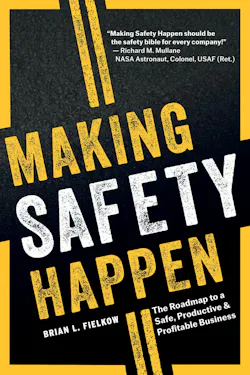
Brian Fielkow has spent decades turning safety leadership into business strategy. As CEO of Jetco Delivery, he built a safety culture that earned national recognition. Today, he leads a national team helping companies across high-consequence industries strengthen culture, reduce risk and drive performance. A recipient of the National Safety Council's Distinguished Service to Safety Award and a sought-after international speaker, he has contributed to The Wall Street Journal and Entrepreneur. His new book, “Making Safety Happen,” distills those lessons into a practical roadmap for leaders at every level.
What was the motivation to write this book?
I wrote “Making Safety Happen” to provide a practical roadmap for leaders building healthy safety cultures. The book recognizes that safety is both a leadership responsibility and a business strategy.
Strong cultures, disciplined processes, engaged employees and visible leadership commitment are what ultimately drive safety. While many resources focus on regulations and theory, “Making Safety Happen” is designed to be accessible, practical and actionable — translating proven principles into clear, step-by-step guidance that leaders, managers, engineers and frontline employees can apply immediately.
My goal was to create a true "how-to" guide that helps organizations build the systems, behaviors and culture that make safety happen every day.
What fundamental concepts can readers expect to learn?
Readers will learn that safety performance largely reflects organizational culture and leadership behavior. The book explores leadership accountability, employee engagement, psychological safety, incident response, learning from failure and unconditional respect for process.
For operators and engineers in the chemical industry, one of the most relevant themes is that process integrity depends on people. Even the best-designed safety systems can fail when procedures are bypassed, risks become normalized or communication breaks down. The book focuses on creating environments where employees feel empowered to identify hazards, challenge unsafe conditions and consistently follow critical processes.
The book also explores how management systems, process discipline, management of change and operational decision-making influence safety outcomes. It challenges the notion that leadership is reserved for executives and emphasizes that safety leadership must occur at every level of the organization — including a focus on leading indicators, continuous improvement and building resilience before an incident occurs.
Can you highlight any challenging topics the book addresses?
One is the tension between production and protection. Many organizations unintentionally create conditions in which employees feel pressured to take shortcuts to meet schedules, production targets or customer demands. The book examines how leaders can recognize those pressures before they contribute to an incident.
Another is how organizations measure safety success. Many companies have extensive safety scorecards that may not measure the factors that truly predict risk. The book explores the difference between lagging indicators and meaningful leading indicators and discusses why organizations must focus on identifying and controlling serious injury and fatality exposures rather than relying solely on injury rates.
The book also addresses accountability — specifically, how organizations can hold everyone accountable while maintaining the trust needed for employees to speak up about risks and concerns.
Finally, the book examines incident response and organizational learning. The most important lessons emerge after something goes wrong, but only if leaders look beyond individual mistakes to examine the systemic causes that enabled the event. The goal is not simply to investigate incidents, but to use them as opportunities to strengthen the organization and prevent recurrence.
Were there specific gaps in existing resources you aimed to fill?
Many excellent safety resources address regulations, compliance, engineering controls or technical risk management — but they often overlook the leadership and cultural factors that determine whether those systems succeed in practice.
My background as a business owner, CEO and executive gives me a somewhat different perspective. Having spent decades running companies in high-consequence industries, I understand the realities leaders face: customer demands, operational challenges, financial pressures and the constant need to balance competing priorities. Safety cannot exist in a vacuum. It must be integrated into the way the business operates.
My goal was to bridge the gap between technical safety management and day-to-day leadership — a resource executives, managers, supervisors, engineers and frontline employees could all use to understand their role in building a safer, higher-performing organization.
The book focuses on implementation and is designed to answer the question many leaders ask: "How do we actually make safety happen consistently?" Rather than explaining what good safety looks like, it provides practical guidance, real-world examples and actionable steps for building stronger cultures, improving accountability and achieving sustainable results.
What practical examples or case studies will readers find valuable?
The book examines well-known incidents across multiple industries to demonstrate how organizational decisions, leadership behaviors and cultural weaknesses contribute to catastrophic outcomes. These include the Deepwater Horizon disaster, the Massey Energy Upper Big Branch mine disaster and the Boar's Head food safety crisis. While the circumstances differ, each reveals important lessons about leadership, risk management, process discipline and organizational culture.
Readers in the chemical sector will recognize recurring themes: process discipline failures, communication breakdowns, normalization of deviance, inadequate management of change and weak accountability systems. These are not unique to any one industry — they are common contributors to serious incidents across virtually every high-risk operating environment.
A key lesson from these cases is that major incidents rarely result from a single failure. They are usually the culmination of small compromises, missed warning signs and cultural weaknesses that develop over time. Recognizing those patterns helps organizations address risks before they become catastrophic.
I also share lessons from my own leadership experiences, including incidents within organizations I led. Some of the most valuable lessons in the book come not from success stories, but from examining what happens when things go wrong — and what leaders choose to do next.
What other resources do you recommend?
One book that significantly influenced my thinking is "The Checklist Manifesto" by Atul Gawande. It demonstrates how simple, well-designed checklists can dramatically improve performance and reduce errors in complex, high-risk environments — a concept that aligns closely with the book's theme of unconditional respect for process.
I also encourage readers to follow the work of the National Safety Council on serious injury and fatality prevention. The council's research has helped organizations understand that traditional safety metrics do not always reveal exposure to catastrophic risk and reinforces the need to identify, measure and control the exposures most likely to cause life-altering injuries and fatalities.
More broadly, I recommend studying organizational culture, leadership, human performance and high-reliability organizations. Many lessons from aviation, healthcare and nuclear power apply directly to chemical manufacturing.
What impact do you hope the book will have?
My hope is that readers come away with a broader understanding of safety as a business and leadership issue — not simply a compliance requirement.
For operators, engineers and leaders in the chemical industry, the stakes are incredibly high. A single serious incident can affect employees, families, communities, customers and shareholders. If this book helps build stronger cultures, encourages employees to speak up and prevents even one serious injury or catastrophic event, it will have achieved its purpose.
I also hope readers recognize that leadership is not limited to those with management titles. Leadership can and must occur at every level of the organization. Whether someone is a plant manager, engineer, supervisor, operator or maintenance technician, they can influence others, reinforce standards, identify risks and help shape culture.
Ultimately, I hope readers see that safety excellence results from intentional leadership, disciplined execution and a culture where every individual understands their role in protecting people and strengthening performance.
About the Author
 Traci Purdum
Traci Purdum
Editor-in-Chief
Traci Purdum, an award-winning business journalist with extensive experience covering manufacturing and management issues, is a graduate of the Kent State University School of Journalism and Mass Communication, Kent, Ohio, and an alumnus of the Wharton Seminar for Business Journalists, Wharton School of Business, University of Pennsylvania, Philadelphia.
Recent Awards:
2025 Eddie Award for her column "Lax Regulations Burn Rivers"
2024 Jesse H. Neal Award for best podcast Process Safety with Trish & Traci