Podcast: Who's Taking Care of the Safety Pro?
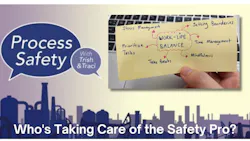




On this episode of Processing Safety with Trish and Traci, General Atomics safety engineer Valerie Stakes returns to discuss well-being in the safety profession, building on her 2026 ASSP conference session. She, Trish Kerin and Traci Purdum explore why safety professionals — often wired to please and fix — struggle to set boundaries and how compassion fatigue, unappreciated efforts and repeated exposure to injuries and fatalities take a cumulative toll. They share personal stories of burnout, offer tips on debriefing, networking and using employee assistance programs and close with a guided breathing exercise. The episode also answers a listener’s question on the role of training in operations and emergency response.
Transcript
Welcome to Processing Safety with Trish and Traci, the podcast that aims to share insights from past incidents to help avoid future events. Please subscribe to this free, award-winning podcast on your favorite platform so you can keep learning with Trish and me. I'm Traci Purdum, editor in chief of Chemical Processing, and joining me, as always, is Trish Kerin, director of Lead Like Kerin. We also have a special guest today: Valerie Stakes, safety engineer at General Atomics Aeronautical Systems. Val has been a guest on this podcast a few times already, so welcome back, Val.
Valerie: Thank you for having me back. It's a pleasure.
Reader Question Answered
Traci: Looking forward to it. But before we get into today's episode, Trish, we have mail. One of our listeners sent us a question.
Trish: Oh, exciting.
Traci: Danny from South Carolina has a background in production, training and emergency response in the chemical industry, mostly involving nuclear fuel production and the conversion of uranium into usable fuel. He's retired now and teaches incident command, fire hazmat and rope rescue. His question for you, Trish, is: What part does training play, not only in emergency response, but in day-to-day operations?
Trish: Thanks for that question, Danny. That's a great one. Training forms the fundamental foundation of how we build competence in anything. Simply completing a training course isn't enough to call ourselves competent — competence requires practice and experience built up over time. But without the training, we don't have the fundamental knowledge to build on.
When it comes to emergency response, training is usually designed to build what we call muscle memory. It teaches us that when scenario A happens, our response needs to be B, and we carry it out. It's a little like driving a car: We learn when to hit the brake because we've learned to observe situations and respond to them.
In day-to-day operations, training serves a similar purpose. It helps us keep operations on track by teaching us the likely outcome of our actions. If I open or close that valve over there, what will it do to the rest of the unit? How will it change the process? If the temperature starts to rise, do I need to add cooling, relieve pressure, or take some other action? Training gives us that foundational understanding.
So training plays an incredibly important role — we can't have a competent workforce without it. But training alone doesn't make us competent. We still need practice and experience. We just need that foundation first.
Traci: Great answer. And Danny, thanks again for sending in that question. Now that we've handled the long-distance dedication, I feel like Casey Kasem over here.
Trish: Ha!
Traci: Thank you for getting that — for not making me feel old.
Trish: I'm old enough to remember listening to Casey Kasem every Sunday.
Well-Being For The Safety Professional
Traci: Well, let's dive into today's topic, which you suggested, Val, as a follow-up to your recent presentation at the 2026 American Society of Safety Professionals conference in June. You offered guidance on well-being for the safety professional — who's looking out for you, and how to recognize the not-so-hidden burdens of our roles. Walk us through the foundation here: What was the moment or the story that made you realize this topic needed its own conversation? And how did the session go — what were some of those conversations like?
Valerie: In terms of the inspiration for this topic, last year I had the opportunity to present on how to incorporate total worker health concepts into a safety program, and it became an important action item for our own department. For the last few years, we've focused a lot on the connection between mental and physical health and its potential impact on incident and injury rates — and, in turn, on how the work we do affects our own physical and mental health. So, looking in both directions.
As I worked to incorporate those concepts into safety committees, training and everyday activities within our department, I realized: What about us? As safety professionals, we're the ultimate caretakers. I thought, I'm exhausted from all that I do — I'm sure others feel the same way. We need to recognize how we fit into that total worker health concept, too, without ignoring the importance of taking care of employees. What about us?
The session itself couldn't have gone better. We had a nearly packed room, and there's nothing like speaking to a group where people are nodding along — not quite riveted, but hanging on your every word, nodding like, "Yes, that's me." I opened with, "Who needs some safety therapy?" and there was a whole show of hands. We had great participation and a lot of conversation about how to reinforce boundaries — we can get into that in a bit — and about accepting that vulnerability, saying you're not OK, is actually strength. We had close to 200 people in the room, and I'd say 25 to 30 of them stuck around afterward talking to each other and to me. I was in that conference room for another hour after the presentation ended.
Priorities
Traci: It's so important. Trish and I always talk about the day-to-day, the concrete tasks, the rat-a-tat-tat of everything. Trish, why must safety professionals prioritize the mental and physical well-being Val described?
Trish: First, Val, fantastic presentation, and a fantastic response. It's a wonderful feeling when you know you've connected with people, and I'm sure every safety professional listening can grasp that sense of satisfaction and pride when you've connected with an audience so well.
Why do we have to prioritize ourselves? Because if we don't, we can't be there to help anybody else. It's similar to the first-responder concept: We're there to take care of the workforce, but if we're not mentally and physically well ourselves, how can we be there for them?
Think about emergency responders. What's the first thing you're taught in a first-aid course? DRSABCD — D is for danger. Look around for danger before you jump in to help anybody else; make sure you'll be safe helping them. You have to prioritize your own well-being and safety first. Firefighters are the same — they don't just rush in. They evaluate the situation first. Our most highly trained emergency responders are trained to stop, evaluate and prioritize their own safety.
Yet as safety professionals, we often just go solve the problem. We're action-oriented people who want to fix things, and that can mean we put so much on the table that we leave nothing for ourselves. If we keep doing that, eventually we have nothing left to give, and the whole system falls down. It's not just about remaining well mentally and physically for our own sake — if we don't, we can't do the job we're here to do. And, as I've said before, being a safety professional is a bit of a calling. I know that sounds a little woo-woo and fuzzy, but — It really is. We do it because we're drawn to it. We have to.
Valerie: Without hesitating whatsoever, I'd say it's about being in service of others. I made that point at the conference: This is who I'm wired to be. I love what you were saying, because even though some of us on the team are lay responders, others are trained — we have a couple of EMTs on our team. We're often called in, and I was, just the other day. I had a medical emergency, and I had to step in and lead, because I became the incident commander at the scene.
And you can't lead while trying to drive through a blocked parking lot — I had to walk. There was a whole series of things, and it came down to keeping a sense of calm and being able to take that position. As you said, if we're burned out, we can't take care of others — there's the physical toll, let alone becoming ill, and the impact on relationships within the team itself. If you're burned out and your whole team is experiencing that dynamic, you're going to roll your eyes. You may not make the best decision. You lose empathy — that compassion fatigue of "oh my God, here it goes again," instead of recognizing the human involved. Sometimes people make interesting choices around safety, and there still has to be recognition and compassion: This person got injured.
So, the only person who can take care of you is you. I recognized that decades ago. No one else is going to do that for you, physically or mentally.
Tips To Take Care Of Yourself
Traci: Now that we're talking about taking care of ourselves, I want some pointers for our listeners on what they can do. And then I want to get personal — I want to know what you each do to take care of yourselves. Val, go first: What can our listeners do to take care of themselves?
Valerie: Do you want tips, what we're doing at work, or both?
Traci: Let's start with things they can do right now, then get personal — what you do yourself.
Valerie: One of the most complicated things is boundary-setting, because of that sense of being on call and not letting it go once you're home. It's about being truly present at work and truly present at home — setting boundaries. Sometimes we train other people to trample over them by taking phone calls when we could be on vacation. That trains people to always reach out to you, and you'll always answer. So establish it: I am either at home, away from work, or truly on call — make the choice. It's not easy, especially for people in leadership roles. But I heard stories there from managers who said, "I'm turning off that phone. I'm with my family." It's OK to set boundaries. You're not doing anything wrong by making time for yourself and your loved ones.
That's the professional side. For me, self-care is always a work in progress. Good sleep is essential — you make much better decisions when you're rested. Eating well, exercise and meditation have been non-negotiable for me for the last four years. Everything feeds into everything else: If I'm well-rested and feeling good, I do a better job at work and take care of others better. I make good decisions, and I'm even more creative. But I have to pencil it in, because it's so easy to put work before myself — "I'll do that task first." So, it's a work in progress, but those things are increasingly how I take care of myself and the people around me.
Trish: One piece of advice I always try to practice: Sometimes you just need to debrief — to an appropriate person, a confidant you trust who won't repeat it — and vent. Sometimes we just need to get the words out: "I can't believe what they just did. What were they thinking?" We can't say that professionally; it would look like we lack empathy, which isn't true. We still have empathy — we just need to deal with ourselves, too. Having a confidant you can talk to, trust and sometimes get advice from is incredibly important.
For me, it was very much a boundary issue. When I went on vacation, I didn't take my company phone. I had no access to company email. I completely disappeared from the organization. I had one rule that allowed the company to contact me: if someone died, because I needed to know immediately. The first time I did this with one of my teams, they looked at me and said, "But what if we need you?" You won't. "But what if we don't know what to do?" Talk to my boss. "But what if I have to make a decision?" I trust you to make it.
I was empowering my second-in-command to step up. My honest response was: If I can't leave my team to do their job for two weeks, I'm not a very good leader — I haven't taught or empowered them enough. I'm not so important to this organization that they need me for two weeks. They'll survive without me. The only reason to call me is if someone has died; I need to know that immediately. Otherwise, I don't take calls. There's a separate number for emergencies, and if you call it and no one's died, someone will die — because I'll kill you when I get back. I don't mean that flippantly, but it got the message across: You can handle anything while I'm away, and if it's too big, go up a level and talk to my boss. They'll support you.
Even in my last role at IChemE, the first time I traveled, I told my assistant, "I'm disconnecting from the email system. I'll have my computer to download photos, but I don't want to see emails pop up." She said, "So you're not answering any emails, not looking at any?" Correct — I'm sure you can handle everything that comes your way while I'm away. Learning that release, that boundary, was incredibly important. From a personal well-being perspective, getting outside, a bit of exercise, taking the dogs for a walk, being present with family — that's important too. I love engaging with nature a little, taking the dogs out.
Valerie: Dogs are incredible at demonstrating how to be present, because everything is brand new and lovely to them. They're the ultimate example. Trish, I have a quick question on the boundary topic that our listeners might relate to.
Trish: Yes, they are.
Boundary Setting
Valerie: Something not so pleasant I learned about myself in the last several years is the constant need to please and help others, almost to a fault — saying, "I got you, I got you." I've heard myself say that so often, agreeing to do things. You mentioned earlier feeling like there's nothing left of you — "who has you?" Have you gone through that, too? I heard during the session that other people feel the same way, about the desire to be needed and helpful, always crossing the line.
Trish: Yeah, I've gone through that, I'd say twice. The first time was quite early in my career, in a very intense operations job. As we've said, this is a bit of a vocation, so I've always worked in a similar way — helping solve the problem, being there for people. Early in my career, I actually got physically sick. I came down with a virus that completely knocked me out. I couldn't work for three or four weeks at all, and when I finally went back, I was working two hours a day, every other day, because that was all I could manage.
It took about three months before I got back to work fully. It was so difficult that I'd wake up, and the energy it took just to get out of bed meant I then had to sit and rest — which is why I could only manage two hours: get dressed, drive to work, then rest; do some work, then rest again before driving home. That physically knocked me around a lot. That was the first time.
The second time was more emotional than physical. I was working at a company with a lot going on — we had a high incident and injury rate, and I was working hard to change the organization. What I found — and how I used to describe it — was that every phone call telling you someone had been seriously hurt takes away a little piece of your soul.
I got to the point where I wasn't willing to lose any more of my soul to it. Those calls were becoming less frequent as the years went on, but each time one came, emotionally, it was something I couldn't keep doing at that point in my life. I realized it was time for a break — I couldn't keep doing that kind of role at that point.
Valerie: What we don't always recognize — and very fortunately, I've only gone through one fatality, not with this organization, years ago, when I was consulting — is that the phone calls aren't always life or death. Sometimes it's responding to an injury, or a gas leak, but there's a whole series of other things we get tasked with. We're always being pulled. I'm the recognized point of contact for our engineering group — they call when the toilet's broken because they know I'll get it fixed, when a facility service request is needed. The other day beat everything: There was a bat in the lobby.
It's often over Teams: "There's a bat in the lobby, what do we do?" That was a new one. But it's like that all day — "I need help, can you help?" You become the established, reliable, responsible resource, which is a blessing and a curse. All those little things — like in incident investigation, it could be something small, a near miss — add up. You're pulled and pulled and pulled all day, and it's not always recognized. We've referred to it as the small t's versus the big T — the big trauma versus the smaller ones. And that takes a collective toll.
Trish: Yeah. That's why it's so important to focus on empowering other people to solve their own problems — we can't fix everything for everybody. Other people need to stand up and manage themselves, too. But that takes time — to get them there, empower them, and help them believe they can do it.
Valerie: I love that.
What Nobody Tells You About The Job
Traci: Ladies, the bats in the lobby made me laugh — that's one of the things nobody tells you about being a safety professional. Trish, let's talk about the emotional load of investigating injuries and fatalities.
Trish: There's always a wildlife story — I could tell you many. That wasn't on my bingo card, but anyway. The emotional toll, as I said, chips away at your very being, your soul. We take on a real emotional load investigating a serious injury or a fatality. You inevitably think: What if that was me? What if that was my family, or someone I knew and loved deeply, not just a worker I may never have met? That hits home. As humans, we connect our experiences to our own little universe — that's why watching a sad movie scene where someone's loved one dies makes us feel a bit of that pain and emotion. We do something similar when investigating these tragic events, because we see our own family and friends within those scenarios.
Sometimes there's a grieving process. That's why a confidant is so important — or even talking to the employee assistance program, having a conversation with a professional. Companies have these resources, and I think safety professionals need to be willing to use them, too. It's not a weakness to seek help and talk to someone — it's actually a sign of strength, because it means recognizing you need to do something, even if it takes a little bravery. It's sad that we need to feel brave to reach out to a professional, but society has told us it's a negative thing to do, so it takes some bravery — but it is strong to do it. That's how we protect ourselves, because you can't keep loading trauma onto yourself without dealing with it. At some point, if you keep loading trauma into that emotional baggage without addressing it, the bag will spring open when you least expect it. You need to address it as it happens.
It can be a really tough job — we deal in people's lives and deaths sometimes. That's probably something we don't tell young safety professionals when they come into the role. You learn that over time. It's important to speak to someone.
Valerie: That compassion is exactly what makes us good at our jobs, and at the same time, it leaves us more vulnerable. Whether I've been a consultant on the insurance side, self-employed, or now working directly with employees — even doing ergonomic assessments, which is a vulnerable time as I help people get more comfortable in their workspace — employees often open up about deep issues. That's when I say, "Do you know we have an employee assistance program?" That was part of the total worker health push over the past several months — highlighting that resource and being able to say, "This is something I've used myself." Going back to self-care, physically, mentally and emotionally, I think being an example for others is crucial. It's hard to tell other people to take advantage of these programs if we're not doing the same ourselves.
Lack Of Appreciation
Traci: I think everyone in a management role has dealt with this: You're doing all you can for your team and keeping everyone safe, and they feel unappreciative and start complaining about what you're asking them to do. Val, I'll toss that to you first, then Trish.
Valerie: We know the value — financially, and the moral and legal responsibilities involved in doing things properly and not exposing employees to hazards. Sometimes you have to highlight the financial side to get people on board. But when you work with an organization or clients long enough that you become friends or friendly with them, and you're doing everything you can with your heart in the right place, and then — did we really have to do that? No, we decided not to; we went a different direction with blatant disregard.
One of the first things — and it's hard, I'm still working on this — is not to take it personally. It has nothing to do with you; you've done your job. Keep working on the partnerships with business leaders to build that backing. It's ongoing. But from time to time, you won't be appreciated, and you have to recognize that you did nothing wrong, even if it hurts.
Trish: Absolutely. I used to joke that being a safety manager means going to work each day and hitting my head against a brick wall. Most days, I just get a headache, but occasionally I make a little crack in the wall and get something through. You keep going back, because those days you make a crack are worth it — even though every other day you go home with a headache. A flippant way to describe it, but that's what it was.
It's important to talk the business language, as you said, Val. We need to give leaders information in a way they understand it. If they don't understand us, that's not their problem to fix — it's ours. We have to make the effort to speak their language. Once we've exhausted every effort to inform, educate and advise them, if they — as the business owners and managers accountable for the decisions — choose to make a call we don't agree with, it's their business and their decision. Part of our job is knowing when to let them be. We can take the horse to water, but we can't make it drink. We're their trusted adviser; it's their business.
If they make the wrong decision, we need to be there to help when it goes wrong. The only caveat: If a decision is completely unacceptable, we may need to look at other avenues — going up further levels, or whistleblowing. But that's rare — those aren't the everyday decisions. In the everyday cases, as long as we've communicated appropriately and given them all the information, if they still make a different call, they may have information we don't. At the end of the day, it's their decision, their business. We're their adviser, but they don't have to follow our advice.
Valerie: Right, we're in an advisory role, not the manager of all people. Interestingly, a young woman came up to me after the presentation, in tears. She said, "I'm doing everything I can to stay OK mentally and physically at this company. Do you have any tips — how do I survive it?" I asked what was going on, and she said she was being asked to falsify documents and audits. I told her there's only one answer: Find another organization, because you're doing all you can. If you're an army of one instead of having a team, and you're in that spot, there are other options. Go somewhere you're appreciated, where you're not forced to choose between keeping your job and doing something downright illegal.
Trish: If you're being asked to do something illegal to keep your job, that's not the right job to have. As I said, there are other avenues at that point, but one key step is finding the door — going to find a job where you can actually add value, because nothing you do will add value in an organization willing to break the law that egregiously.
Finding Support
Traci: What about other ways to find support — for people who want to stick it out and need support if they're the sole safety professional at their facility? You both do a lot of safety talks at conferences; that's one way to find peers. Are there other ways? Val, then Trish.
Valerie: At every place I've worked, I've found support not always within my own department, but by partnering with other business leaders. In construction, I'd walk job sites with my foremen and superintendents and build real connections. Where I work now, I have a team, but I also have great relationships with the business leaders I support — I'll ask their opinion and get good insight into how things work.
Joining groups like the American Society of Safety Professionals helps, too — there are specialty practice groups for just about every industry, and so much information available through webinars if you can't attend in person. Get involved in your local chapter, start building a network, so when you don't know what to do, you can phone a friend. And if you want to move into a different role or part of the industry, that networking will show you a clear path upward.
Trish: I'd add that membership bodies — where you join with other professionals in your field — offer great networking opportunities and can be a wonderful place to find that confidant I mentioned earlier, someone who's had similar experiences and can relate. That's especially valuable if you're a lone operator in your field. Where else do you find a room full of peers who understand the role and its challenges, and can help you grow?
In terms of learning from others, read the journal publications with new research and perspectives. Listen to podcasts — find voices you find helpful and can relate to. But don't listen blindly; apply critical thinking. You may not agree with everything someone says, and that's fine — even agreeing with just part of it is valuable. It's about gathering different perspectives to grow. Professional bodies and societies are a wealth of information, a wonderful network, and a place to find true friends who last well beyond the roles you hold. Some people I've met through membership bodies over my career are among my dearest friends today.
Valerie: Not the best analogy, but it's like Wicked — "I found my people." It's a mental, almost spiritual relief. It's not just me. None of us are alone in this.
Just Breathe
Traci: Speaking of spirituality — Val, you mentioned meditation earlier and offered to lead us. I'll take you up on that. Would you guide Trish, me and our listeners through a breathing exercise they can use on the floor, or whenever they need a moment for themselves?
Valerie: Two quick things. First, the idea of multitasking is really an exercise in futility — the brain doesn't work that way. So going from one task to the next, before you respond to something or jump in the car, just take five breaths. We don't have to do all of that now, but —
Traci: Let's do it. I want to.
Trish: Yes, let's do it.
Valerie: Everyone listening, close your eyes. We'll do an inhale for three counts and an exhale for six. Envision breathing into your belly, then your chest, then up to your collarbone, and exhaling for six. I'll lead us through a few.
Inhale — one, two, three — and pause. Exhale — one, two, three, four, five, six. Relax even more.
Inhale — one, two, three — pause. Exhale — one, two, three, four, five, six.
One more time. Inhale — one, two, three — and pause. Exhale — one, two, three, four, five, six.
And open your eyes.
Traci: Thank you, Val. Thank you, Trish. Unfortunate events happen all over the world, and we'll be here to discuss and learn from them. Subscribe to this free podcast to stay on top of best practices — and meditation practices. Visit us at ChemicalProcessing.com for more tools and resources aimed at helping you run efficient, safe facilities. On behalf of Trish and Val, I'm Traci — this is "Processing Safety with Trish and Traci." Thanks again, you two.
Trish: Stay safe.
About the Author
 Traci Purdum
Traci Purdum
Editor-in-Chief
Traci Purdum, an award-winning business journalist with extensive experience covering manufacturing and management issues, is a graduate of the Kent State University School of Journalism and Mass Communication, Kent, Ohio, and an alumnus of the Wharton Seminar for Business Journalists, Wharton School of Business, University of Pennsylvania, Philadelphia.
Recent Awards:
2025 Eddie Award for her column "Lax Regulations Burn Rivers"
2024 Jesse H. Neal Award for best podcast Process Safety with Trish & Traci
 Trish Kerin, Stay Safe columnist
Trish Kerin, Stay Safe columnist
Director, Lead Like Kerin
Trish Kerin is an award-winning international expert and keynote speaker in process safety. She is the director of Lead Like Kerin Pty Ltd, and uses her unique story-telling skills to advance process safety practices at chemical facilities. Trish leverages her years of engineering and varied leadership experience to help organizations improve their process safety outcomes.
She has represented industry to many government bodies and has sat on the board of the Australian National Offshore Petroleum Safety and Environmental Management Authority. She is a Chartered Engineer, registered Professional Process Safety Engineer, Fellow of IChemE and Engineers Australia. Trish also holds a diploma in OHS, a master of leadership and is a graduate of the Australian Institute of Company Directors. Her recent book "The Platypus Philosophy" helps operators identify weak signals.
Her expertise has been recognized with the John A Brodie Medal (2015), the Trevor Kletz Merit Award (2018), Women in Safety Network’s Inaugural Leader of the Year (2022) and has been named a Superstar of STEM for 2023-2024 by Science and Technology Australia.