Common Solvent Enables Scalable Amide Synthesis, Researchers Say
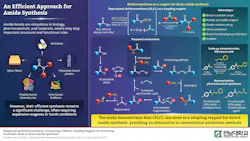
Dichloromethane can serve as a coupling reagent for direct amide synthesis, according to researchers at Chonnam National University in South Korea. The approach could provide chemical manufacturers with an alternative to conventional coupling reagents for producing amides, including pharmaceutical compounds.
A research team led by Sunwoo Lee of Chonnam National University's Department of Chemistry demonstrated that dichloromethane can facilitate amide formation directly from carboxylic acids and amines. The study was published in the Journal of the American Chemical Society.
The researchers found that under basic conditions, carboxylates attack dichloromethane through an SN2 reaction to form reactive chloromethyl ester intermediates. Those intermediates subsequently react with amines to form amides.
Using benzoic acid and benzylamine as model substrates, the researchers identified conditions that produced good yields using sodium carbonate as the base, dichloromethane as the coupling reagent and dimethyl sulfoxide as the solvent. The optimized reaction used a temperature of 80 C, a 12-hour reaction time and excess amine.
The approach worked across a range of carboxylic acids and amines. Researchers produced the pharmaceutical amides procainamide at a 92% yield and moclobemide at a 76% yield. They also demonstrated direct, single-step amide synthesis using carboxylic acids and ammonium bicarbonate.
The team then tested the process at a 100-millimole scale using 4-chlorobenzoic acid and 2-morpholinoethanamine. The reaction produced more than 20 grams of moclobemide with greater than 99% purity.
Mechanistic studies indicated that the primary reaction pathway involves carboxylate attacking dichloromethane to form an activated ester through SN2 substitution. A competing pathway produces a methylene bis(carboxylate) intermediate that can also undergo aminolysis and contribute to acyl transfer.
The researchers said the approach avoids many conventional stoichiometric coupling reagents and reduces coupling-reagent-derived waste.
Why It Matters
For chemical manufacturers, the study is relevant because it moves beyond reaction discovery into process-scale demonstration, showing the chemistry at a 100-millimole scale and with high-purity product. The ability to use a readily available process chemical in place of conventional coupling reagents could be relevant to process development and waste-reduction strategies, although the reported work does not establish commercial-scale economics or demonstrate that dichloromethane is preferable to existing processes across industrial applications.