Copper Catalyst Design Improves CO2 Conversion Into Fuels
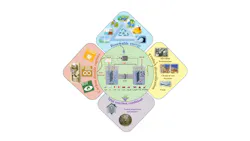
Researchers from Southeast University, Nanjing, China, and Korea University, Seoul, have developed advanced copper-based catalyst strategies aimed at improving electrochemical CO2 conversion into higher-value fuels and chemicals. According to the researchers, the work could help advance scalable carbon recycling technologies for chemical and energy applications.
The study, published in Small Structures, examined how engineered copper electrocatalysts can improve the formation of multi-carbon (C2+) products such as ethylene and ethanol while addressing long-standing issues related to catalyst stability and selectivity.
The researchers focused on tailoring catalyst structures at the atomic and electronic levels to better control adsorption and conversion of reaction intermediates. Their approach combined tandem catalytic effects, synergistic charge-transfer interactions and geometric control of atomic spacing to improve carbon–carbon coupling during CO2 reduction.
A key finding was the importance of maintaining a balance between Cu⁰ and Cu⁺ oxidation states during operation. According to the study, this mixed-valence system improves intermediate formation and lowers energy barriers associated with multi-carbon product generation.
“Maintaining a dynamic balance between different copper states is crucial for achieving both stability and selectivity,” stressed Xiangzhou Yuan, a professor at Southeast University, in a press statement. Yuan co-led the research with Korea University professor Yong Sik Ok.
The team also evaluated how reaction conditions such as local pH, electrolyte composition and CO2 concentration affect catalytic performance. Machine learning models were incorporated to predict catalyst behavior and reduce experimental trial-and-error during development.
“By combining data-driven tools with experimental insights, we can significantly reduce trial-and-error and design more efficient systems faster,” said Sik Ok in a statement.
The researchers said future work will focus on integrating catalyst development with reactor design and system-level optimization to improve scalability. The study outlines a framework for combining advanced materials, real-time characterization and artificial intelligence to support industrial carbon recycling systems powered by renewable energy.