Study Points to More Efficient Propane-to-Propylene Catalysts
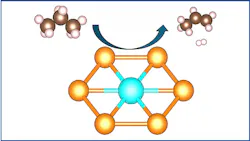
Improving the efficiency and reliability of propene production could lower energy demand and operating costs in one of the chemical industry’s most important plastic precursor supply chains, according to researchers at UCLA Samueli School of Engineering. Propene is a key feedstock for polypropylene production, and current industrial routes are energy intensive and prone to catalyst degradation.
In a study published in Chem Catalysis, researchers led by Philippe Sautet used computational modeling to identify a potential alternative catalyst design based on single-atom alloys. According to the study, these materials could improve propane dehydrogenation performance while reducing energy input and limiting carbon buildup that often leads to process downtime.
The researchers modeled copper-based alloys containing isolated atoms of hafnium or iridium and found that this configuration could enhance catalytic activity compared to conventional platinum systems. The simulations suggest that isolated active metal atoms improve control over hydrogen–carbon bond activation in propane, leading to higher propene selectivity.
“Replacing platinum with these materials could enable more efficient production of propene and hydrogen while limiting coke formation,” Sautet said.
According to the researchers, the single-atom alloy structure plays a key role by dispersing small amounts of reactive metal across a copper surface, reducing side reactions and improving overall process stability.
“What makes these copper-based single-atom alloys work is their structure. There is just enough active metal to carry out the reaction, but not so much that it creates waste or unwanted byproducts,” explained study leader Philippe Sautet, professor of chemical and biomolecular engineering at the university. “Replacing platinum with these materials could enable more efficient production of propene and hydrogen while limiting coke formation.”
The findings are based on computational predictions and will require experimental validation before industrial application. The study notes that prior experimental work has demonstrated strong selectivity in similar catalyst systems, supporting the feasibility of the approach, though scalability remains to be determined.
This piece was created with the help of generative AI tools and edited by our content team for clarity and accuracy.